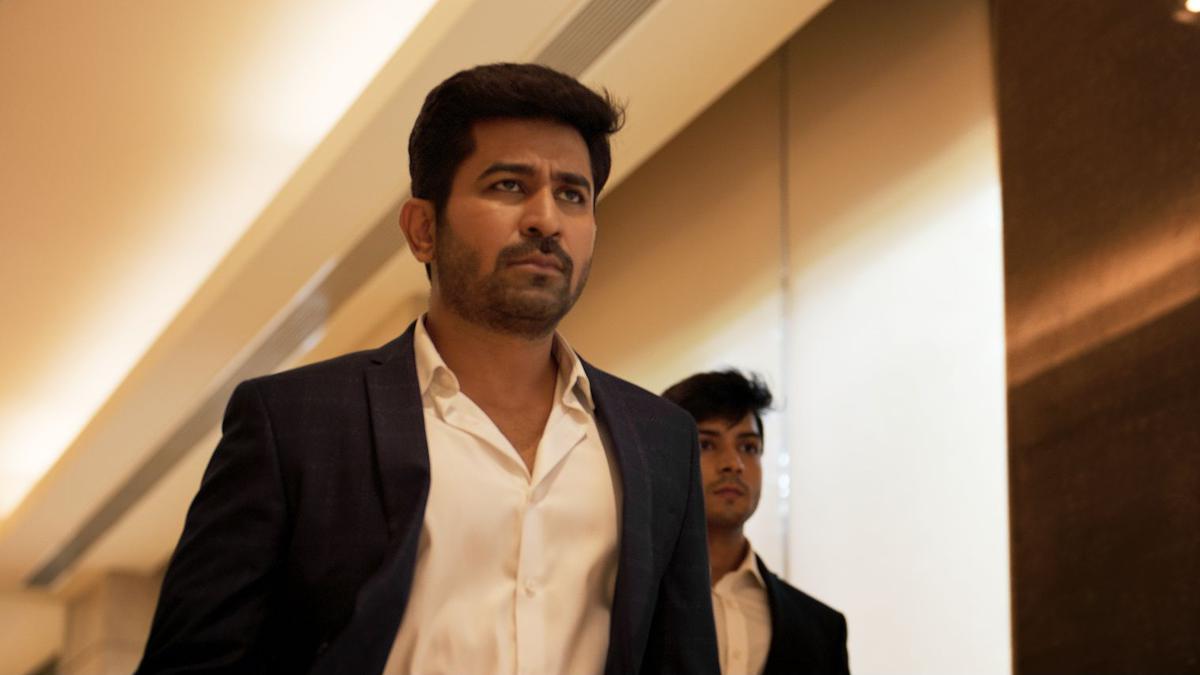
‘Pichaikkaran 2’ movie review: Vijay Antony fails to recreate his magic, due to a mediocre story and insipid writing
The Hindu
With ‘Pichaikkaran 2’, Vijay Antony, for the first time, takes over directing duties too, but it’s the acting part where he shines the most
In a film industry that has almost never gotten a sequel right, standalone sequels feel like an excuse to cash in on the popularity of a hit film and Pichaikkaran 2 is a textbook example of it. The 2016 film Pichaikkaranwasn’t a revelation but amidst an overdose of action and mother sentiment, director Sasi squeezed in an interesting plot that worked majorly for its mass moments. Pichaikkaran 2 tries to maintain the idea as a scaffolding to build a new story from scratch, and though it gets an intriguing idea, it fails to make headway.
Vijay Antony has shown his abundant inclination towards playing multiple characters. Of the thirteen films he has played the lead in, the ones with multiple roles, including his latest release, are five. While he played a billionaire who moonlighted as a beggar in Pichaikkaran, the sequel has him playing billionaire Vijay Gurumoorthy as well as a beggar named Sathya. While the first film was high on mother sentiment, we’ve got Tamil cinema’s age-old sister sentiment this time. If a rich man had to be poor for a month in the first film, a poor man amasses a wealth of one lakh crores in the sequel. But apart from the dichotomy and parallels, the two films don’t have anything else in common.
For those working for Vijay Gurumoorthy, greed, as always, gets the better of them and they need to find a nobody whose brain can be transplanted into Vijay’s body. They track down an orphan/beggar in the form of Sathya and let science — that’s understandable to only Stephen Hawkings and Michio Kaku — take its course. They dispose of Sathya’s body in the Dubai desert, erase Vijay’s mind like it’s a hard drive that can be formatted, and voila, we’ve got Vijay’s body with Sathya’s mind. The first 20-odd minutes of Pichaikkaran 2, where the above sequence happens, is over-the-top in a manner that’s unique to Vijay Antony starrers, something I particularly enjoyed in his films like Thimiru Pudichavan, Kodiyil Oruvan, and of course, Pichaikkaran. But, from there, the film goes downhill.
ALSO READ: ‘Thuppakki’ to ‘Petta’ to ‘Pichaikkaran’: Tamil cinema’s 15 best masala movies of the decade
Sathya is obviously no Admiral General Haffaz Aladeen’s simpleton body double from The Dictator, and once he climbs the social ladder, it’s only he who can get himself back down. But keeping in tradition with Tamil cinema heroes’ toxic relationship with the Robin Hood syndrome, Sathya decides to use his wealth to provide basic needs to the impoverished at subsidised prices. He even coins the term ‘Bikili’ to the opulent folks who stay so by basking on the hard work of the poor; this apparently makes him ‘Anti Bikili.’
With Pichaikkaran 2, Vijay Antony takes over the responsibilities of playing the lead, editor, music director, and for the first time, direction duties too. It’s the acting part where he shines the most. He brings in a variation between the two characters he plays — Vijay is a money-minded business magnate who reaches out to a sanitiser dispenser after holding his dead father’s hands, while Sathya kisses the feet of a child for whom he wishes he had always been there. But the script doesn’t really give him the space to do much. The idea of placing a poor man in the shoes of an affluent one is anything but new — we’ve seen MGR do it in Enga Veettu Pillai, Rajinikanth from the days of Billa, Athisaya Piravi, Uzhaippali and even Sivaji. It’s one of the oldest tropes of double-action films, and what baffles me more is the shockingly simple treatment.
There are moments like the one right before the intermission and when Sathya calls up the Chief Minister to uphold justice that feels similar to the mass moments we loved in Pichaikkaran. But they are few and far between, and by the time he announces an Anti Bikili mall where one can get soaps for 3 Rs, toothbrushes for 7 Rs and an actual house for 23,000 Rs, you completely give up on the film. So much that you actually don’t mind a shoddy VFX shot of a helicopter taking off a huge piece of cloth over a building to unveil an entire mall.


Spring season celebrated at Ramakrishna Mission Institute, Kolkata, with ‘Evening of Basant’

The Spirit of the Land, a solo show by artist Shivakumar Sunagar, is a vista of Nature-inspired emotions

Tal Fry is all set for an exciting new performance season

Netflix is making a bold move by snagging InterPositive, the AI filmmaking company founded by Ben Affleck, in a deal that could hit $600 million

Watch the eerie trailer for 'Hokum,' where Adam Scott faces a witch haunting in a mysterious Irish inn.

Oscars 2026 security heightened amid FBI warnings of a potential Iranian drone threat ahead of the Hollywood ceremony.

Directed by Rahul Pandey, the series also stars Naila Grewal, Nidhi Bisht, Anant Joshi, Anjum Batra and Kusha Kapila

A tribute to the versatile actor and comedian V.K. Ramasamy in his birth centenary year.

‘One Piece’ Season 2 review: As the Straw Hats enter the Grand Line, Netflix’s live-action adaptation finds its sea legs with bigger islands, stranger villains and the same stretch-happy sense of boundless adventure

Geeta Gandbhir, the Indian-origin American filmmaker is waves at this year’s Oscars with not one, but two nominations. Her documentaries, ‘The Perfect Neighbor’ and ‘The Devil is Busy’ are in the race for the Academy Award

Directed by filmmaker and environmentalist Pradip Krishen, the film follows a group of "dope-smoking, bellbottom-wearing and vaguely idealistic" final-year students racing to complete their theses.

Alan Ritchson powers through 'War Machine', a lean sci-fi action thriller on Netflix. A competent, Reacher-style chase adventure with nonstop tension and solid set pieces

Explore the Unshelving Memories exhibition in Thiruvananthapuram, showcasing diverse book art by 61 talented artists until March 15.