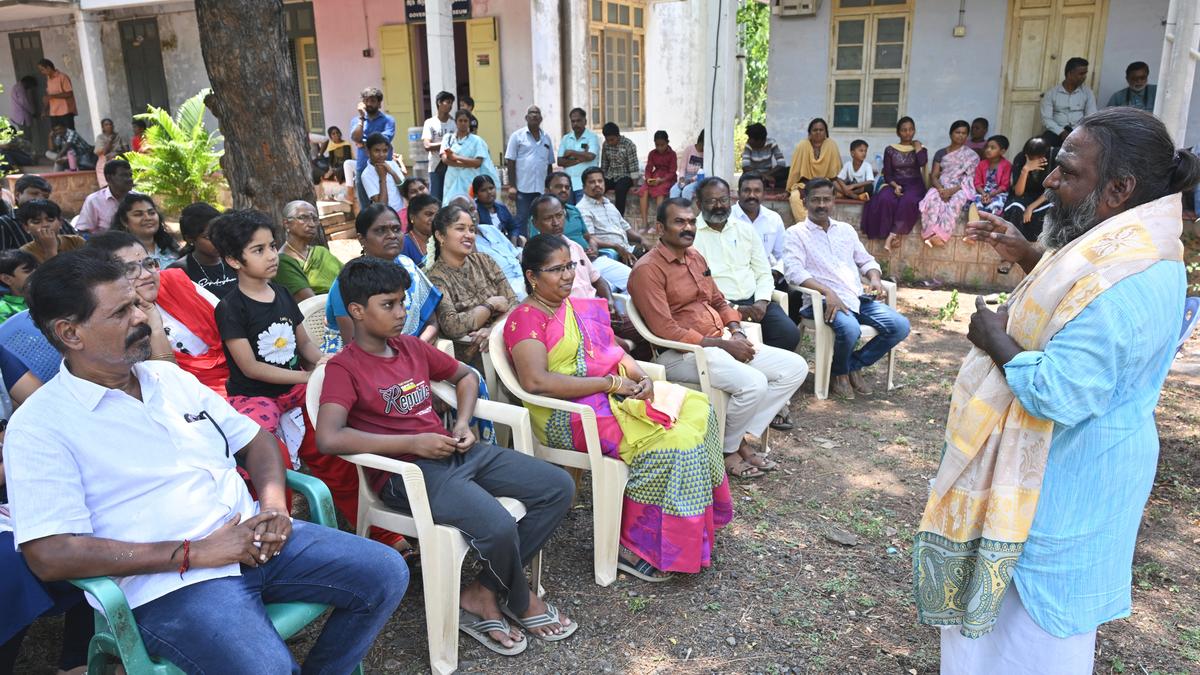
Parai, important instrument of humankind, confined to a caste: Padma Shri awardee Velu Aasan
The Hindu
Parai artist Velu Aasan discusses the historical significance of the parai instrument and the importance of traditional games.
“Parai, which was the most important communication tool of humankind, over the years, was restricted to a particular caste,” said Parai artiste and Padma Shri awardee Velu Aasan.
He spoke at the prize distribution event of ‘Madurai Kramiya Olympic,’ conducted by Department of Museums here on Saturday.
He said that the instrument which was given various names like ‘seithi,’ (news) parai, ‘por,’ (war) parai, ‘vaithiya,’ (medicinal) parai, among others, was used for different purposes starting from mourning to celebrating.
When parai was performed at a person’s demise, it was to communicate with the people about the death of a beloved person, he noted.
“Donning the role of ‘vaithiya,’ parai, it was also played with a belief that the reverberance of the instrument would wake up the dead person,” he said.
The instrument, which would be seen in almost all ceremonies, was celebrated as part of the lifestyle until the stigma that got attached to it owing to several reasons, Mr. Velu Aasan added.
Carnatic music which got introduced in between could not be used for mourning purposes, as people could not accept the way it was played, he stated.


Erode district conducts first EVM randomisation for April 23 Assembly elections, ensuring transparency and fairness in allocation.

TNCC conducts public consultation in Erode to gather community input for its upcoming election manifesto.

CID to investigate sexual assault allegations against suspended Moodbidri Police Inspector P.G. Sandesh, reveals Home Minister Parameshwara.

A 50-year-old woman was found dead in southwest Bengaluru’s Kengeri in the early hours of Monday, the police said.

Papanasam dam's water level reaches 66.15 feet, with inflow at 76 cusecs and discharge at 300 cusecs.

Development without impact: Coastal residents of Kanniyakumari and Nagercoil constituencies voice discontent

Rampant encroachments in Tiruchi threaten pedestrian safety and traffic flow, undermining smart pavement initiatives and exacerbating congestion.

Discover Kerala's electoral history in 'Vottarivu,' a 201-page booklet released ahead of the 2026 Assembly elections.

Experts at a floriculture conference in Shivamogga stress the need to reduce greenhouse gas emissions and enhance soil carbon levels.

First randomisation of EVMs and VVPATs for Tiruchi and Perambalur districts completed with political party representatives present.

Puducherry elections see ongoing DMK-Congress rift over seat-sharing, leading to candidate conflicts on nomination day.

Einstein College and Sri Sarada College in Tirunelveli celebrated significant events, honoring academic excellence and cultural heritage.

Priyanka Gandhi criticises PM Modi's West Asia remarks, urging for a comprehensive Parliament discussion on the matter.