Pampa | In Hampi’s ruins, a textile template emerges
The Hindu
The ancient stones were the backdrop for Pampa, a survey exhibition of Karnataka’s heritage weaves, led by crafts crusader Lavina Baldota
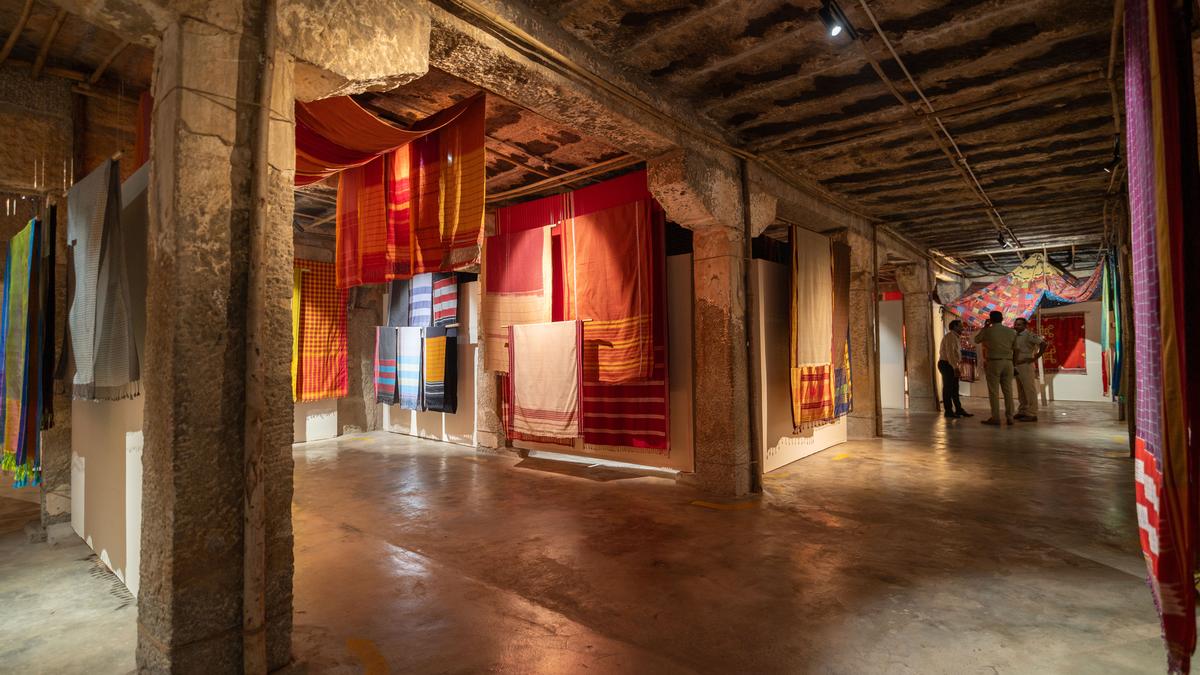
The bamboo poles stop just short of grazing the walls of the 17th century structure that, for 10 days, housed Pampa: Textiles of Karnataka — presented by the Abheraj Baldota Foundation, in collaboration with Karnataka’s department of tourism and the Archaeological Survey of India. A careful matrix of similar poles, held together sturdily with jute ropes, criss-cross the aged ceiling of the Mantapa Photo Exhibition Centre and hold the magnificent textiles.
In a way, the exhibition design is an apt metaphor for the intent behind Pampa: one of building connections between the old and the new, each showing off the other to their best advantage to revive interest in the textiles of the state. “What we need is a synergy,” says Lavina Baldota, who made her curatorial presence felt as the patron of Sutr Santati: Then, Now, Next, a celebration of Indian textiles in 2022. Pampa is her sixth presentation, an ode to her marital home of Karnataka.
The state is not the first to be associated with a strong or storied textile legacy, especially when it comes to fine fabrics — in comparison to, say, Bengal or Gujarat or closer home, to Tamil Nadu — but Pampa (an ancient name for the mighty Tungabhadra), she hopes, will help it claim its rightful place in the sun. “As a survey exhibition, the first iteration of Pampa sets the framework for further work that the Baldota Foundation intends to take up in the region,” she adds. “The research will deepen, followed by documentation, revivals, and new commissions leading to exhibitions in other cities in Karnataka and beyond.”
It’s a formidable ambition but there are few better placed than Baldota to realise it. As custodian of the 54-year-old Abheraj Baldota Foundation, an affiliate of the diversified Baldota Group, with businesses in mining, power, steel and similar core industrial areas, she is uniquely positioned to pull together discrete work on crafts and textiles — her core interest areas, building on an education in fashion and textiles — and provide them a powerful platform. Like the bamboo poles in the historical structure, Baldota enables weavers, designers, practitioners to get in touch with their desired audiences, including market-facing counterparts, so as to build a complete ecosystem.
In a way, it’s a conscious effort to update the finely balanced honeycomb of farmers, spinners, weavers, dyers, traders, transporters that existed in the pre-colonial heydays of handwoven Indian textiles. Today’s set-up still requires all of them, but it also needs champions who can take intellectual ownership, in a manner of speaking, of particular textile clusters to create documentation, disseminate information, forge connections, design for new generations and help build respectful markets.
That this is no isolated endeavour is evident from the fact that Pampa is the 20th textile exhibition Mayank Mansingh Kaul has curated in the past 10 years; it’s also his fourth for the Baldota Foundation. By any standards, that’s an impressive number, given the months of research each of them must have required. But it is as impressive as an indicator for the increased appetite for textile knowledge among the cognoscenti and the curious.
Featuring 108 textiles in nine sections, the exhibition (March 1-10) hits all the right notes, including an early Kalamkari recreation of the Shiva-Parvati wedding mural on the central ranga mantapa ceiling of the 7th century Virupaksha temple, and a display of the Tricolour in khadi, crafted in nearby Hubbali. The Karnataka Khadi Gramodyoga Samyukta Sangha is one of only five units authorised to make the national flag in its originally mandated weave. “When we set out on our research trips a few years ago, Lavina and I thought we’d find maybe 10 examples of handmade textiles,” says Kaul. “Instead, the further we travelled, the more we acquired.”


Explore 2026's wallpaper trends in India, highlighting botanicals and handmade designs that enhance modern homes with nature-inspired aesthetics.

Mercedes-Benz CLA 250+ with EQ Technology review: design, performance, range and features explained. Discover how the new electric CLA combines advanced AI, long range, fast charging and futuristic styling for the next generation of luxury EVs.

AI tool for sparrow conservation

BTS’s comeback with ‘Arirang’ marks a major global music event. When does the album release, and where can you watch their concert live stream? We have all the details

The 2026 U.S. cholesterol guidelines urge starting screening and treatment at 30 to prevent cardiovascular disease effectively.

Olam Festival 2026 in Thiruvananthapuram returns March 27-29 with 120+ vendors, music, art, and cultural zones.

A few storytellers in Thiruvananthapuram share their journeys, challenges, and evolving methods on World Storytelling Day, inspiring young minds.

76-year-old Kurian Jacob from Kerala triumphs with seven medals, including five golds, at the Open Masters Games in Abu Dhabi.

Explore the nature of the human mind as an emergent property of brain activity and complex neural interactions.

CERN's Large Hadron Collider discovers the Xi-cc-plus particle, enhancing understanding of quantum mechanics and baryon behavior.

Vibha Batra’s latest book, Spotless (Hachette India) is a novel in verse for young adults

In its first edition, the Madras Art Salon spotlights the works of journalist and artist Narayan Lakshman at The Botanical Club, a social space in the British Deputy High Commission, Chennai

Cholesterol enhances melanoma cell invasion by making nuclei squishier, revealing a potential treatment target in cancer progression.