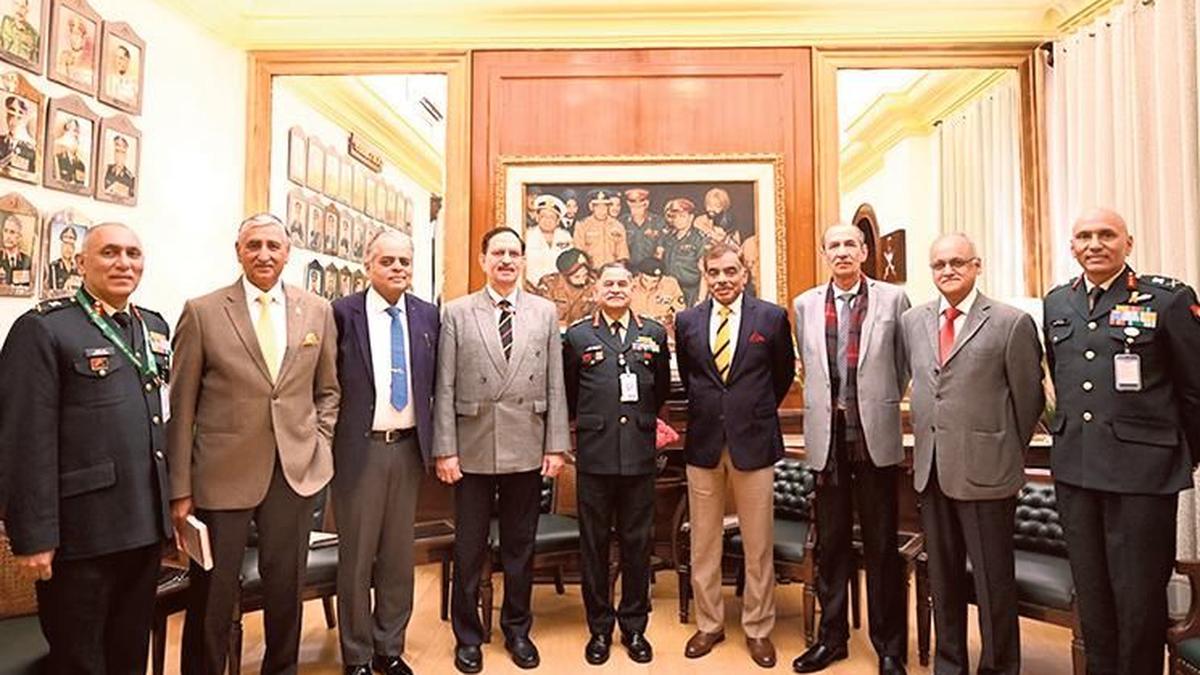
Painting on 1971 surrender replaced in Army Chief’s lounge, veterans miffed
The Hindu
Controversy surrounds new Indian Army painting replacing iconic 1971 surrender image in Army Chief's lounge.
A new painting adorning the Army Chief’s lounge, where he greets visiting dignitaries, has miffed the veteran community. The new painting replaced the one showing the surrender during the 1971 Bangladesh war.
Army sources said the new painting, ‘Karam Kshetra – Field of Deeds’, done by Lt. Col. Thomas Jacob of the 28 Madras regiment, portrays the Army as a “guardian of Dharma, fighting not merely as a defender of the nation but to uphold justice and protect the nation’s values”, and also captures the Army’s evolution into a “technologically advanced, integrated force”.
It shows snow-capped mountains in the backdrop, with the Pangong Tso lake in Eastern Ladakh on the right, and Garuda and Krishna’s chariot on the left, along with Chanakya and modern equipment such as tanks, all-terrain vehicles, infantry vehicles, patrol boats, indigenous Light Combat Helicopters and Apache attack helicopters.
“If one were to sum up, it signifies a country with a rich civilisation, one which has always believed in righteous cause, just use of force where needed, with renowned scholars, statesmen and strategists. It has a courageous, modern and capable Army which is always ready to defend its borders and interests,” Army sources said.
This painting represents the Indian Army’s timeless commitment to righteousness, as drawn from the teachings of the Mahabharata, sources said. “It portrays the Army as a guardian of Dharma, fighting not merely as a defender of the nation but to uphold justice and protect the nation’s values. This inspiration is complemented by the strategic and philosophical wisdom of Chanakya, whose principles guide the Army’s approach to leadership, diplomacy, and warfare,” a source said.
Of late, there has been a major effort to study ancient Indian texts and integrate India’s “ancient strategic acumen” into the contemporary military domain, and develop an “indigenous strategic vocabulary”, rooted in India’s “philosophy and culture”.
Sources said the new painting reflects how the modern Indian Army is equipped with cutting-edge systems, seamless coordination across land, air, and sea, and the readiness to strike swiftly and decisively against adversaries. “At its core, the painting honours the Army’s legacy of sacrifice, discipline, and valour, while highlighting its preparedness to meet future challenges with unwavering resolve,” sources added.


The actor, along with director Shashant Shah, speak about their upcoming series ‘Chiraiya’, Divya’s process of working on the dialect, Sushant’s approach to telling a story about women, and more

Sri Lanka's Minister Bimal Rathnayake announces support for Indian refugees, urging political sensitivity from Tamil Nadu and India.

51 couples take thebig plunge at Udaipur mass wedding event

India shows significant progress in reducing child mortality, despite global slowdowns, highlights a new UN report on child health.

Puducherry's upcoming elections test the NDA's governance model amid opposition rifts and promises of stability and welfare delivery.

A Russian oil tanker diverts to India, boosting local refineries despite sanctions and geopolitical tensions.

Supreme Court questions if temple activities like book publishing and prasadam manufacturing qualify as industrial activities under current laws.

Ten of Kozhikode's 13 incumbent MLAs are seeking re-election, with no women candidates from CPI(M) in the upcoming polls.

Height restrictions near airports are stifling Bengaluru's growth, prompting calls for a review to boost development potential.

Explore the Gandhi Bunakar Mela in Vijayawada, showcasing traditional textiles and supporting handloom weavers until March 31.

MDMK leader Vaiko announces a movement to remove Prosopis juliflora trees in Tamil Nadu following a landmark High Court directive.

Lok Sabha Speaker Om Birla emphasizes the importance of Question Hour over meetings and urges decorum during obituary references.

Karnataka approves 300-bed Puttur Government Medical College Hospital project, enhancing healthcare in the coastal region.