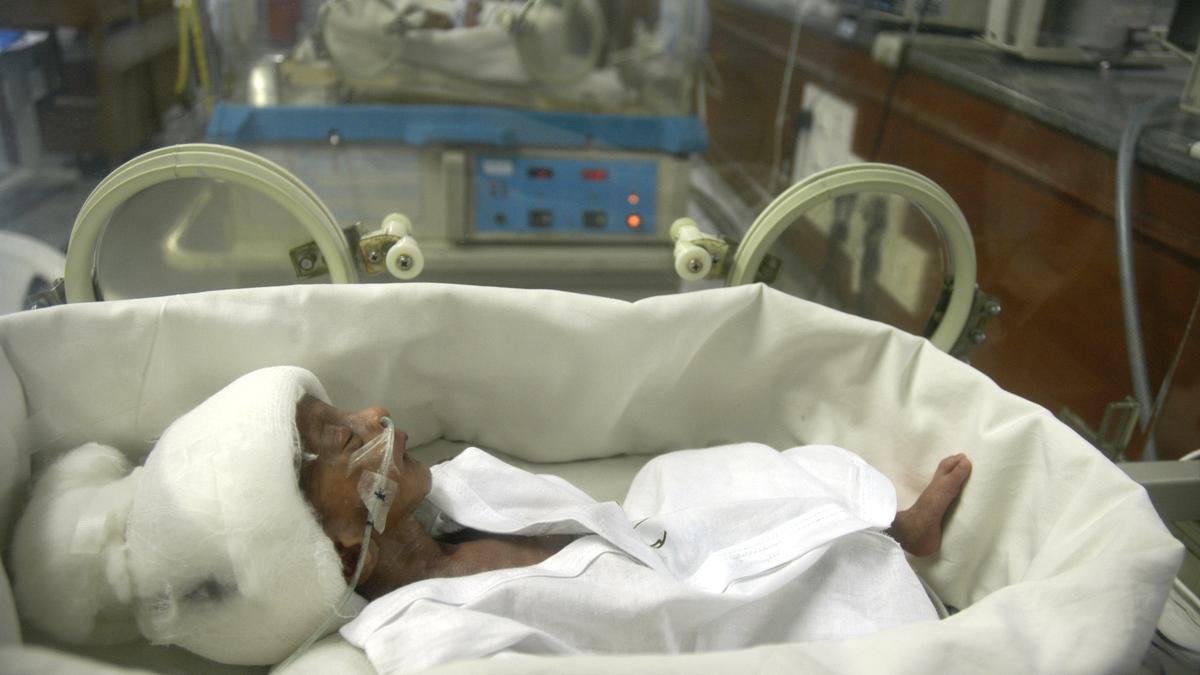
Paediatric surgeons record a rise in neonatal congenital anomalies
The Hindu
A three-day annual conference of the Indian Association of Paediatric Surgeons, Karnataka Chapter begins in the city today
A newborn brought to the Department of Paediatric Surgery in Bangalore Medical College and Research Institute (BMCRI) with absent anal opening required an emergency bypass surgery of the intestine as a temporary method for passing stools. Later, on evaluation the baby was found to have a complex urological anomaly with a single kidney which was poorly functioning. Also the baby had a tethered cord where her spinal cord was adherent and was causing neurological problems of limbs and bladder.
The baby needed surgery involving multiple systems — intestine, kidney and spine. All surgeries were done at the right time in a staged manner by doctors and the baby has recovered well.
Such neonatal congenital anomalies that contribute to over 15% of all paediatric surgeries are on the rise. Paediatric surgeons, who have noted a 30% increase in the incidence compared to a decade ago, attribute this to greater awareness and increased antenatal detection of such anomalies.
Newborn congenital anomalies, often referred to as birth defects, have a variety of causes ranging from pregnancy or birth complications to genetic malformations to viral infections in utero. In many cases, however, a congenital anomaly may have no known cause.
“We get nearly 50 cases of neonatal congenital anomalies every month only at our hospital. The number of children born with such anomalies are only increasing by the day mainly due to greater awareness and antenatal detection,” said Anand Alladi, who heads the Department of Paediatric Surgery at BMCRI.
“If picked up early and treated appropriately, the potential for recovery in such children is very good. Handling children with such anomalies requires special knowledge and care as any intervention has to take into account the growth and development of the child. Unless appropriately handled these interventions can have long lasting consequences,” he explained.
Dasmit Singh, President of Indian Association of Paediatric Surgeons, said unlike in the past, paediatric surgeons are now available at taluk level hospitals and even in smaller towns. “This along with advances in equipment and training, support departments like anesthesia, radiology and pathology has made surgery in children safe,” he said.


The actor, along with director Shashant Shah, speak about their upcoming series ‘Chiraiya’, Divya’s process of working on the dialect, Sushant’s approach to telling a story about women, and more

Sri Lanka's Minister Bimal Rathnayake announces support for Indian refugees, urging political sensitivity from Tamil Nadu and India.

51 couples take thebig plunge at Udaipur mass wedding event

India shows significant progress in reducing child mortality, despite global slowdowns, highlights a new UN report on child health.

Puducherry's upcoming elections test the NDA's governance model amid opposition rifts and promises of stability and welfare delivery.

A Russian oil tanker diverts to India, boosting local refineries despite sanctions and geopolitical tensions.

Supreme Court questions if temple activities like book publishing and prasadam manufacturing qualify as industrial activities under current laws.

Ten of Kozhikode's 13 incumbent MLAs are seeking re-election, with no women candidates from CPI(M) in the upcoming polls.

Height restrictions near airports are stifling Bengaluru's growth, prompting calls for a review to boost development potential.

Explore the Gandhi Bunakar Mela in Vijayawada, showcasing traditional textiles and supporting handloom weavers until March 31.

MDMK leader Vaiko announces a movement to remove Prosopis juliflora trees in Tamil Nadu following a landmark High Court directive.

Lok Sabha Speaker Om Birla emphasizes the importance of Question Hour over meetings and urges decorum during obituary references.

Karnataka approves 300-bed Puttur Government Medical College Hospital project, enhancing healthcare in the coastal region.