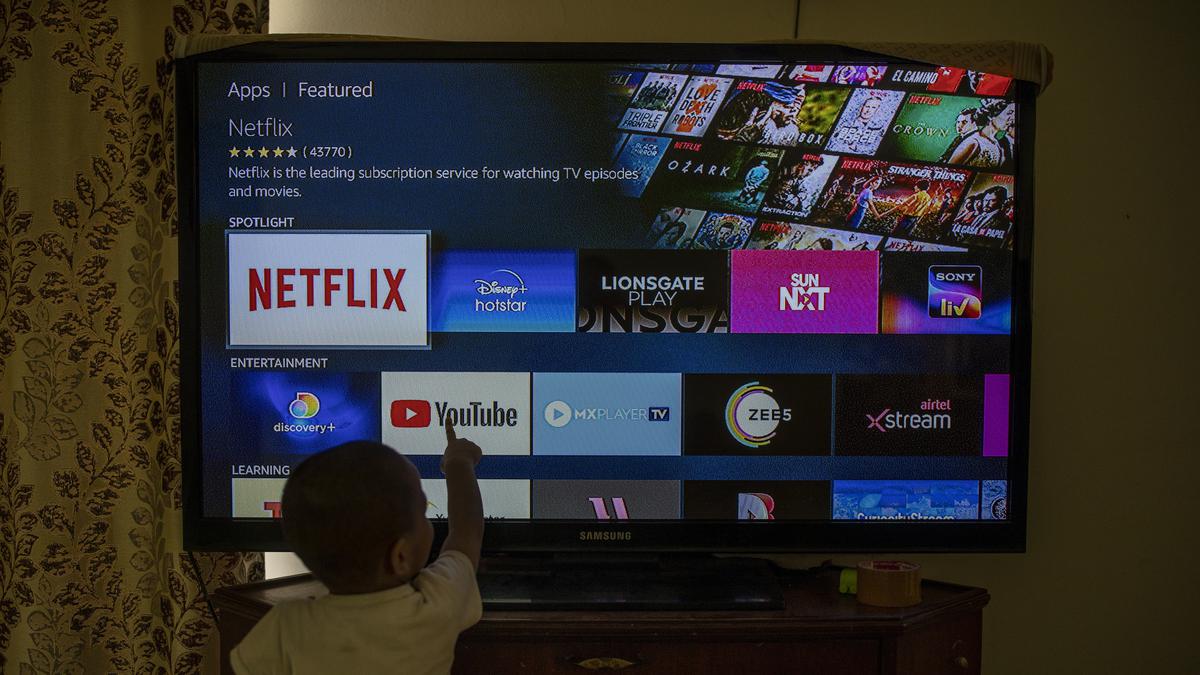
OTT streaming will need satellite bandwidth: Netflix, Amazon, Hotstar collective
The Hindu
OTT streaming players pitched for greater use of satellite bandwidth to reach viewers.
In a consultation about satellite spectrum pricing, OTT streaming players pitched for greater use of satellite bandwidth to reach viewers. “Hundreds of millions of Indians rely upon [the media industry] for entertainment, information, education, religious participation and so on,” the Asia Video Industry Association (AVIA) said in a filing. “Reaching these consumers, now and in the future, requires satellite-based distribution. In this, India is like every other large country on the globe.”
AVIA, which represents Netflix, Amazon, Disney+ Hotstar, and other Asian OTT players, was responding to a Telecom Regulatory Authority of India consultation paper. “There is no other country on the globe that actually auctions satellite frequency assignments,” AVIA said, echoing the sentiment of other global satellite service operators.
“[U]nlike terrestrial communications, satellite spectrum is a completely shared resource among different satellite operator,” AVIA said. “Satellite frequencies are today re-used many, many times at the same geographic location. This re-use is governed by ITU [International Telecommunication Union] international rules… By auctioning and granting exclusive rights to one user, all the current extensive re-use would be gone and the spectrum resources available to India would be greatly reduced compared with today.”
5G services won’t serve rural users any time in the “near future,” AVIA said, urging the government to encourage satellite broadband systems, which usually rely on a constellation of internet-connected satellites in the sky to deliver internet access to remote areas. India currently only uses satellite broadband as ‘backhaul’ in places like the Union Territory of Lakshadweep, which is not yet connected terrestrially or with an undersea cable to the Indian mainland’s networks.
Other players who encouraged administrative assignment of satellite spectrum instead of auctioning it include the ITU-APT Foundation of India, a non-profit that comes under the ITU; the Broadband India Forum, which represents some large technology firms and internet service providers; the Manufacturers’ Association For Information Technology; the US-India Business Council; the New Delhi-based Satcom Industry Association; and Nasscom, the software industry association.
The GSM Association, which represents mobile network operators globally, said that some spectrum that might go to satellite assignments should be reserved for terrestrial mobile networks, as 5G traffic growth trends might warrant more spectrum for this purpose in the future.


OpenAI is in advanced talks with private equity firms including TPG, Advent International, Bain Capital and Brookfield Asset Management to form a joint venture

Shares of Samsung Electronics rose as much as 5% on Tuesday after Nvidia CEO Jensen Huang said the South Korean company was producing Nvidia’s new artificial intelligence chips.

Stock markets rebound after early losses, with Sensex and Nifty rising amid global bullish trends despite notable laggards.

The rupee declines 14 paise to 92.42 against the dollar amid rising crude prices and foreign fund withdrawals.

Dell’s total workforce declined by about 10%, or 11,000 employees, in fiscal 2026, it said on Monday

Nvidia chief Jensen Huang on Monday said the leading artificial intelligence chip maker is heading for space with a goal of powering orbiting data centres.

Meta Platforms shares rose nearly 3% on Monday after a Reuters report that the social media giant plans to lay off 20% or more of its workforce to offset heavy spending

Wholesale price inflation hits 11-month high at 2.13%, driven by rising crude prices and increased costs across various sectors.

Kerala's wellness sector faces uncertainty due to the West Asian crisis, impacting tourism and threatening economic stability.

Experts link Punjab's distress migration to economic stagnation and job mismatches, highlighting systemic failures in political leadership.

India's merchandise exports remain flat in February, with Commerce Secretary warning of a potential dip in March due to trade constraints.

Hard Rock International closes 10 outlets in India, including three cafes in Bengaluru, while Goa hotel remains open.

The booming market for artificial intelligence servers brought Taiwan's Foxconn a 24 percent jump in annual net profit, the company said