Opposition parties criticise demolition of shops near Andhra University in Visakhapatnam in the name of security
The Hindu
‘Shops were demolished without giving notice and action should be taken against those responsible’
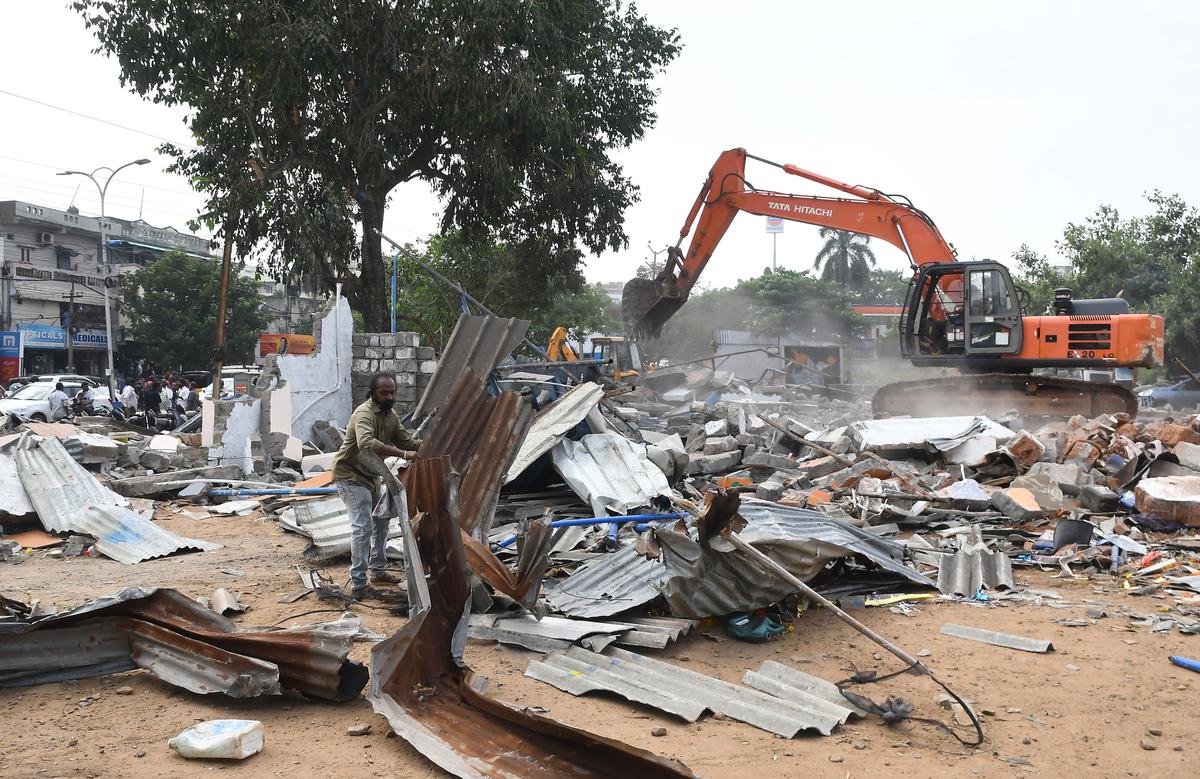
The demolition of shops near Polamamba Temple in the name of security ahead of Prime Minister Narendra Modi’s public meeting is taking a political turn and is also drawing flak from the Opposition parties here in the city. Criticising the move as a deliberate one to suppress the poor, the Opposition party leaders questioned what was the need to demolish the shops without even giving a notice.
Former Minister Bandaru Satyanarayana, former MLA Palla Srinivasa Rao and TDP MLA (East) Velagapudi Ramakrishna Babu visited the spot and spoke to the victims here on Wednesday. The leaders alleged that this was an act of the State government against the poor and condemned the demolitions without prior information. They also demand action against the authorities who have taken part in the demolition.
Condemning the act, members of HRF, P. Raghu and K. Anuradha, said that for any demolition, there are a set of instructions to be followed. Without giving any notices or prior information, demolishing the 16 shops is an act of revenge, they said. Over 200 people have lost their livelihood, they said. Meanwhile, Corporator of Ward 22, (Jana Sena Party) P.L.V.N. Murthy also condemned the act.
One of the victims and member of Polamamba Temple Varthaka Sangham said that the officials from the GVMC, Revenue and police have come at around 12.30 a.m. on Tuesday and have demolished the properties without even giving notices. Several shops and six garages were running here. The families have been residing here since the year 1980s. Around 250 persons depend on these shops for livelihood, he said.
Owner of a garage, said that the sheds were constructed with an investment of about ₹2.5 lakh and they were completely demolished. A number of customer cars which were parked inside were thrown out and they were partially damaged.
“Some days ago, some authorities have informed us that shops needed to be closed not just on the day of PM’s visit, but even a day or two before. They also asked us not to leave any car outside and we agreed for it, since Prime Minister’s public meeting is a prestigious event. We do not understand why did they demolish the constructions all of a sudden,” said a member. The Varthaka Sangham members demanded that the government provide them an alternative place to set up their shops.
Mr. Srinivasa Rao and Mr. Ramakrishna Babu said that AU claims that the land belongs to them and had tried to evacaute the residents earlier. But the Division Bench in AP High Court had given an order favouring the residents. AU had then filed an SLP in the Supreme Court, which was dismissed. Now keeping the PM’s visit and security concerns as pretext, the authorities concerned have demolished the structures, rendering the residents homeless in the middle of the night, they alleged. Efforts to contact the GVMC authorities failed as they did not respond to the calls.


Pinarayi Vijayan criticizes Rahul Gandhi and Congress for allegedly aiding BJP's rise in various states during Kerala polls.

Sonia Gandhi is responding well to treatment for a systemic infection and remains under observation at a Delhi hospital.

J&K Police's Counter Intelligence Wing conducts raids in three districts linked to a transnational terror module operated by Lashkar-e-Taiba.

Vaccination policies must prioritize saving human lives over individual choice amid rising vaccine skepticism, asserts scientist Dr. Virander Singh Chauhan.

Seven Indian fishermen from Rameswaram arrested by Sri Lankan Navy, sparking protests and calls for government intervention.

Kerala cyber police file a case against X for an AI video allegedly defaming PM Modi and the Election Commission.

iKure and Izawa Co. partner to combat avoidable blindness by integrating innovative eye care technology into rural healthcare networks.

Thousand Lights MLA from the DMK N. Ezhilan, in an interview to The Hindu, observes that any popular personality entering politics will attract the limelight. But only a structured party machinery combined with popularity can ensure success. In this interview, he speaks about his tenure as first-time MLA from Thousand Lights Assembly constituency in Chennai, Vijay’s political entry shaping the 2026 elections, redressal of key grievances and more.

Abhishek Banerjee challenges BJP's Suvendu Adhikari in Nandigram, pledging community health initiatives if Trinamool Congress wins.

Rising LPG shortages in Karnataka boost firewood demand, reviving an informal market as households and hotels seek alternatives.

Against the backdrop of intense poll activity, a 400-metre stretch of an arterial road in the outskirts of Chennai (technically in Madurapakkam panchayat under Tambaram assembly constituency) presents a salute to the idea of res publica, which underpins India’s system of governance, where citizens have a say, at least before a government is securely ensconced in the seat of power. A Republic Day initiative shines bright every night

Fadnavis claims zero FIR in Ajit Pawar crash is a defamation attempt by Karnataka against Maharashtra's investigation efforts.

Set to unfold as a one-day pop-up on April 5, the Easter Sadya brings together both vegetarian and non-vegetarian menus, offering a peek into the food traditions of the Syrian Christian (Nasrani) community. While the traditional Sadya is often associated with dishes such as sambar, avial, and rice, this version expands to include community-specific festive dishes.