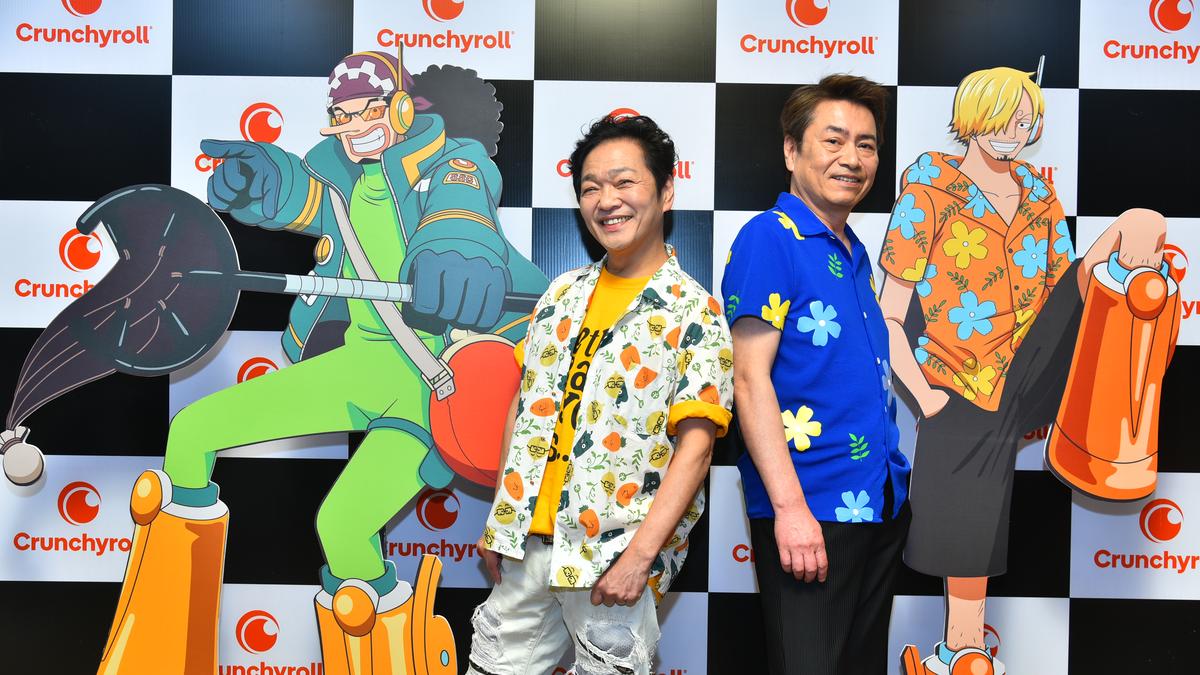
‘One Piece’ interview: How Usopp and Sanji became intergenerational role models among the Straw Hats
The Hindu
In an interview facilitated by Crunchyroll ahead of their appearance at Comic Con Mumbai this weekend, veteran ‘One Piece’ voice-actors Kappei Yamaguchi and Hiroaki Hirata talk about their beloved characters and their journeys so far
After twenty-five years aboard the Merry and the Sunny, one might anticipate at least a smidge of existential drift from the iconic voices of the Straw Hats from One Piece. After all, voicing the same character — year after year, arc after arc — requires a particular blend of loyalty, flexibility, and cosmic patience. Yet, when Kappei Yamaguchi and Hiroaki Hirata, the voices of Usopp and Sanji, respectively, sat down for a chat ahead of their first visit to India for Comic Con Mumbai 2025, it’s clear that their connection to their beloved crew is anything but stagnant.
Across One Piece’s quarter-century’s worth of seafaring across the Grand Line, there’s been no shortage of larger-than-life dreams. But tucked between the three-sword slashes and Gomu Gomu punches are two characters who’ve quietly become unlikely role models for an entire generation of boys trying to figure out what kind of men they want to be. Usopp and Sanji — the sniper who perjures his way into courage and the cook who’d rather starve than hit a woman — are some of the series’ most important emotional anchors.
When Yamaguchi-san first auditioned for the anime adaptation of One Piece, he wasn’t aiming to be the ship’s sharpshooter. “I originally went in for Luffy, but I was rejected,” Yamaguchi-san says, and the role went on to the legendary Mayumi Tanaka, who voices the Straw Hat captain to this day. For many actors, that might’ve been the end of it. But fate — or perhaps a bit of Oda-esque foreshadowing — had other plans. “After playing Usopp for 25 years, he feels he’s the most perfect person for the role,” the interpreter continues. “It’s the closest character to who he is now.”
For all his tall tales and impeccable comic timing, Usopp has never been the loudest or the strongest. But he may very well be the bravest of the Straw Hats because, unlike Luffy or Zoro, he doesn’t start out believing he’s invincible, and his fear is never erased. He shows up. He stammers. He runs. And then he comes back anyway.
There’s a gentle kindness and humility in the way Yamaguchi-san speaks about Usopp. The character almost doesn’t feel crafted, but as someone he’s grown alongside. Picking a favorite moment from the anime is, unsurprisingly, an impossible task for someone who’s voiced over a thousand episodes. But he does recall the farewell to the Going Merry — a moment as teary for fans as it was for the cast. “That episode is very close to me,” he says. “But it’s a sad one. Maybe something more fun would be my actual favorite.”
The melancholy, though, is part of the territory. Usopp’s journey has always had an underdog undercurrent in One Piece’s sprawling narrative. While Luffy barrels toward Pirate King-hood, Usopp’s dream is vague, tender, and undeniably human — to become a “brave warrior of the sea.” Yamaguchi-san interprets it as an emotional inheritance: “Usopp wants to be like his father, who he respects and loves deeply. That is his real dream.”
Usopp is for the kids who’ve never won a fight, who’ve told lies to seem taller, who’ve been scared more often than not. And for them, he offers something better than bravado: permission to feel fear and still keep going. There’s no need, Yamaguchi-san notes, to make Usopp “cooler” in the traditional anime sense. “It’s better for him to grow naturally.” The statement could just as easily be a credo for the series itself: nothing forced and everything earned.


Spring season celebrated at Ramakrishna Mission Institute, Kolkata, with ‘Evening of Basant’

The Spirit of the Land, a solo show by artist Shivakumar Sunagar, is a vista of Nature-inspired emotions

Tal Fry is all set for an exciting new performance season

Netflix is making a bold move by snagging InterPositive, the AI filmmaking company founded by Ben Affleck, in a deal that could hit $600 million

Watch the eerie trailer for 'Hokum,' where Adam Scott faces a witch haunting in a mysterious Irish inn.

Oscars 2026 security heightened amid FBI warnings of a potential Iranian drone threat ahead of the Hollywood ceremony.

Directed by Rahul Pandey, the series also stars Naila Grewal, Nidhi Bisht, Anant Joshi, Anjum Batra and Kusha Kapila

A tribute to the versatile actor and comedian V.K. Ramasamy in his birth centenary year.

‘One Piece’ Season 2 review: As the Straw Hats enter the Grand Line, Netflix’s live-action adaptation finds its sea legs with bigger islands, stranger villains and the same stretch-happy sense of boundless adventure

Geeta Gandbhir, the Indian-origin American filmmaker is waves at this year’s Oscars with not one, but two nominations. Her documentaries, ‘The Perfect Neighbor’ and ‘The Devil is Busy’ are in the race for the Academy Award

Directed by filmmaker and environmentalist Pradip Krishen, the film follows a group of "dope-smoking, bellbottom-wearing and vaguely idealistic" final-year students racing to complete their theses.

Alan Ritchson powers through 'War Machine', a lean sci-fi action thriller on Netflix. A competent, Reacher-style chase adventure with nonstop tension and solid set pieces

Explore the Unshelving Memories exhibition in Thiruvananthapuram, showcasing diverse book art by 61 talented artists until March 15.