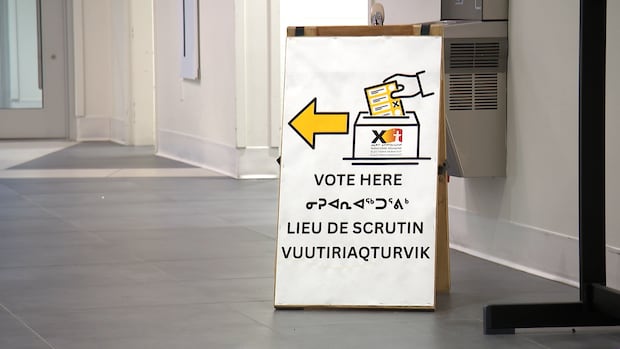
Nunavut election saw one of the lowest voter turnouts in territory’s history
CBC
As victory sets in for Nunavut’s newly-elected MLAs, it’s clear the outcome could’ve been very different if more people voted.
Nunavut Elections data shows voter turnout in Monday’s territorial election was just 48 per cent, on par with the 2021 election which saw the lowest in the territory’s election history.
Out of the 17,063 people registered to vote in this election, Elections Nunavut results show 8,190 of them cast ballots.
Voter turnout in Nunavut elections has been in steady decline since the territory was created in 1999 amid much hope — though it's not clear why.
Nunavut’s chief electoral officer, Kiran Situt, was not available for an interview.
One of Elections Nunavut’s mandates, according to its website, is to promote voter participation.
Some candidates offered rides to polling stations to encourage voter participation.
Manitok Thompson was a member of the Northwest Territories legislature prior to the creation of Nunavut and was elected to the new territory’s first legislative assembly where she served for five years.
She remembers the early enthusiasm.
“Everybody was just so excited to be part of it and then it started to go down,” she said.
Thompson says she heard people say they weren't going to vote in this year's election because of a lack of action by the territorial government.
“It’s very discouraging and that’s why I think people are not interested to go out to vote — because the food prices have not gone down, the housing [wait]list is still the same no matter who they vote for.”
Elisapee Sheutiapik, another former Nunavut MLA, believes voter apathy comes down to broken promises. For example, she points to missed deadlines with the territory's housing strategy.
The Nunavut government launched its Nunavut 3,000 strategy in 2022 to address the territory’s housing crisis. Part of that strategy is to build 3,000 homes by 2030.


Premier Doug Ford says his government plans to give Toronto's Billy Bishop Airport special designation that would allow the province to bypass municipal and provincial laws as it pushes to expand the runway downtown.

Jenelle Hughes says she worries every time her two older children take their car to get to Fanshawe College in London, Ont., from their home in Dutton.

Oil prices fell Monday morning after President Donald Trump said the U.S. would hold off on striking Iran’s energy infrastructure amid productive talks between the two countries.

While spring technically started late last week, Newfoundland and Labrador isn't free from winter weather just yet.

The Sudbury School Bus Consortium is suspending all school buses in Greater Sudbury as the community continues to clean up following a major storm.

Two large corporate landlords owning a combined 9,008 rental units in Halifax are reporting smaller annual increases in their average rents for 2025 than the previous year.

The Holt government has reached a deal with Ottawa on compensation for tens of millions of dollars in lost sales tax revenue from the Christmas season in 2024.

The government of Saskatchewan has announced plans to reduce the length of non-resident game bird hunting licences to combat illegal guiding.

An 87-year-old Alberta man is fighting extradition to the United Kingdom to stand trial for historical allegations of physical and sexual assault involving minors.

Eight casinos across southwest B.C. have been sold to First Nations in the last two years, with the province's gambling scene set to be reshaped as a result.

Hamilton hosts the Junos Sunday, and the musical awards show is bringing tourists, musicians, concerts and a ton of themed events to the city this week.

The multi-million-dollar deal at the heart of a high-profile fight between the Canadian government and one of the world’s biggest carmakers contains multiple clauses about the company’s footprint in Ontario, according to a copy obtained by CBC Windsor.

In recent months, Calgary police have carried out three day-long safety blitzes, parading out dozens of officers to flood an area with their increased presence — at least, temporarily.