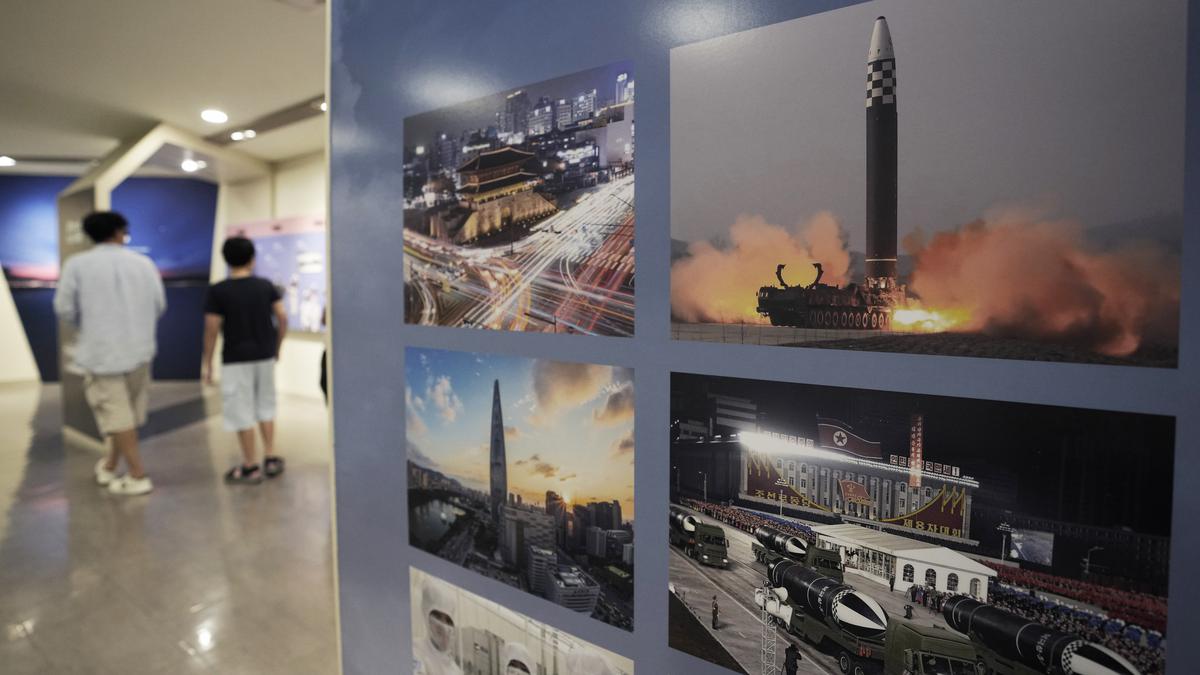
North Korea threatens nuclear response after U.S. sub deployment
The Hindu
Seoul and Washington have ramped up defence cooperation in response to Pyongyang’s weapons testing, incl. a U.S. nuclear-capable submarine port visit. Pyongyang baulks at this, warning it could lead to the “end” of Kim Jong Un’s regime.
Seoul North Korea's Defence Minister said on July 20 the current port visit of a U.S. nuclear-capable submarine to South Korea could meet the legal conditions under which Pyongyang would use its nuclear weapons.
Relations between the two Koreas are at one of their lowest points ever, with diplomacy stalled and North Korean leader Kim Jong Un calling for increased weapons development, including tactical nuclear weapons.
The United States and South Korea have stepped up displays of military muscle in response, and a U.S. nuclear-capable submarine made a port call to South Korea this week for the first time since 1981.
Pyongyang's Defence Minister Kang Sun Nam said the arrival in Busan port of a U.S. Ohio-class submarine "may fall under the conditions of the use of nuclear weapons specified in the DPRK law on the nuclear force policy", referring to North Korea by its official name.
North Korea last year adopted a sweeping nuclear law, setting out an array of scenarios in which it could use its nukes, including pre-emptive nuclear strikes if threatened.
Mr. Kang said the presence of the sub was an "undisguised and direct nuclear threat to the DPRK", and meant that "strategic nuclear weapons have been deployed on the Korean peninsula for the first time after 40 odd years".
"The U.S. military side should realise that its nuclear assets have entered extremely dangerous waters," he said in a statement carried by the official Korean Central News Agency.


Vietnam accelerates its shift to ethanol fuel as rising energy prices from the Iran war impact its economy.

Teenagers sue Musk's xAI, alleging its image-generator created explicit images of them as minors, sparking concerns over AI safety.

Shorts News:Watch: Netanyahu: Israel ‘acted alone’ in Iranian gas field attack

Indonesian billionaire Michael Bambang Hartono, co-founder of Djarum Group, has died at 86, leaving a significant legacy.

European nations, Japan, and Canada unite to ensure safe passage through the Strait of Hormuz and stabilize energy markets.

Some of the estimated 20 billion yuan ($2.9 billion) worth of equipment, including screen-printing production lines, will require export approval from Chinese regulators, according to the people. It wasn't immediately clear how much of the equipment would require approval or how long it would take.

Three men, including a Super Micro VP, charged with smuggling U.S. AI technology to China, threatening national security.

Trump compares U.S. strikes on Iran to Pearl Harbor in meeting with Japan's PM, highlighting the element of surprise.

Iran-Israel war: Follow the latest updates from The Hindu on the West Asia conflict on March 20, 2026

The closure of the Strait of Hormuz disrupts a vital artery of the global economy, triggering price increases and turmoil in energy markets; as supply shocks reshape the geopolitics of energy, countries like India, the U.S., and Russia recalibrate strategies amid shifting oil flows and rising dependence

EU lawmakers advance U.S. trade deal legislation, overcoming delays and adding safeguards amid concerns over compliance from the Trump administration.

Pro-Iran Iraqi group pauses U.S. embassy attacks for five days, imposing conditions amid ongoing regional tensions and strikes.

Russia condemns the Israeli airstrike injuring RT journalists in Lebanon, calling it deliberate amid ongoing regional conflict.