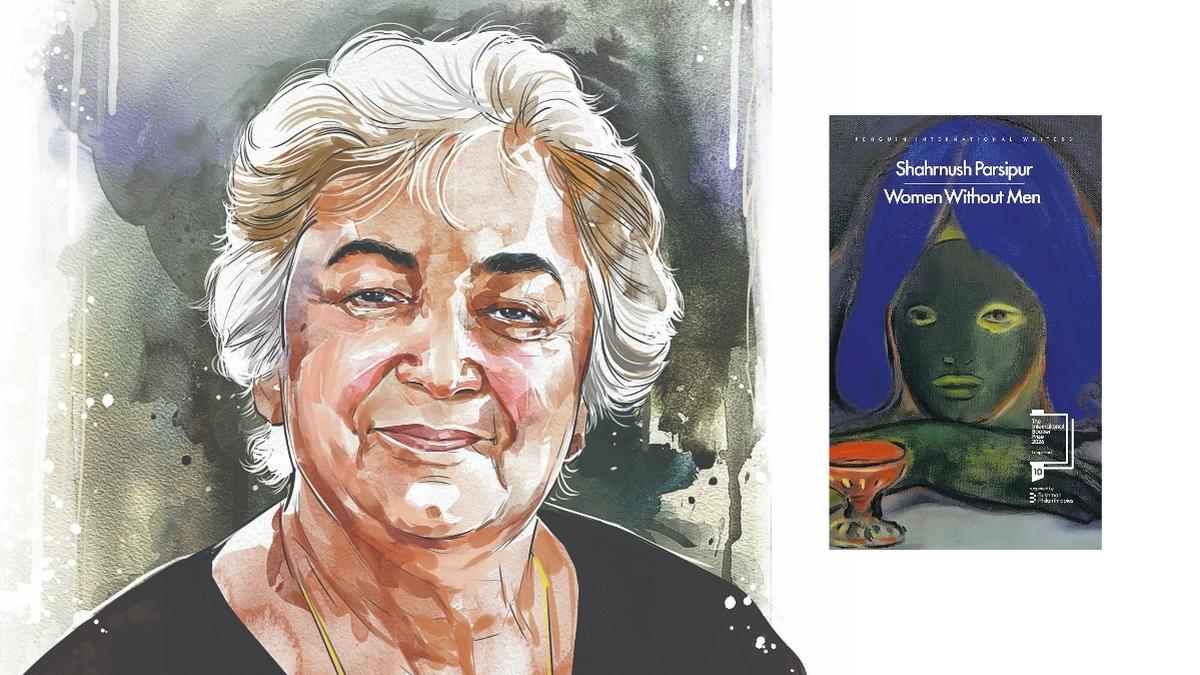
Exiled Iranian writer Shahrnush Parsipur on her International Booker Prize-nominated novella
The Hindu
Exiled Iranian writer Shahrnush Parsipur’s banned novella explores women’s freedom amid political repression and cultural patriarchy.
In writing Women Without Men (Zanan bedun-e Mardan), Shahrnush Parsipur gave her female characters a freedom that cost her her own. Set against the CIA-backed 1953 coup in Iran, the novella follows five women — a sex worker, a schoolteacher, a menopausal housewife, and two unmarried women — all seeking escape from the religious diktats governing their lives. In the book, virginity is divorced from honour, and shame is cast aside to create identity.
The vision was radical for its time. Published in 1989, the book appeared just as Iran was consolidating itself as an Islamic Republic. As the state moved to institutionalise hijab and Sharia-based law, Parsipur’s fantastical tale was seen as an act of insurrection. She was jailed and the book was banned.
Yet, the novella has outlasted its censors. Circulating underground for decades, it went on to become one of the most discussed works of modern Persian literature, even fuelling the ‘Woman, Life, Freedom (Jin, Jiyan, Azadi)’ movement that shook Iran in 2022. This defining book, newly translated by Faridoun Farrokh and published by Penguin International Writers, appears on the 2026 longlist of the International Booker Prize — 37 years after its publication.
A march in Berlin, 2023, to commemorate the first death anniversary of Iranian student Mahsa Amini, who was allegedly tortured by Iran’s morality police. | Photo Credit: Getty Images
On a video call from her home in California, 80-year-old Parsipur leans closer to the screen when I mention the nomination. “It hasn’t won yet,” she says in broken English, her eyes lighting up, belying the decades of exile that have led to this moment.
“From the time I was a little girl, I wanted to be a writer,” she later writes in Persian over email. “Back then, I did not have a concept of myself as man or woman writing books for men or women. Even today, I don’t necessarily write for women. I write for both men and women.”


Some of the estimated 20 billion yuan ($2.9 billion) worth of equipment, including screen-printing production lines, will require export approval from Chinese regulators, according to the people. It wasn't immediately clear how much of the equipment would require approval or how long it would take.

Three men, including a Super Micro VP, charged with smuggling U.S. AI technology to China, threatening national security.

Trump compares U.S. strikes on Iran to Pearl Harbor in meeting with Japan's PM, highlighting the element of surprise.

Iran-Israel war: Follow the latest updates from The Hindu on the West Asia conflict on March 20, 2026

The closure of the Strait of Hormuz disrupts a vital artery of the global economy, triggering price increases and turmoil in energy markets; as supply shocks reshape the geopolitics of energy, countries like India, the U.S., and Russia recalibrate strategies amid shifting oil flows and rising dependence

EU lawmakers advance U.S. trade deal legislation, overcoming delays and adding safeguards amid concerns over compliance from the Trump administration.

Pro-Iran Iraqi group pauses U.S. embassy attacks for five days, imposing conditions amid ongoing regional tensions and strikes.

Russia condemns the Israeli airstrike injuring RT journalists in Lebanon, calling it deliberate amid ongoing regional conflict.

Iran criticizes France's Macron for ignoring Israel-US attacks amid escalating West Asia conflict over shared gas fields.

China condemns killing of Iran's Larijani, urges halt to violence and calls for regional peace and humanitarian aid.

Iran executes three men from January protests amid rights concerns over coerced confessions and unfair trials.

Qatar expels two Iranian embassy officials within 24 hours over Iran’s attack on a Qatari gas facility.

Taiwan rejects China's energy security offer linked to reunification, securing alternative LNG supplies amid West Asian conflict disruptions.