NMACC showcase: From beetle wings to chintz, India’s gift to global fashion
The Hindu
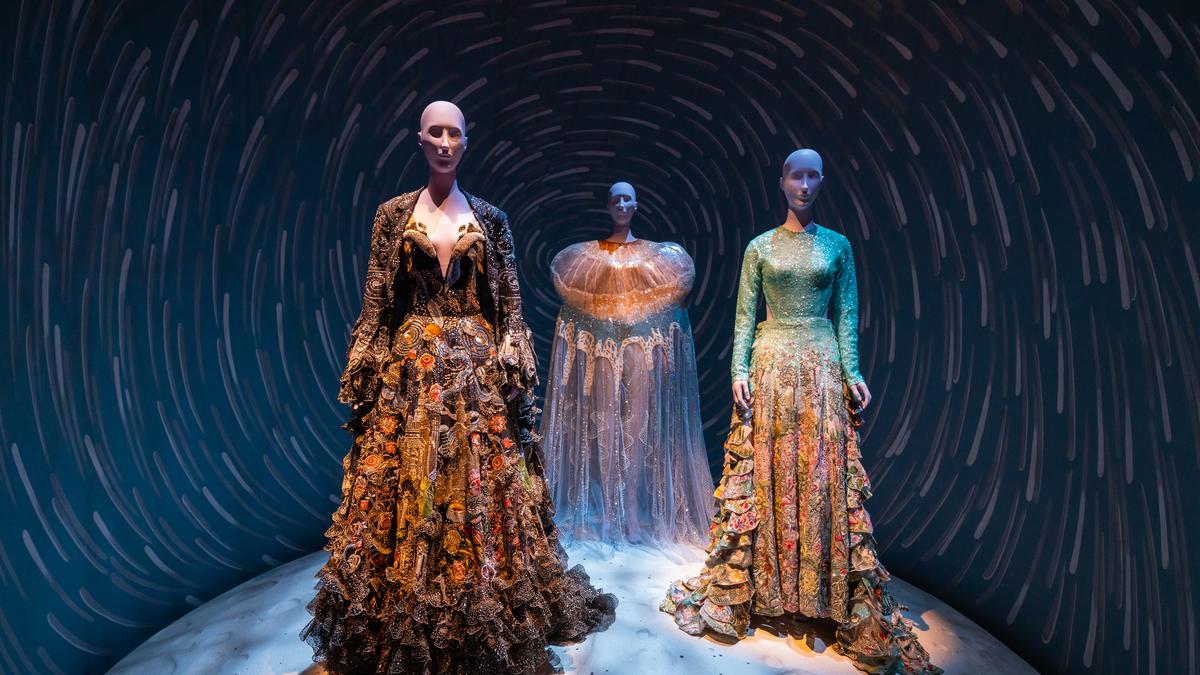
At NMACC, fashion milestones volley back and forth in time, displayed against a majestic set designed to international standards — occasionally let down by bad lighting and the stray safety pin
A little over 150 years ago, over 30,000 hand cut and mounted samples of Indian textiles were painstakingly organised into an album series to educate and inspire commercial and design industries in India and Britain. Its creator, John Forbes Watson, called them ‘trade museums’.
Watson would have been pleased to walk around the ‘India in Fashion’ exhibition at the newly-opened Nita Mukesh Ambani Cultural Centre (NMACC) in Mumbai, which documents the country’s impact on global fashion in modern times. The exhibition starts off with a magnificent armadillo dress and a striking pair of shoes, notable for its unconventional shape and covered with scales of iridescent paillettes, designed by the late British designer Alexander McQueen for his Spring/Summer 2010 show, Plato’s Atlantis. The costume is juxtaposed against a large framed visual of a jewelled beetle, the Sternocera ruficornis — its shiny greenish-blue wings used frequently in exclusive embroidered textiles in India since the 15th century.
Captivated, British women in India had commissioned their gowns with this decorative element by the late 18th century and it soon spread across the costume world over the next century. From the iconic ‘Peacock Dress’ worn by Baroness Curzon at the Delhi Durbar in 1903 to celebrate the king’s coronation to paintings by American artist John Singer Sargent, these shiny green jewels captured the fashionable imagination.
This example of a quiet reverberation between India and the West is the leitmotif that British journalist and curator Hamish Bowles presents in this exhibition through around 140 costumes, carefully hand-picked and drawn from some of the biggest museums and formidable archives around the world. It is mounted in a nearly 50,000 square feet facility, with climate control capabilities making possible for the first time in India the hosting of international art exhibitions at this scale.
Presented as 10 segments — from 18th century Dutch costumes of chintz, a coveted colonial trade textile, and Indian craft inspired jewellery, to unseen haute couture archival pieces drawn from Yves Saint Laurent, Chanel, Dior and more — the curatorial prowess of bringing so many exhibits to Mumbai is admirable. It also demanded the onerous task of writing to multiple institutions, requesting these pieces of history, often up to four years ahead.
The emergence of the Ambani family at leading international museums, as patrons over the past two decades, has played a significant role in bringing vital pieces from museums such as the Metropolitan Museum in New York, the Royal Ontario Museum and others. Costs for loans, wall-to-wall insurance, transport, conservation care, and a long list of other requirements are also part of the lending process.
In exhibition design director Patrick Kinmonth, Bowles found an able partner. The designer references the curator’s segmented narrative, picking up the scrutiny of fashion storytelling by referencing the architecture and vibrant colours from India and weaving it into the theme. He brings in a scale and grandeur of museum exhibition design that the country is not quite used to — visually connecting spaces and infusing drama.


The actor, along with director Shashant Shah, speak about their upcoming series ‘Chiraiya’, Divya’s process of working on the dialect, Sushant’s approach to telling a story about women, and more

Sri Lanka's Minister Bimal Rathnayake announces support for Indian refugees, urging political sensitivity from Tamil Nadu and India.

51 couples take thebig plunge at Udaipur mass wedding event

India shows significant progress in reducing child mortality, despite global slowdowns, highlights a new UN report on child health.

Puducherry's upcoming elections test the NDA's governance model amid opposition rifts and promises of stability and welfare delivery.

A Russian oil tanker diverts to India, boosting local refineries despite sanctions and geopolitical tensions.

Supreme Court questions if temple activities like book publishing and prasadam manufacturing qualify as industrial activities under current laws.

Ten of Kozhikode's 13 incumbent MLAs are seeking re-election, with no women candidates from CPI(M) in the upcoming polls.

Height restrictions near airports are stifling Bengaluru's growth, prompting calls for a review to boost development potential.

Explore the Gandhi Bunakar Mela in Vijayawada, showcasing traditional textiles and supporting handloom weavers until March 31.

MDMK leader Vaiko announces a movement to remove Prosopis juliflora trees in Tamil Nadu following a landmark High Court directive.

Lok Sabha Speaker Om Birla emphasizes the importance of Question Hour over meetings and urges decorum during obituary references.

Karnataka approves 300-bed Puttur Government Medical College Hospital project, enhancing healthcare in the coastal region.