New rootstocks promise faster, higher apple yields for Kashmir farms Premium
The Hindu
Discover how new rootstocks enhance apple yields and efficiency in Kashmir’s orchards, addressing climate challenges and boosting farmer income.
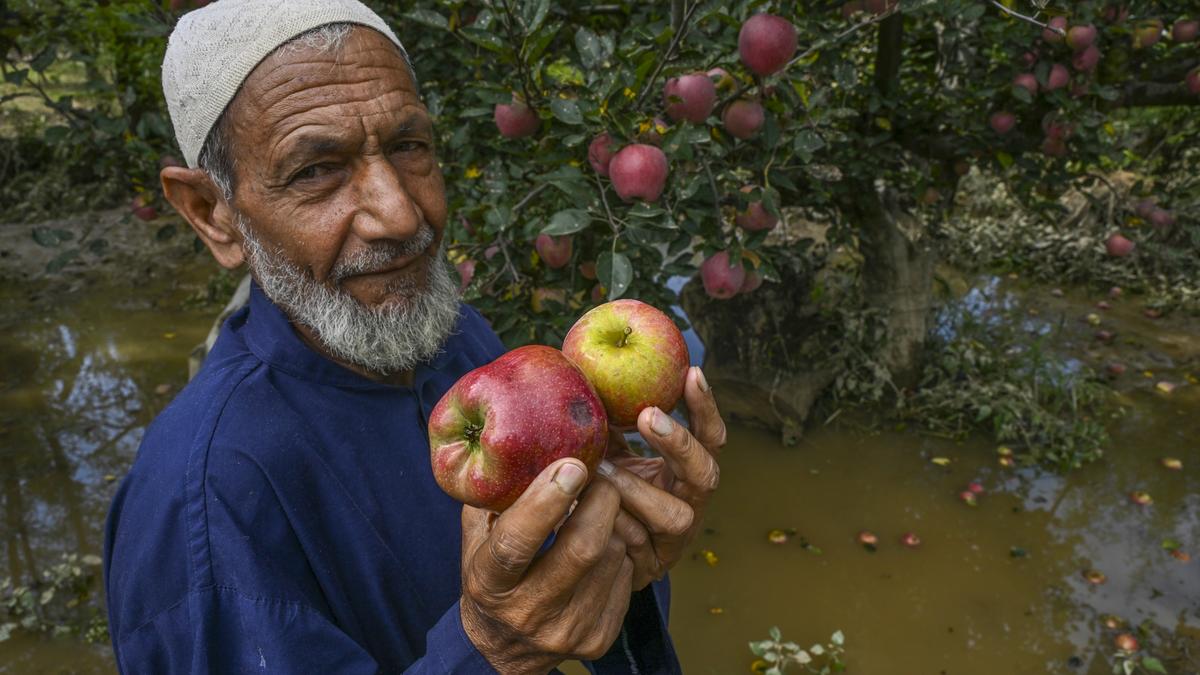
Kashmir grows apples across a wide range of altitudes, each shaping how the crop flowers, sets fruit, and yields. Yet, even with one of the largest apple-growing areas in the country, productivity in the valley remains modest. As traditional orchards face rising costs, delayed returns, and increasing climate stress, researchers and growers are turning to new rootstock technologies and high-density systems to make apple cultivation more efficient and resilient.
Apple is a major fruit crop in Kashmir cultivated on 1.08 lakh ha with a production of 11 lakh tonnes, providing livelihoods to around 27 lakh people. The performance of apples is determined by the valley’s diverse altitudes. They range from 1,500 m to more than 2,600 m above sea level, creating distinct microclimates. The trees need a certain amount of winter cold (chilling hours), they are sensitive to frost, and need enough warmth in summer (heat accumulation). So, the altitude influences how much cold or heat the trees get, which directly affects how well apples grow, flower, and produce fruit.
However, despite having one of the largest areas under apple cultivation in India, productivity in the Kashmir Valley remains far below that of developed apple-growing regions.
“One major reason is that for decades, orchards have been dominated by seedling-based trees that produce tall, vigorous, low-density, and extremely slow to bear fruit. These trees take 6-8 years to produce a commercial crop and yield just 10-12 tonnes per hectare, making them unviable for small landholdings,” Dr. Wasim Hassan Raja says.
Dr. Raja is a scientist at Fruit science division, ICAR-Central Institute of Temperate Horticulture (CITH), Srinagar, who has developed two novel technologies for apple rootstock multiplication and feathering, both now licensed to 25 nursery growers and adopted by over 100 orchardists across India.
He adds that the modern rootstock techniques on the other hand offer a solution. Rootstock refers to the roots and lower stem of a specially selected apple plant onto which the desired variety is grafted. It forms the entire root system and the lower trunk of the tree, essentially acting as its foundation.


District Collector releases coffee table book on Coimbatore

Madras High Court stays civil suit by PMK founder Ramadoss against son Anbumani until April 2026, amid party leadership disputes.

As they chug in from Arakkonam and Tirutanni and head towards Chennai Central, fast local trains do not have a platform on the fast line to halt at Ambattur railway station. As a result, commuters taking these trains to reach Ambattur have to do an extra train trip. Ambattur Rail Commuters Welfare Association wants Southern Railway to carry out yard remodelling and provide this much-needed platform

A.P. government assures LPG availability and urges consumers to avoid panic booking, with 17,962 MT stock and uninterrupted supply measures in place.

Deputy CM Udhayanidhi Stalin distributes ₹122.08 crore in welfare aid to 24,518 beneficiaries, highlighting Tamil Nadu's development progress.

Dakshina Kannada Member of Parliament Captain Brijesh Chowta on Thursday urged the Union Ministry of Environment, Forest and Climate Change to formulate a comprehensive district-level coastal protection plan for the district in coordination with the Ministry of Earth Sciences

Telangana High Court to deliver verdict on April 8 regarding Ghose Commission's report on Kaleshwaram Lift Irrigation Scheme irregularities.

Kerala High Court summons home secretary over delays in Rs 47 crore compensation for sexual assault survivors.

Indian Embassy in Iran assists stranded fishermen amid West Asia conflict, as court hears plea for evacuation and support.

The Gowd Saraswat Brahman Seva Sangh in association with Sri Narayani Sangeeth Kala Kendra will organise Vasantha Sangeetotsava, an assembly of exceptional young artists here on Sunday.

Join the 16th M.K. Nambyar Memorial Moot Court Competition in Belagavi, featuring 100+ participants debating government health interventions.

LPG shortage jeopardizes meals for over 8,000 students in Visakhapatnam's government-run hostels amid ongoing conflicts.

Forest Minister bans tree felling amid rising firewood demand, urging officials to enforce inspections and prevent illegal logging.