New atlas of bird migration shows extraordinary journeys
The Hindu
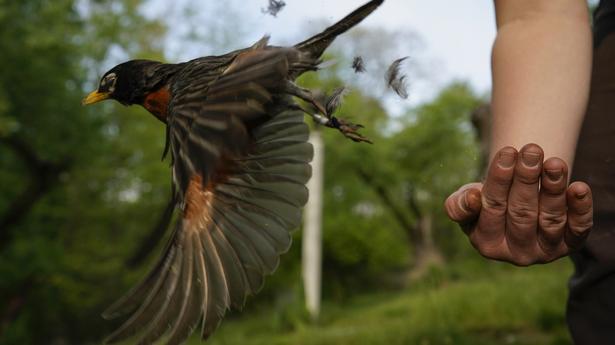
A new online atlas of bird migration draws from an unprecedented number of scientific and community data sources to illustrate the routes of about 450 bird species in the Americas.
A bay-breasted warbler weighs about the same as four pennies, but twice a year makes an extraordinary journey. The tiny songbird flies nearly 4,000 miles (6,437 kilometers) between Canada's spruce forests and its wintering grounds in northern South America.
“Migratory birds are these little globetrotters,” said Jill Deppe, the senior director of the migratory bird initiative at the National Audubon Society.
A new online atlas of bird migration, published on Thursday, draws from an unprecedented number of scientific and community data sources to illustrate the routes of about 450 bird species in the Americas, including the warblers.
The Bird Migration Explorer mapping tool, available free to the public, is an ongoing collaboration between 11 groups that collect and analyze data on bird movements, including the Cornell Lab of Ornithology, Smithsonian Migratory Bird Center, the U.S. Geological Survey, Georgetown University, Colorado State University, and the National Audubon Society.
Also Read: A dam built in the Amazon created thousands of ‘forest islands’ but they are too small to sustain most species
For the first time, the site will bring together online data from hundreds of scientific studies that use GPS tags to track bird movements, as well as more than 100 years of bird-banding data collected by USGS, community science observations entered into Cornell's eBird platform, genomic analysis of feathers to pinpoint bird origins, and other data.
“The past twenty years have seen a true renaissance in different technologies to track bird migrations around the world at scales that haven't been possible before,” said Peter Marra, a bird migration expert at Georgetown University who collaborated on the project.


Explore 2026's wallpaper trends in India, highlighting botanicals and handmade designs that enhance modern homes with nature-inspired aesthetics.

Mercedes-Benz CLA 250+ with EQ Technology review: design, performance, range and features explained. Discover how the new electric CLA combines advanced AI, long range, fast charging and futuristic styling for the next generation of luxury EVs.

AI tool for sparrow conservation

BTS’s comeback with ‘Arirang’ marks a major global music event. When does the album release, and where can you watch their concert live stream? We have all the details

The 2026 U.S. cholesterol guidelines urge starting screening and treatment at 30 to prevent cardiovascular disease effectively.

Olam Festival 2026 in Thiruvananthapuram returns March 27-29 with 120+ vendors, music, art, and cultural zones.

A few storytellers in Thiruvananthapuram share their journeys, challenges, and evolving methods on World Storytelling Day, inspiring young minds.

76-year-old Kurian Jacob from Kerala triumphs with seven medals, including five golds, at the Open Masters Games in Abu Dhabi.

Explore the nature of the human mind as an emergent property of brain activity and complex neural interactions.

CERN's Large Hadron Collider discovers the Xi-cc-plus particle, enhancing understanding of quantum mechanics and baryon behavior.

Vibha Batra’s latest book, Spotless (Hachette India) is a novel in verse for young adults

In its first edition, the Madras Art Salon spotlights the works of journalist and artist Narayan Lakshman at The Botanical Club, a social space in the British Deputy High Commission, Chennai

Cholesterol enhances melanoma cell invasion by making nuclei squishier, revealing a potential treatment target in cancer progression.