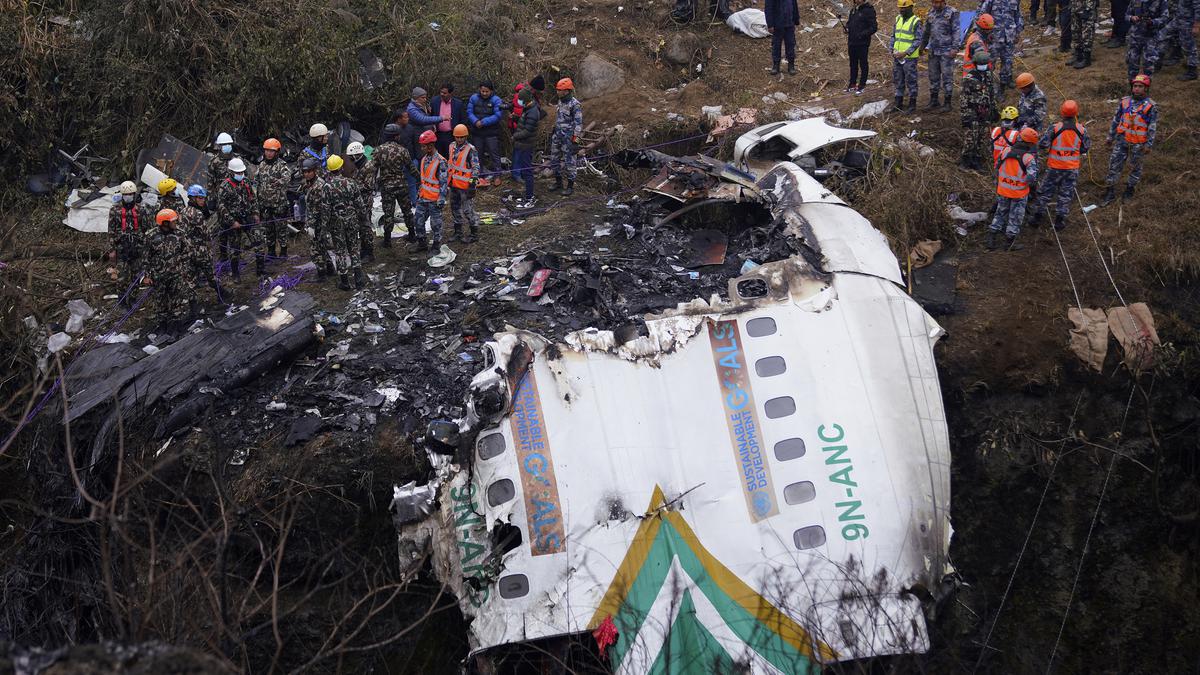
Nepal plane crash preliminary report: Investigators suspect human error
The Hindu
According to the preliminary report, the flight crew had made two flights between Kathmandu and Pokhara earlier in the morning. The flight that crashed was the third in a row by the same crew.
The Yeti Airlines aircraft which crashed in Nepal last month killing 71 people, including five Indians, lost thrust and fell after the propellers of both engines went into a feathered position, according to a preliminary probe report which lead investigators to suspect human error behind the deadly crash.
Yeti Airlines flight 691, after taking off from Kathmandu's Tribhuvan International Airport on January 15, crashed on the Seti River gorge between the old airport and the new airport in the resort city of Pokhara.
There were 72 people including four crew members onboard the ATR-72 aircraft when it crashed, but rescue officials have so far managed to recover only 71 bodies with the other missing passenger presumed dead.
It is rare for the propellers of both engines to come to a feathered position, said one of the members of the five-member probe committee, which is also mentioned in the 14-page preliminary report posted on the website of the Ministry of Tourism, Culture and Civil Aviation of Nepal.
“Human factor in the accident could not be disregarded. So it is an issue of investigation,” said the member on condition of anonymity.
“When both propellers were feathered, the investigation team observed that both engines of 9N-ANC were running flight idle condition during the event flight to prevent over torque,” states the preliminary report.
“As per the Flight Data Recorder (FDR) all the recorded parameters related to engines did not show any anomaly,” adds the report.


Indonesia arrests four military officers linked to an acid attack on activist Andrie Yunus, sparking calls for an independent investigation.

Sri Lanka's Minister Bimal Rathnayake announces support for Indian refugees, urging political sensitivity from Tamil Nadu and India.

Trump temporarily waives maritime law to lower energy costs amid rising gasoline prices from the Iran-Israel conflict.

Gideon Levy discusses Israel's militarism, the Palestinian question, and the challenges of achieving peace in West Asia.

Israel claims to have killed another top Iranian official as Iran's missile attacks near Tel Aviv leave two dead.

Test your knowledge with our daily quiz on significant events that occurred on March 18.

Iran's Foreign Minister asserts nuclear doctrine remains unchanged and advocates for a new protocol for the Strait of Hormuz post-war.

Exploring Banksy's identity reveals the significance of his anonymity and the cultural impact of his provocative art.

Iran's Foreign Minister asserts Larijani's assassination won't destabilize the political system, while the IRGC pledges revenge.

Shorts News:Watch: Cuba right now in ‘very bad shape’: Trump

As political loyalties shift, Vice President Vance navigates the turbulent MAGA landscape amidst Trump's new war strategy.

Oil prices drop over $2 as Iraq and Kurdish authorities finalize an export deal, easing supply concerns amid ongoing conflict.

Marco Rubio denies U.S. efforts to oust Cuba's President, calling a New York Times article "fake" and misleading.