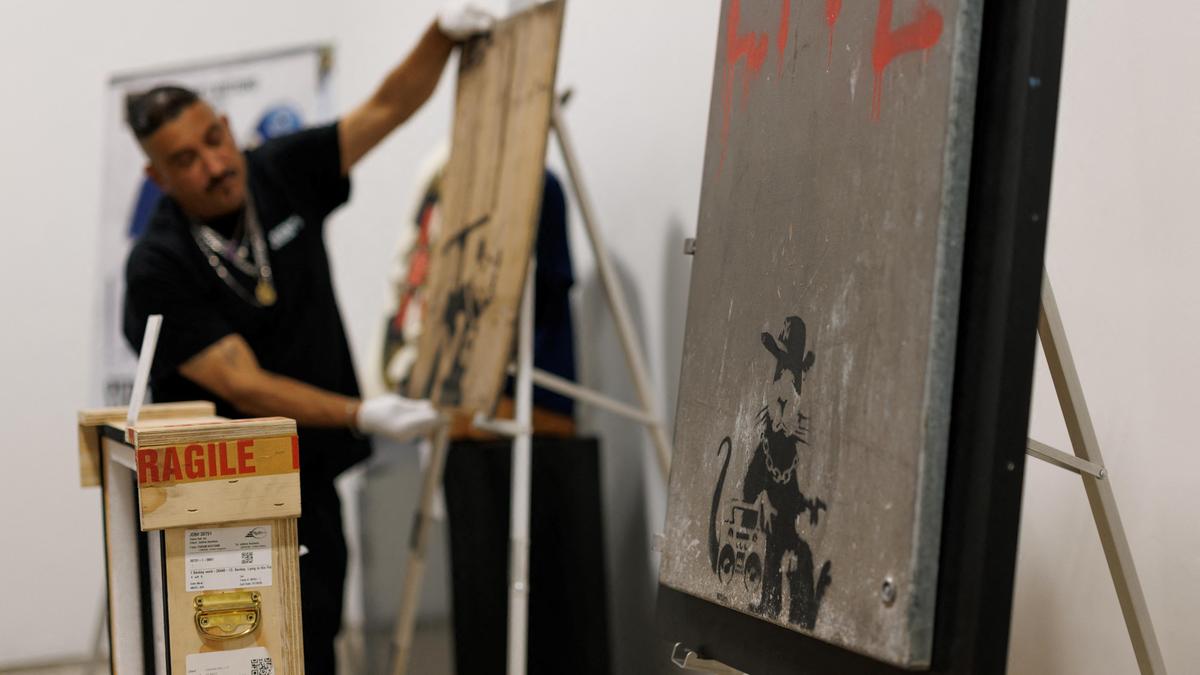
Quest to identify the artist Banksy uncovers much more than a name
The Hindu
Exploring Banksy's identity reveals the significance of his anonymity and the cultural impact of his provocative art.
In late 2022, an ambulance pulled up to a bombed-out apartment building in this village outside Kyiv. Three people emerged. One wore a gray hoodie, another a baseball cap. Both had masks covering their faces.
The third was more easily identifiable: He was unmasked, and had one arm and two prosthetic legs, witnesses told Reuters.
The masked men carried cardboard stencils from the ambulance and taped them to what had been an interior wall of an apartment before the Russians obliterated the place. Then they pulled out cans of spray paint and got to work. An absurd image appeared in minutes: a bearded man in a bathtub, scrubbing his back amid the wreckage.
Its creator was Banksy, one of the world’s most popular and enigmatic artists, whose identity has been debated and closely guarded for decades. Banksy is best known for simple yet sophisticated stencil paintings with searing social commentary. His work has generated tens of millions of dollars in sales over the years. Once an annoyance to authorities who viewed him as a vandal, he has become a British national treasure. In one survey, Brits rated him more popular than Rembrandt and Monet. In another poll, his “Girl with Balloon” painting was voted the favorite piece of artwork Britain has produced.
Some critics believe Banksy’s anonymity is as important to his work as stencils and paint. The British press has run many articles over the years that tried to deduce his identity. Still, Banksy and his inner circle won’t talk about it. Some have signed non-disclosure agreements. Others keep quiet out of loyalty, or fear of crossing the artist, his fans and his influential company, Pest Control Office, which authenticates his work and decides who gets the first chance to buy Banksy’s latest pieces. When the bathtub mural and other Banksy pieces began appearing in Ukraine, Reuters wondered about the artist and how he had pulled off the stunt. Horenka was less than five miles east of Bucha, where Russian forces had left behind at least 300 civilians dead seven months earlier.
So we set out to determine how Banksy did it – and who he really is. Weeks later, a reporter visited Horenka with a photo lineup of graffiti artists often rumored to be the artist and showed the pictures to locals to see if anyone recognized him. Not long after, we heard that a famous British musician – one of the people often whispered to be Banksy – had been spotted in Kyiv, giving us a theory to pursue.


Shooting at a Georgia VA clinic leaves one employee hospitalized and the gunman dead, prompting investigations by authorities.

UNICEF reports 100,000 flee South Sudan's Akobo due to escalating conflict, worsening conditions for displaced populations in Ethiopia.

Cuba restores electricity to two-thirds of the country after a nationwide blackout amid ongoing economic challenges and U.S. sanctions.

U.S. President Donald Trump declares the U.S. no longer needs ally support in Iran conflict amid rising tensions and global energy concerns.

Joe Kent resigns as National Counterterrorism Centre head, citing Iran poses no imminent threat amid war pressures from Israel.

PJAK emphasizes its autonomy in the fight for a democratic Iran, rejecting involvement in external conflicts, says co-chair Peyman Viyan.

The Hindu quiz: Does the joint U.S.-Israeli military operation on Iran constitute a war, conflict, escalation, or campaign change? A quiz on lexicons and lives.

A 5.8-magnitude earthquake struck off Cuba's coast, with no immediate reports of casualties or damage.

Israel's Defence Minister announces the killing of Iran's security chief Ali Larijani in an overnight military strike.

China pledges humanitarian aid to Iran and West Asia amid ongoing conflict, highlighting the region's urgent humanitarian crisis.

Ofcom extends BT Openreach regulation for five years, widening price caps to boost competition and enhance broadband access in the U.K.

Israeli Prime Minister Netanyahu shares Nowruz greetings with Iranians, emphasizing hope and freedom amid ongoing tensions.

India strongly condemns Pakistan's airstrikes on a Kabul hospital, urging accountability for violence against Afghan civilians.