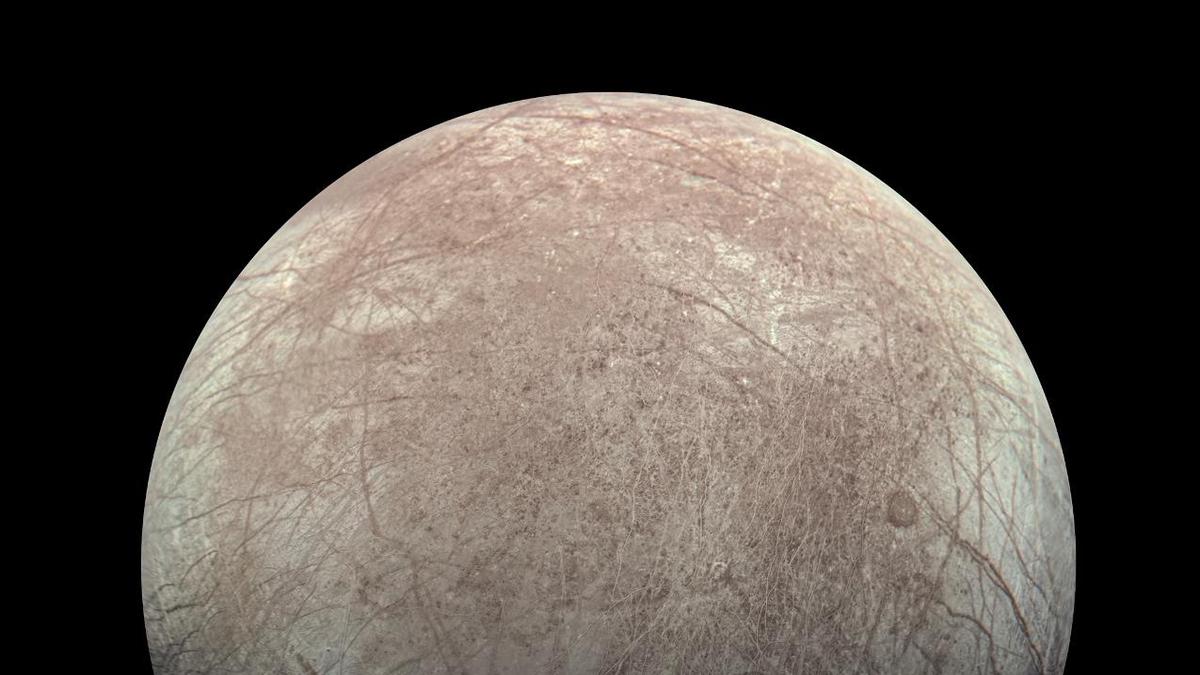
NASA will let you send your name to Jupiter’s moon Europa
The Hindu
Send Your Name into Space: Join NASA’s Mission to Send Your Name to Europa. NASA is inviting people to send their names into space through its Europa Clipper Spacecraft
NASA is inviting people to send their names to Jupiter’s moon via its Europa Clipper spacecraft that is scheduled to launch next year and orbit the Europa moon by 2030.
Astronomy lovers can send their names into space or submit a loved one’s name. An American poem will be engraved on the spacecraft, while people’s names will be stencilled onto microchips that are mounted on the craft, according to NASA.
“Scientists are almost certain that beneath Europa’s ever-changing icy crust lies a vast saltwater ocean that holds almost twice as much water as Earth’s oceans. With a thin oxygen atmosphere and abundant water, Europa is considered one of the best places in our solar system to search for life,” posted NASA on Instagram on Christmas, suggesting that sending in names could serve as a last minute gift.
People can submit names through a form on the NASA website. Applications will close on December 31.
2,204,120 names have been added to the list since June this year, with over 350,000 of them coming from India.
(For top technology news of the day, subscribe to our tech newsletter Today’s Cache)
The Europa Clipper spacecraft will travel 2.9 billion km to study Jupiter’s moon and learn more about its oceanic structures, to see if it can one day sustain life.


Mercedes-Benz CLA 250+ with EQ Technology review: design, performance, range and features explained. Discover how the new electric CLA combines advanced AI, long range, fast charging and futuristic styling for the next generation of luxury EVs.

Pi Day is celebrated every year on March 14, honouring the significance of the mathematical constant π and its applications in mathematics.

Discover how sculptural interior design transforms modern spaces, blending creativity and functionality to evoke emotion and identity.

A study reveals that certain antibiotics can cause long-lasting changes in gut microbiome diversity for up to eight years.

Indian scientists and international experts are divided over a study questioning the viability of a nuclear reactor fuel called HALEU-thorium; while critics cite safety risks, proponents argue the technology is vital to achieve national energy goals.

ISRO and AIIMS partner to enhance space medicine research, focusing on human health during long-duration space missions.

A practical guide to induction setups for students, families, and home food businesses as India’s LPG supply faces its biggest disruption in years

Explore the electrifying Oscars 2026 race, featuring standout films, baffling nominations, and memorable performances amid a cinematic transition.

Zai and Rom Whitaker’s latest book for young readers, The Book of Indian Snakes, tackles common misconceptions surrounding snakes, highlighting their utility to humans

Discover PC Mahalanobis's pivotal role in India's statistical revolution and his lasting influence on modern statistics in this episode.

Explore why nothing can exceed light speed and the paradoxes that arise if it were possible.

Scientists have engineered bacteria to produce designer proteins by smuggling artificial amino acids, enabling precise drug delivery and multifunctional applications.

Scientists successfully grew chickpeas in simulated lunar soil, paving the way for future extraterrestrial agriculture on the moon.