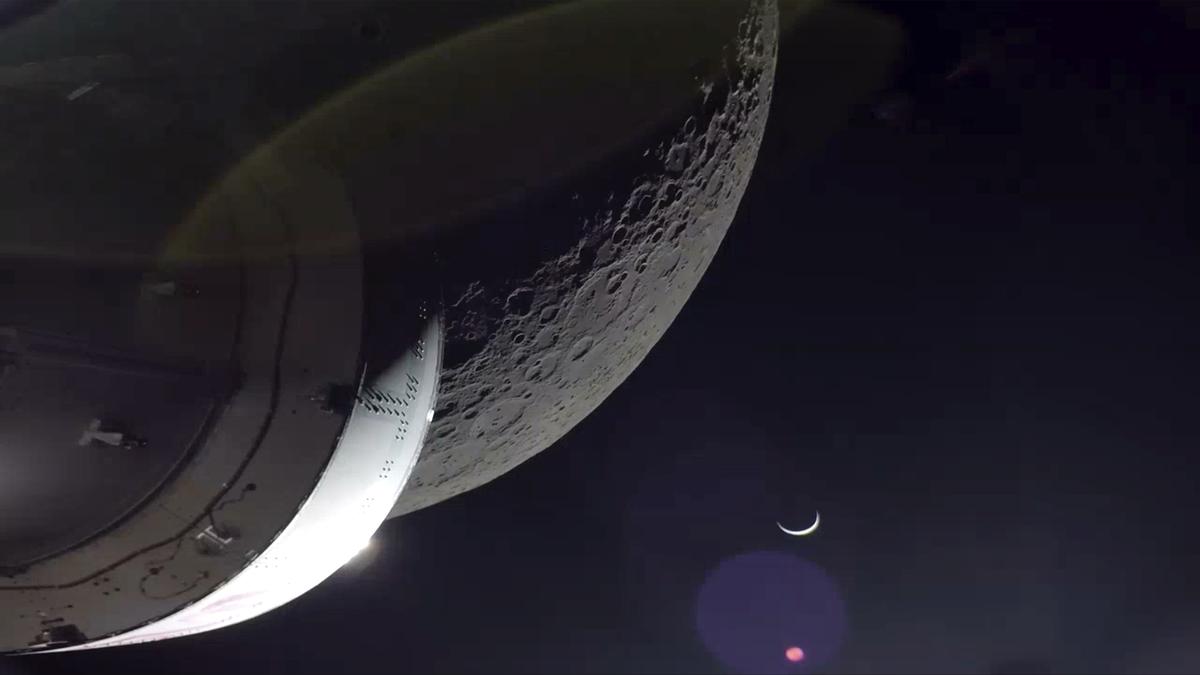
NASA Moon capsule Orion due to splash down after record-setting voyage
The Hindu
Splashdown in the Pacific off the Mexican island of Guadalupe is scheduled for 1739 GMT.
After making a close pass at the Moon and venturing further into space than any previous habitable spacecraft, NASA's Orion capsule is due to splash down Sunday in the final test of a high-stakes mission called Artemis.
As it hurtles into Earth's atmosphere at a speed of 25,000 miles (40,000 kilometers) per hour, the gumdrop-shaped traveler will have to withstand a temperature of 2,800 degrees Centigrade (5,000 Fahrenheit) -- about half that of the surface of the sun.
Splashdown in the Pacific off the Mexican island of Guadalupe is scheduled for 1739 GMT (9:39 am local time).
Achieving success in this mission of just over 25 days is key for NASA, which has invested tens of billions of dollars in the Artemis program due to take people back to the Moon and prepare for an onward trip, someday, to Mars.
So far the first test of this uncrewed spacecraft has gone very well.
But it is only in the final minutes of this voyage that the true challenge comes: seeing if Orion's heat shield, the biggest ever built, actually holds up.
"It is a safety-critical piece of equipment. It is designed to protect the spacecraft and the passengers, the astronauts on board. So the heat shield needs to work," said Artemis mission manager Mike Sarafin.


Set between the Siwalik hills and the plains, Butwal offers travellers a mix of regional cuisine, pilgrimage trails to Lumbini and the comfort of Hyatt’s new hospitality landmark

Explore 2026's wallpaper trends in India, highlighting botanicals and handmade designs that enhance modern homes with nature-inspired aesthetics.

Mercedes-Benz CLA 250+ with EQ Technology review: design, performance, range and features explained. Discover how the new electric CLA combines advanced AI, long range, fast charging and futuristic styling for the next generation of luxury EVs.

AI tool for sparrow conservation

BTS’s comeback with ‘Arirang’ marks a major global music event. When does the album release, and where can you watch their concert live stream? We have all the details

The 2026 U.S. cholesterol guidelines urge starting screening and treatment at 30 to prevent cardiovascular disease effectively.

Olam Festival 2026 in Thiruvananthapuram returns March 27-29 with 120+ vendors, music, art, and cultural zones.

A few storytellers in Thiruvananthapuram share their journeys, challenges, and evolving methods on World Storytelling Day, inspiring young minds.

76-year-old Kurian Jacob from Kerala triumphs with seven medals, including five golds, at the Open Masters Games in Abu Dhabi.

Explore the nature of the human mind as an emergent property of brain activity and complex neural interactions.

CERN's Large Hadron Collider discovers the Xi-cc-plus particle, enhancing understanding of quantum mechanics and baryon behavior.

Vibha Batra’s latest book, Spotless (Hachette India) is a novel in verse for young adults

In its first edition, the Madras Art Salon spotlights the works of journalist and artist Narayan Lakshman at The Botanical Club, a social space in the British Deputy High Commission, Chennai