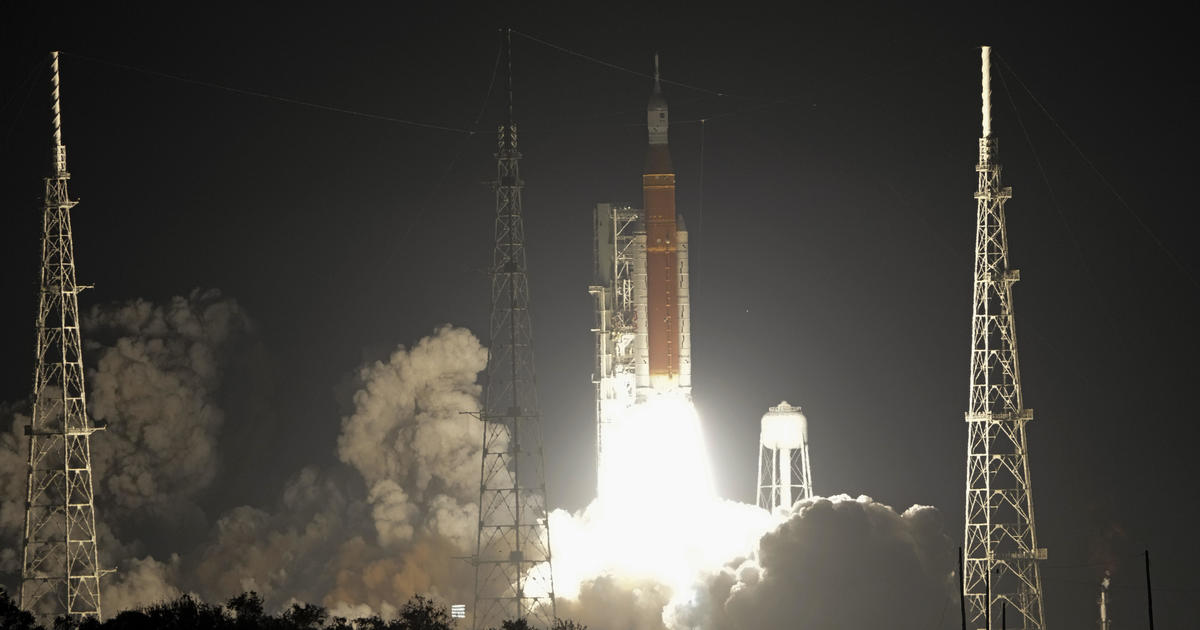
NASA launches Artemis rocket on a mission to the moon
CBSN
In a jaw-dropping spectacle, the 322-foot-tall Artemis moon rocket, the most powerful ever built for NASA, finally blasted off Wednesday with an eruption of white-hot fire and an earth-shaking roar, boosting an uncrewed Orion capsule on a flight to the moon to open a new era in American space flight.
After multiple delays due to repeated hydrogen fuel leaks, ground system glitches, two hurricanes and back-to-back launch slips, the Space Launch System rocket's four main engines finally roared to life at 1:47 a.m. EST, followed a few seconds later by ignition of two extended strap-on solid-fuel boosters.
At that instant, four explosive bolts at the base of each booster detonated to free the SLS from its launch stand and the 5.7-million pound rocket leaped away from pad 39B, propelled skyward by 8.8 million pounds of thrust, hitting 70 mph — straight up — in about 7 seconds.


Financial markets experts are raising concerns about possible insider trading after an unusual spike in oil futures trading only minutes before President Trump announced talks with Iran on Truth Social. Edited by Alain Sherter In:

NASA announced ambitious long-range plans Tuesday to spend $20 billion over the next seven years to build a moon base near the lunar south pole featuring habitats, pressurized rovers and nuclear power systems. The announcement came just over a week before the planned launch of NASA's Artemis II around-the-moon mission. In:

Minnesota state and county officials sued the federal government Tuesday, alleging they are being blocked from investigating the shootings of Renee Good, Alex Pretti and Julio Cesar Sosa-Celis by federal agents. In:

Washington — It's not a palace, but next month the White House is set to be overrun by royals. Gabrielle Ake contributed to this report.

Epic Games, the video game maker behind Fortnite, is laying off more than 1,000 workers amid "extreme" market conditions and a downturn in engagement with its most popular game, CEO Tim Sweeney said in a blog post Tuesday. Edited by Aimee Picchi In:

Security screening lines are so long at some U.S. airports that major airlines are letting passengers cancel or rebook their tickets free of charge during the ongoing partial federal government shutdown. Edited by Alain Sherter In:

Travelers at Houston's George Bush Intercontinental Airport are standing for hours in security lines that may cause more risks for travelers — amid a DHS funding fight that's resulted in TSA staff shortages at major U.S. airports. Kaia Hubbard and Kathryn Krupnik contributed to this report. In:

Washington — President Trump, who calls voting by mail "cheating" and wants to restrict the method, voted by mail this month in Florida's special elections, public records show. In:

Washington — Oklahoma Gov. Kevin Stitt appointed energy executive Alan Armstrong on Tuesday to replace newly confirmed Department of Homeland Security Secretary Markwayne Mullin in the Senate.

Washington — The Senate is closing in on a deal to fund the bulk of the Department of Homeland Security and end the partial government shutdown that has stretched six weeks and snarled air travel. Seiji Yamashita and Alan He contributed to this report.

Ford Motor Co. is recalling 254,640 Lincoln and Explorer vehicles due to a software issue that may disrupt the rearview camera and other features intended to enhance safety while driving. Edited by Aimee Picchi In:

The Trump administration deployed ICE and other Homeland Security agents to 14 of the nation's airports on Monday to help shuttle passengers through overcrowded TSA checkpoints. In one airport, the security line wait-time was up to six hours. Nicole Sganga and Kaia Hubbard contributed to this report. In:

One of South Africa's most notorious apartheid police commanders testified on Monday at an inquiry into the killing of four activists in 1985 as part of the country's renewed focus on atrocities committed by security forces during decades of forced racial segregation that went unpunished. In: