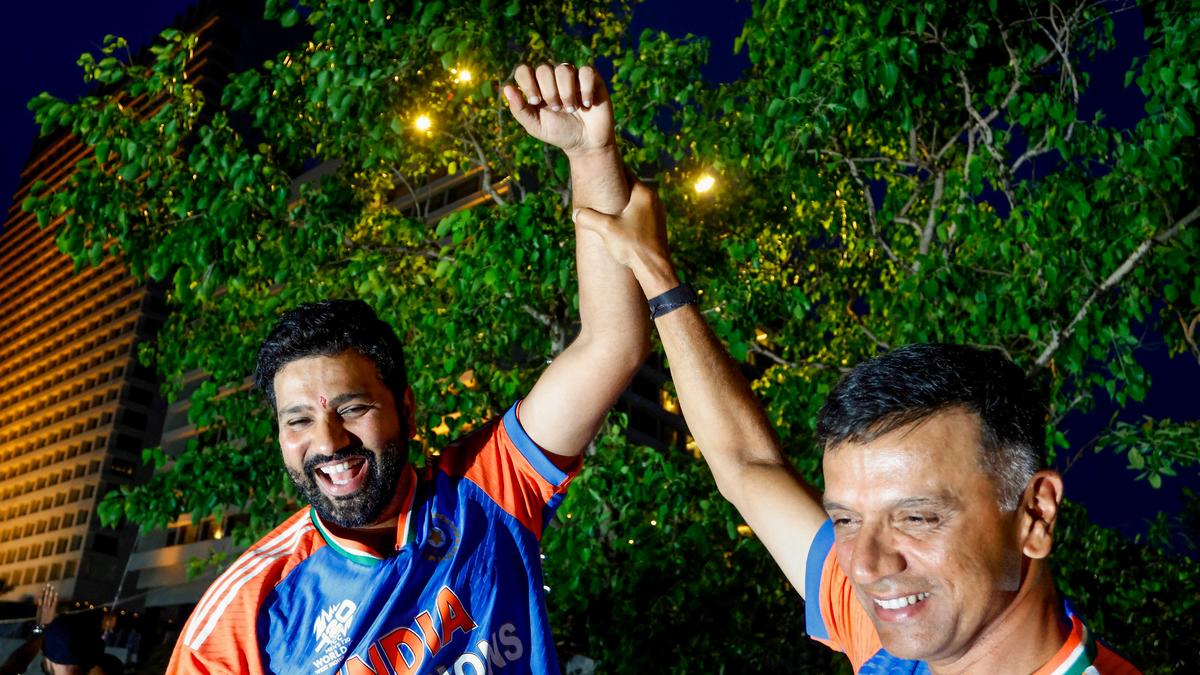
Men in Blue — a T20 behemoth Premium
The Hindu
Men in Blue — a T20 behemoth
A couple of hours after Tilak Varma held the catch that crowned India T20 World Cup winners for an unprecedented third time, head coach Gautam Gambhir arrived with Suryakumar Yadav, who was proudly holding the trophy, to discharge his media responsibilities. Despite the lateness of the hour – Sunday had given way to Monday – there was no sign of restlessness or irritation amongst the usually restless and irritable media corps. Contrary to what many, even within the team environs, might believe, journalists aren’t impervious to results; most rejoice when the team wins and are openly disappointed when the results don’t go the Indian side’s way, and this was clearly a night of celebration, a night to applaud a magnificent campaign either side of a blip against South Africa.
Gambhir carries the not unfounded reputation of being grumpy and snappy at press conferences, often not even waiting for the questioner to complete his query before launching into a reply that might not have any direct relevance to what the question would have been had the head coach been a little more patient. Of course, one can’t entirely blame him because several questions are couched at the end of a long discourse from said questioners, but we digress.
Understandably, Gambhir was gung-ho. He might not admit as much, but this World Cup triumph would have come as a soothing balm, a vindication of his methodologies and his philosophies. Gambhir was under public (and perhaps self-imposed) pressure coming into the tournament; in his brief tenure, he has overseen two crushing home series Test defeats. Given that India hadn’t lost at home in the preceding dozen years, two routs in 12 months will remain a millstone around his neck, no matter what happens from here on.
The former opener, combative and intrepid, held forth on eschewing the fear of losing, especially when it came to T20s, adding that it was that fear which often resulted in defeats. “The most important thing in this format was that we didn’t want to be afraid of losing, because if you are afraid of losing, you never win,” he thundered. “I always believe that high risk, high reward is very important in this format. I would have been happier if we had been out at 110-120. But our target was always to make 250 runs. But we didn’t want to play the 160-180 runs cricket. For too long, we played cricket with 160-170 runs. But for the last two years, it was the captain’s philosophy, the captain’s ideology – the captain himself wanted to play high risk, high reward.”
Most of what Gambhir said was indisputably correct. But it isn’t only in the last two years that India’s philosophy has changed. And the duo that initiated the change was the one that ended the country’s prolonged wait for a T20 World Cup crown even though India boasted the most visible and high-profile T20 franchise tournament in the universe.
Against all odds, and perhaps thriving on the supreme lack of expectations, India went all the way in the inaugural T20 World Cup in South Africa, back in 2007. Heading into the tournament, India had played exactly one T20 International, the previous December in South Africa which they won. The squad was without several stalwarts — then Test and ODI skipper Rahul Dravid, champion bat Sachin Tendulkar and Dravid’s predecessor Sourav Ganguly foremost among the absentees. There was a surprise first-time captain (Mahendra Singh Dhoni) even though the team had experienced hands in Virender Sehwag and Yuvraj Singh, among others. Dhoni’s band played a glorious brand of cricket, using the might of their batting and the assistance in Durban to their pace-orientated attack before subduing Pakistan in the final in Johannesburg to come home to a spectacular reception.


RBI women's team secures third title in four years, while PSPB men dominate with their 24th consecutive championship win.

Join the IPL 2026 countdown as Shreyas Iyer leads Punjab Kings in their quest for a maiden title.

New Zealand defeats South Africa by 68 runs in the second T20I, leveling the series at 1-1.

Novak Djokovic withdraws from the Miami Open due to a shoulder injury, missing his chance for a seventh title.

Sing language interpreters from India Signing Hands made sure that hearing impaired audience of the matches involving India in the recently concluded T20 World Cup “heard” them

Iran is negotiating with FIFA to move its World Cup matches to Mexico due to safety concerns amid ongoing conflict.

CSK names James Foster as fielding coach

English clubs face daunting Champions League challenges, trailing by three goals against top European teams after disappointing first legs.

My target is to be in the top-30: Devika Sihag

CSK names James Foster as fielding coach

Mayank Chakraborty becomes Assam's first Grandmaster, ending a three-decade wait for the North-East in chess history.

M.S. Dhoni advises CSK rookie Prashant Veer to save money wisely as he navigates his first IPL experience.

Sanju Samson reflects on his T20 World Cup victory, sharing his excitement for the upcoming IPL with CSK.