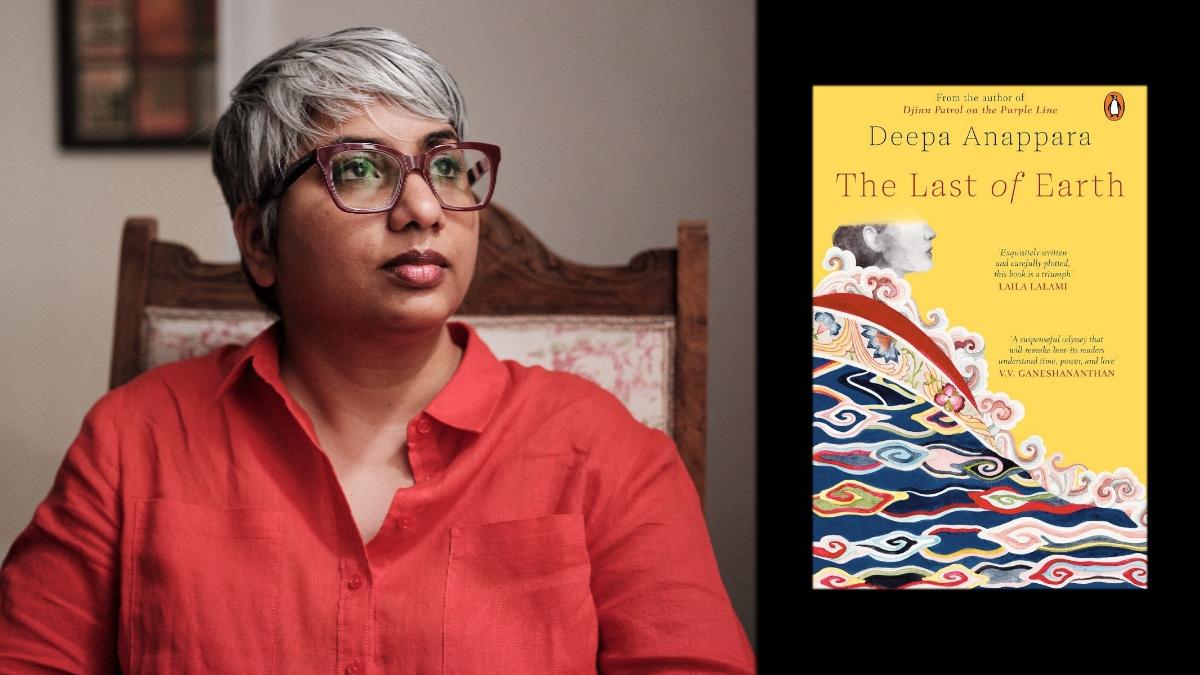
Mapping imperialism | Deepa Anappara on her new novel The Last of Earth
The Hindu
Explore Deepa Anappara's novel, The Last of Earth, as she critiques imperialism and redefines exploration through diverse narratives.
In her sweeping historical novel, The Last of Earth (published by Penguin), set in late 19th century British India, former journalist Deepa Anappara weaves a dual narrative of friendship and imperial ambition. The story follows Balram, an Indian schoolteacher engaged as a surveyor-spy by a British officer who embarks on a perilous expedition into Tibet after its borders have been closed to Europeans. “It’s in the nature of white men to believe they own the world, that no door should be shut to them,” Balram recalls his father telling him when he was a boy.
Also on a mission to open doors, though for different reasons, is Katherine, a 50-year-old explorer in disguise. As their paths cross on the Himalayan mountain passes and true identities and intentions come to light, the novel reflects on the uneasy partnership between coloniser and colonised. “I was interested in looking at who is considered an explorer and who becomes a coolie,” says London-based Anappara, whose debut novel, Djinn Patrol on the Purple Line, was longlisted for the Women’s Prize for Fiction 2020. Edited excerpts from an interview:
What inspired the historical setting of ‘The Last of Earth’?
Answer: In 2009, I came across an Englishman’s account of travelling through Tibet in the 19th century, where he referred to his two Indian “manservants” as loyal and faithful and credited them with saving his life but in the same breath spoke about whipping them as a necessary corrective to teach them to behave appropriately. I became interested in the power dynamic between the coloniser and the colonised, away from the setting of imperial power, in a region like Tibet, which can be harsh to an outsider. I was also interested in looking at who is considered an explorer and who becomes a coolie. For instance, in this particular account, it was clear that the Englishman saw himself as an explorer while his bearers were just that, despite the fact that they were walking across the same landscape that he was.
Traditionally, the exploration novel is seen as the domain of white men, and I wanted to subvert the tropes of that genre to examine how exploration and cartography can be tools of imperialism.
This 1812 painting by British soldier Hyder Young Hearsey shows him and fellow explorer William Moorcroft disguised as Indian holy men (left) on yaks, travelling in Tibet. | Photo Credit: Werner Forman Archive


Iran asserts its right to nuclear enrichment, dismissing foreign attempts to limit its nuclear program amid rising tensions with the U.S.

Unknown gunmen kill three militants linked to recent attacks on government officials in northwest Pakistan, police report.

As Ramzan approaches, Muslims around the world prepare for renewed spiritual discipline. A quiz on the holy month

Unitree, a private company started by tech entrepreneur Wang Xinxing (36) who designed his first robot at university, said this week it plans to sell as many as 20,000 humanoid robots this year, an almost four-fold rise from 2025

India has added its name to the list of countries criticising Israel for its unilateral measures on the West Bank.

Russia calls for restraint amid rising U.S. military presence near Iran, urging diplomatic solutions to escalating tensions.

Former Prince Andrew arrested by U.K. police for suspected misconduct related to allegations involving Jeffrey Epstein.

Test your knowledge on how countries got their names with our engaging quiz featuring fascinating etymological insights!

Satellite images reveal Iran's military site fortifications amid escalating U.S. tensions, highlighting significant construction and repairs.

A suspected gas explosion in Karachi kills 16, including children, and injures 14, causing building collapse during Sehri.

Former South Korean President Yoon Suk Yeol receives a life sentence for illegally imposing martial law and attempting a power grab.

Macron shares a heartwarming AI image with PM Modi, highlighting India-France collaboration at the AI Impact Summit 2026.

NIA charges three accused in Myanmar human trafficking case involving Indian youth, revealing a network deceiving victims for cyber scams.