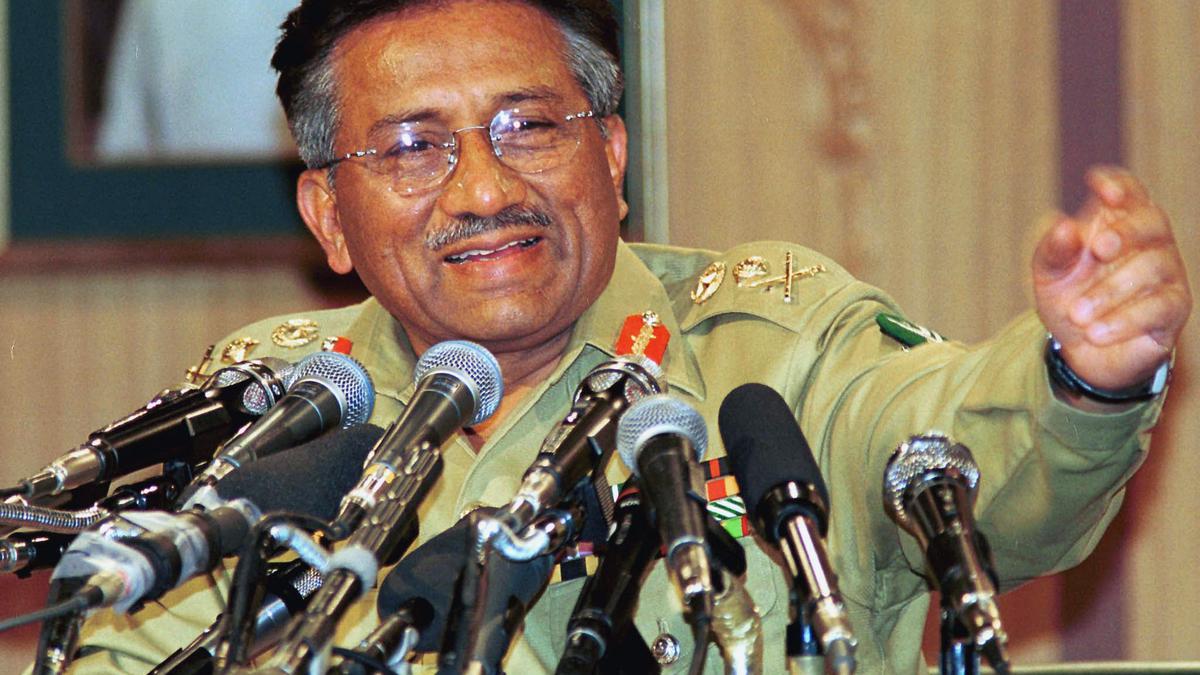
Mapping General Pervez Musharraf’s legacy
The Hindu
President Musharraf wanted to do what no other Pakistan leader was able to do till that time, to make India agree to Pakistan’s position that the J&K issue was the primary cause of India-Pakistan problems. However, the question is whether Musharraf was really interested in building a viable relationship with India who he viewed as an eternal threat
About an hour into Prime Minister Atal Bihari Vajpayee’s first one-on-one conversation with Army Chief and self-appointed President of Pakistan, General Pervez Musharraf, in July 2001 at Agra, the enormous difference between the approaches, wisdom and stature of the two were becoming increasingly apparent. While the former was deeply invested in overcoming bilateral differences of the past and taking the relationship into constructive and productive channels, the latter was fixated on India acknowledging that the Jammu and Kashmir (J&K) issue lay at the root of all difficulties between the two countries.
In this conversation, and in others, between them in Agra, the General’s single-minded instincts — perhaps honed during his years as an army commando — were always getting the better of him. He wanted to return to Pakistan and show his people that he had achieved what no other Pakistan leader had ever done: he had made India to implicitly, if not explicitly, agree to Pakistan’s position that the J&K issue was the primary cause of India-Pakistan problems. And that in doing so, India had abandoned its view that J&K was merely a symptom of Pakistan’s overall attitudes towards India. Ironically, in a speech, some months after becoming the Army Chief of Pakistan, Musharraf had said that India-Pakistan differences would remain even if the J&K issue was resolved because India was a hegemonic power.
For Musharraf, J&K’s incorporation into Pakistan was an unfinished agenda of India’s Partition. This is also an opinion that was and continues to be widely held in Pakistan. The logical inference which flows from this standpoint is that India-Pakistan ties do not depend on a resolution of the J&K issue alone, and that India must be flexible on all bilateral matters even if it involves sacrificing its own interests.
It is an open question if Musharraf ever overcame the basic thrust of his initial commando training. Certainly, Musharraf’s actions in Kargil show his thinking as simplistic and tactical. The entire operation was based on the assumption that India would be unwilling to militarily counter the Pakistan army’s occupation of the Kargil heights. The fact that India would undertake all steps required to protect its northern defences was obviously ignored. The General also misread the reaction from major powers. He anticipated that they would pressure India to accept a ceasefire which would enable Pakistan to continue occupying the Kargil heights. Instead, they viewed the Kargil action as immature and irresponsible. Additionally, Musharraf had largely kept Prime Minister Nawaz Sharif in the dark about the connotations of the Kargil enterprise. However, this writer can state with confidence that for a few days Sharif entertained the illusion that Kargil could lead him to becoming ‘Fateh-e-Kashmir’ (conqueror of Kashmir). It is only when Vajpayee conveyed to him that India would pay any price to defeat Musharraf’s intrusion that he realised that he had to seek a way out.
Pakistan was humiliated because of Kargil. Musharraf and Nawaz Sharif fell out and the former began to make plans to oust Sharif. However, he had to proceed circumspectly to assess the attitudes of some corps commanders, because of the inroads that Sharif and his father had made in the top levels of the army. Musharraf and his cronies used trusted businessmen, among other civilians, to contact some of the corps commanders whose loyalty to the Army Chief could not be taken for granted. Sharif’s father, popularly called ‘abba mian’ tried to patch up differences between his elder son and Musharraf but failed. In October 1999, Musharraf took over power and a few months later, Sharif went into exile. However, ‘abba mian’ continued to live for long periods in his home in Raiwind. Musharraf had always respected him and instructed the General Officer commanding Lahore to ensure his welfare. Musharraf also dismissed DG ISI General Ziauddin Butt who Sharif had appointed as Army Chief.
Musharraf effectively ruled Pakistan from October 1999, when the army ousted Nawaz Sharif and restored the General to the position of its chief, till late November 2007 when he appointed Ashfaq Kayani as his successor. He continued in office as President of Pakistan till August 2008, after which he quit under threat of impeachment.
Musharraf drew the substance of his power from his position as Army Chief and the moment he handed over the baton to Kayani he became powerless. If Musharraf had hoped that Kayani would help him retain the Presidency, he was sorely disappointed. But he should have known better. The Pakistan Army has always acted as a body corporate. Once a chief leaves, his honour is sought to be protected to all extent possible, but he is expected to stop interfering in the army’s functioning or in the country’s public affairs. Musharraf learnt this to his bitter cost when he tried his hand in politics.


Russia condemns the Israeli airstrike injuring RT journalists in Lebanon, calling it deliberate amid ongoing regional conflict.

Iran criticizes France's Macron for ignoring Israel-US attacks amid escalating West Asia conflict over shared gas fields.

China condemns killing of Iran's Larijani, urges halt to violence and calls for regional peace and humanitarian aid.

Iran executes three men from January protests amid rights concerns over coerced confessions and unfair trials.

Qatar expels two Iranian embassy officials within 24 hours over Iran’s attack on a Qatari gas facility.

Taiwan rejects China's energy security offer linked to reunification, securing alternative LNG supplies amid West Asian conflict disruptions.

Russia-Ukraine peace talks are paused amid the Iran war, potentially pressuring Kyiv toward compromise, Kremlin confirms.

Hong Kong's deadly fire investigation reveals multiple failures causing the 2025 blaze that killed 168 and destroyed seven buildings.

Trump confirms Israel’s solo Iran gas field attack, warning Iran against targeting Qatar or facing U.S. retaliation.

U.S. detects unidentified drones over Fort McNair, prompting officials to consider relocating Rubio and Hegseth amid security concerns.

FBI probes whether ex-counterterrorism official Joe Kent leaked classified info amid ongoing DOJ investigations into Trump critics.

Democrats walked out of a Justice Department briefing on Epstein files, demanding Attorney General Bondi testify under oath.

Iran-Israel war: Follow live updates from The Hindu on the West Asia conflict on March 19, 2026