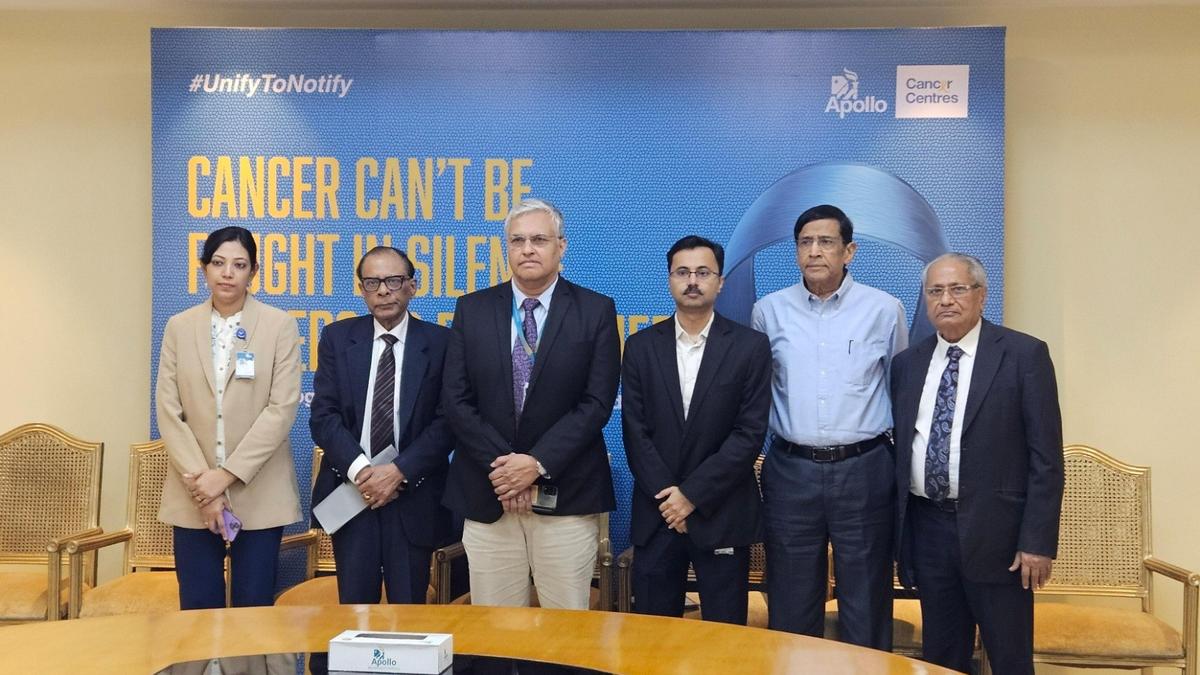
Make cancer a notifiable disease urge medical bodies and Indian Cancer Society on World Cancer Day
The Hindu
Indian medical organizations push for cancer to be classified as a notifiable disease in India for better detection and management.
The Indian Council of Medical Research (ICMR), the Indian Cancer Society, the Apollo Cancer Centres, and the Family Physician Associations started a campaign on World Cancer Day and urged the Government of India to classify cancer as a notifiable disease for better efficiency in cancer detection, management, and research.
The doctors of this nationwide campaign “Unify to Notify” believe that the initiative can help real-time data collection and accurate reporting to understand the gravity of the disease and its impact. It can also help in developing standardized treatment protocols through epidemiological analysis and targeted intervention strategy planning. They urged that this could put India in the global map of global oncology research and care and help to combat the disease with a holistic approach.
According to data shared by the National Centre for Biotechnology Information, the estimated number of incident cases of cancer in India for the year 2022 was found to be 14,61,427 and is estimated to increase by 12.8% in 2025 as compared to 2020.
Dr. Arunabha Sengupta, Honorary Secretary of Indian Cancer Society, Kolkata, said, “The Indian Cancer Society stands firmly with this initiative to make cancer a notifiable disease. This step will bridge the current gaps in our cancer surveillance system and enable better coordination between various healthcare providers.” He added that this can ensure that all cancer cases are reported and documented, and enable them to track cancer cases, mortality, and survival rates of patients.
“With proper documentation of every cancer case, we can better understand patterns, allocate resources efficiently, and develop targeted treatment protocols. At Apollo Cancer Centres, we have already established a robust cancer registry, which has enabled us to track cancer trends and outcomes,” Dr P. N. Mohapatra, Director Medical Oncology, Apollo Cancer Centre, Kolkata, said. He added that making cancer a notifiable disease can be a gamechanger and can be a transformative step towards revolutionising how the disease and its care is approached in India.
Multiple States in India including Haryana, Karnataka, Tripura, West Bengal, Punjab, among others have already made cancer a notifiable disease but it is not a countrywide affair to date.
According to a Parliamentary Standing Committee on Health and Family Welfare submitted a report to the Rajya Sabha in 2022, they recommended the “classification of cancer as a notifiable disease so that the cancer deaths are mandatorily required to be reported to the Government machinery.” Industry experts hoped that the Government of India will take the next step in passing the bill in both the Lower and Upper Houses of the Parliament in the Budget Session.


Pinarayi Vijayan criticizes Rahul Gandhi and Congress for allegedly aiding BJP's rise in various states during Kerala polls.

Sonia Gandhi is responding well to treatment for a systemic infection and remains under observation at a Delhi hospital.

J&K Police's Counter Intelligence Wing conducts raids in three districts linked to a transnational terror module operated by Lashkar-e-Taiba.

Vaccination policies must prioritize saving human lives over individual choice amid rising vaccine skepticism, asserts scientist Dr. Virander Singh Chauhan.

Seven Indian fishermen from Rameswaram arrested by Sri Lankan Navy, sparking protests and calls for government intervention.

Kerala cyber police file a case against X for an AI video allegedly defaming PM Modi and the Election Commission.

iKure and Izawa Co. partner to combat avoidable blindness by integrating innovative eye care technology into rural healthcare networks.

Thousand Lights MLA from the DMK N. Ezhilan, in an interview to The Hindu, observes that any popular personality entering politics will attract the limelight. But only a structured party machinery combined with popularity can ensure success. In this interview, he speaks about his tenure as first-time MLA from Thousand Lights Assembly constituency in Chennai, Vijay’s political entry shaping the 2026 elections, redressal of key grievances and more.

Abhishek Banerjee challenges BJP's Suvendu Adhikari in Nandigram, pledging community health initiatives if Trinamool Congress wins.

Rising LPG shortages in Karnataka boost firewood demand, reviving an informal market as households and hotels seek alternatives.

Against the backdrop of intense poll activity, a 400-metre stretch of an arterial road in the outskirts of Chennai (technically in Madurapakkam panchayat under Tambaram assembly constituency) presents a salute to the idea of res publica, which underpins India’s system of governance, where citizens have a say, at least before a government is securely ensconced in the seat of power. A Republic Day initiative shines bright every night

Fadnavis claims zero FIR in Ajit Pawar crash is a defamation attempt by Karnataka against Maharashtra's investigation efforts.

Set to unfold as a one-day pop-up on April 5, the Easter Sadya brings together both vegetarian and non-vegetarian menus, offering a peek into the food traditions of the Syrian Christian (Nasrani) community. While the traditional Sadya is often associated with dishes such as sambar, avial, and rice, this version expands to include community-specific festive dishes.