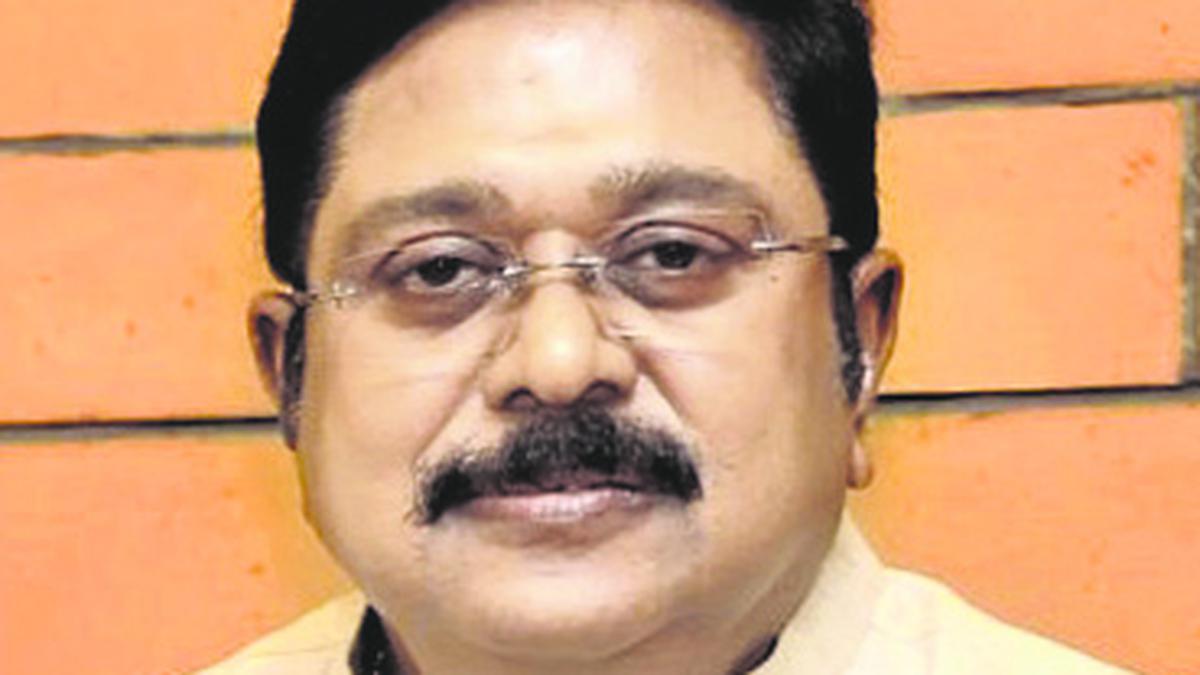
Madras High Court dismisses ED’s 18-year-old appeal against quashing of insolvency notice issued to Dhinakaran in 2001
The Hindu
Madras HC dismisses ED's 18-yr-old appeal against insolvency notice issued to AMMK leader T.T.V. Dhinakaran. Bench held debt, debtor & creditor terms capable of wider meaning & application in insolvency maintainable for non-payment of penalty. Left 4th question open.
The Madras High Court on Friday dismissed an appeal preferred by Enforcement Directorate in 2005 challenging a 2002 order of a single judge who had quashed an insolvency notice issued to Amma Makkal Munnetra Kazhagam (AMMK) leader T.T.V. Dhinakaran for not having paid penalty imposed in a Foreign Exchange Regulation Act (FERA) case.
A Division Bench of Justices R. Subramanian and R. Kalaimathi dismissed the original side appeal, pending for last 18 years, on the technical ground that the insolvency notice issued on March 1, 2001 under Section 9 (2) of the Presidency Towns Insolvency Act of 1909 was not valid since on that date the decree or order against Mr. Dhinakaran had not become final.
After the pronouncement of the verdict, when Additional Solicitor General AR.L. Sundaresan and ED Special Public Prosecutor Rajnish Pathiyil asked whether the ED could issue a fresh notice now since the proceedings had become final, the senior judge in the Bench stated that it goes without saying since the court had interfered with the 2001 notice on a limited ground.
Justice Subramanian told the lawyers that his Bench had framed five questions for determination in the appeal. They were: Whether the words ‘creditor, debt and debtor’ as defined under Sections 2(a) and 2(b) of the Presidency Towns Insolvency Act should be given a restricted conventional meaning or not.
Whether the term ‘decree or order’ appearing in Section 9(2) of the 1909 Act would mean only a decree or order of a civil court or would include any order for payment of money passed after an adjudicatory process? Whether the application filed by Mr. Dhinakaran, under Section 9(5), to set aside the insolvency notice on the grounds mentioned in it is maintainable?
Whether the ED is competent to initiate proceedings in insolvency for failure in payment of the penalty imposed? and whether Section 9(2) could be invoked before the decree or order becoming final? Answering the first two questions together, the Bench held that the terms ‘debt, debtor and creditor’ were capable of a wider meaning and therefore an application in insolvency was maintainable for non payment of penalty too.
Similarly, answering the third and fifth questions together, the Bench said, an application under Section 9(5) could be filed only on the grounds mentioned in the legal provision and not on other grounds.


The actor, along with director Shashant Shah, speak about their upcoming series ‘Chiraiya’, Divya’s process of working on the dialect, Sushant’s approach to telling a story about women, and more

Sri Lanka's Minister Bimal Rathnayake announces support for Indian refugees, urging political sensitivity from Tamil Nadu and India.

51 couples take thebig plunge at Udaipur mass wedding event

India shows significant progress in reducing child mortality, despite global slowdowns, highlights a new UN report on child health.

Puducherry's upcoming elections test the NDA's governance model amid opposition rifts and promises of stability and welfare delivery.

A Russian oil tanker diverts to India, boosting local refineries despite sanctions and geopolitical tensions.

Supreme Court questions if temple activities like book publishing and prasadam manufacturing qualify as industrial activities under current laws.

Ten of Kozhikode's 13 incumbent MLAs are seeking re-election, with no women candidates from CPI(M) in the upcoming polls.

Height restrictions near airports are stifling Bengaluru's growth, prompting calls for a review to boost development potential.

Explore the Gandhi Bunakar Mela in Vijayawada, showcasing traditional textiles and supporting handloom weavers until March 31.

MDMK leader Vaiko announces a movement to remove Prosopis juliflora trees in Tamil Nadu following a landmark High Court directive.

Lok Sabha Speaker Om Birla emphasizes the importance of Question Hour over meetings and urges decorum during obituary references.

Karnataka approves 300-bed Puttur Government Medical College Hospital project, enhancing healthcare in the coastal region.