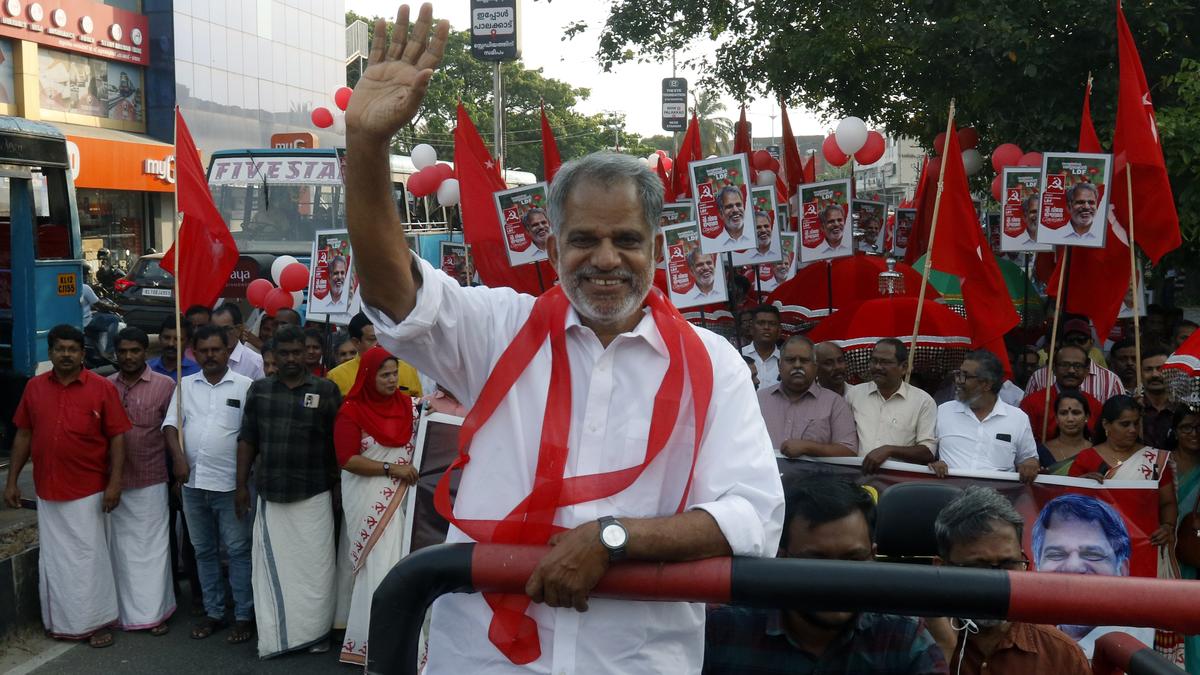
LDF fields heavyweight candidates to give political fight to Congress
The Hindu
Left Democratic Front (LDF) in Kerala gears up for Lok Sabha elections with heavyweight candidates challenging Congress dominance.
By pitching heavyweight candidates against the Congress in nearly all Lok Sabha constituencies, the Left Democratic Front (LDF), particularly the Communist Party of India (Marxist) [CPI-M], is unequivocally signalling that its alliance within the INDIA bloc holds little significance for the party in Kerala.
Even the Communist Party of India (CPI) has nominated one of its most formidable candidates, Annie Raja, in Wayanad possibly to take on Congress leader Rahul Gandhi. Ms. Raja is the general secretary of the National Federation of Indian Women and is also a member of the national executive of the CPI.
On all accounts, party sources said, the CPI(M) aims to fiercely contest in as many seats in the State as possible, bettering its performance in the 2014 elections. Back then, the CPI(M) notched up six seats, including the one secured by late actor Innocent, who contested as an Independent supported by the LDF. Among them, four MPs hailed from Malabar — P. Karunakaran (Kasaragod), P.K. Sreemathi (Kannur), M.B. Rajesh (Palakkad), and P.K. Biju (Alathur). The sixth seat was won by A. Sampath from Attingal in the south.
Out of the 20 seats, the CPI(M) is contesting 15, while the CPI is contesting four, with the remaining one allocated to the Kerala Congress (M). Except for Wayanad, Malappuram, Ernakulam, Kottayam, Kollam, and Thiruvananthapuram, all the other 14 seats are high-stakes battles for both the LDF and the UDF at the hustings, sources said.
The list of candidates indicates that the CPI(M) has shown no magnanimity towards accommodating the Congress party, which leads the national-level alliance aimed at unseating the ruling Bharatiya Janata Party (BJP). In Kasaragod and Kannur, the CPI(M) has nominated its district secretaries — M.V. Balakrishnan and M.V. Jayarajan — respectively. However, many party leaders believe that K.P. Satheesh Chandan, who was unsuccessful last time, would have been a better choice in Kasaragod.
Similarly, in Vadakara, the CPI(M) has fielded the popular leader often seen as Chief Minister material, K.K. Shailaja, to challenge K. Muraleedharan of the Congress. The party has chosen trade unionist and Rajya Sabha member Elamaram Kareem to take on the three-time MP, M.K. Raghavan, in Kozhikode.
Even in Ponnani, the party has selected K.S. Hamsa, former State secretary of the Indian Union Muslim League (IUML), with the objective of securing votes from a section of the Samastha Kerala Jamiyyathul Ulama. This move has been cited as one of the factors prompting the IUML to swap the seat of the national organising secretary, E.T. Mohammed Basheer, with M.P. Abdussamad Samadani, in the neighbouring Malappuram. Another factor is the IUML’s gradual decline in Ponnani, evident from the 2014 Lok Sabha elections and Assembly polls in 2021.


Pinarayi Vijayan criticizes Rahul Gandhi and Congress for allegedly aiding BJP's rise in various states during Kerala polls.

Sonia Gandhi is responding well to treatment for a systemic infection and remains under observation at a Delhi hospital.

J&K Police's Counter Intelligence Wing conducts raids in three districts linked to a transnational terror module operated by Lashkar-e-Taiba.

Vaccination policies must prioritize saving human lives over individual choice amid rising vaccine skepticism, asserts scientist Dr. Virander Singh Chauhan.

Seven Indian fishermen from Rameswaram arrested by Sri Lankan Navy, sparking protests and calls for government intervention.

Kerala cyber police file a case against X for an AI video allegedly defaming PM Modi and the Election Commission.

iKure and Izawa Co. partner to combat avoidable blindness by integrating innovative eye care technology into rural healthcare networks.

Thousand Lights MLA from the DMK N. Ezhilan, in an interview to The Hindu, observes that any popular personality entering politics will attract the limelight. But only a structured party machinery combined with popularity can ensure success. In this interview, he speaks about his tenure as first-time MLA from Thousand Lights Assembly constituency in Chennai, Vijay’s political entry shaping the 2026 elections, redressal of key grievances and more.

Abhishek Banerjee challenges BJP's Suvendu Adhikari in Nandigram, pledging community health initiatives if Trinamool Congress wins.

Rising LPG shortages in Karnataka boost firewood demand, reviving an informal market as households and hotels seek alternatives.

Against the backdrop of intense poll activity, a 400-metre stretch of an arterial road in the outskirts of Chennai (technically in Madurapakkam panchayat under Tambaram assembly constituency) presents a salute to the idea of res publica, which underpins India’s system of governance, where citizens have a say, at least before a government is securely ensconced in the seat of power. A Republic Day initiative shines bright every night

Fadnavis claims zero FIR in Ajit Pawar crash is a defamation attempt by Karnataka against Maharashtra's investigation efforts.

Set to unfold as a one-day pop-up on April 5, the Easter Sadya brings together both vegetarian and non-vegetarian menus, offering a peek into the food traditions of the Syrian Christian (Nasrani) community. While the traditional Sadya is often associated with dishes such as sambar, avial, and rice, this version expands to include community-specific festive dishes.