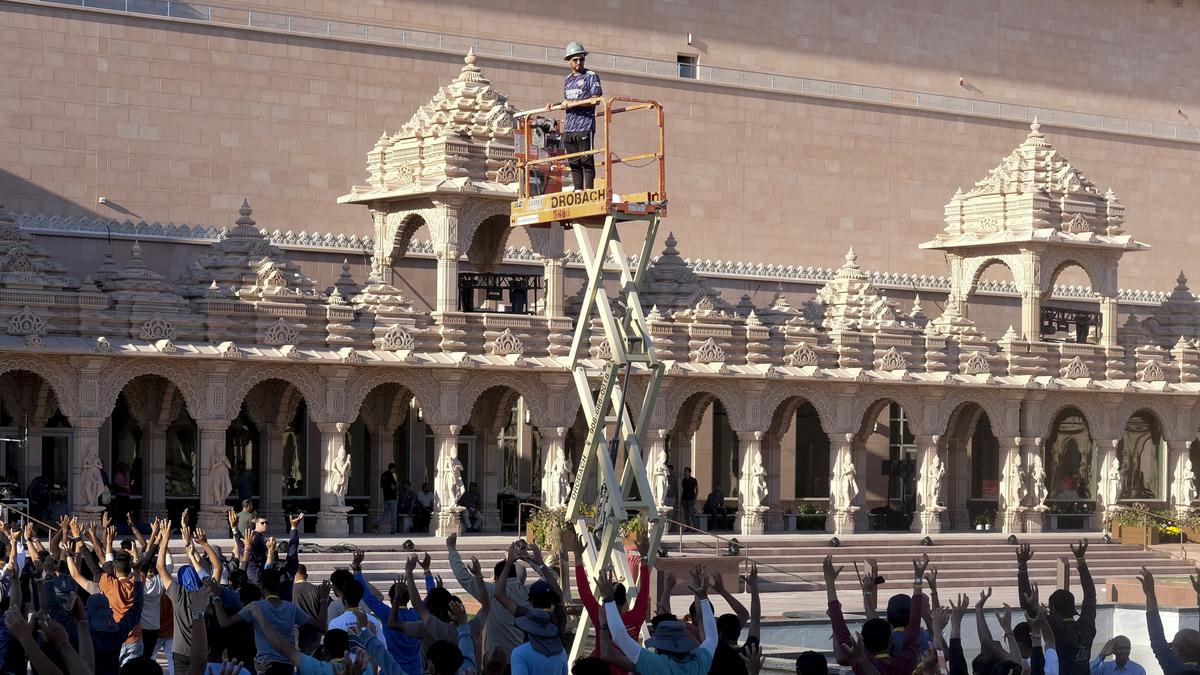
Largest Hindu temple outside India in the modern era opens in New Jersey
The Hindu
It took a combined total of about 4.7 million hours of work by artisans and volunteers to hand-carve about 2 million cubic feet of stone. The four varieties of marble from Italy and limestone from Bulgaria traveled first to India and then over 8,000 miles across the world to New Jersey.
If stones could talk, sing and tell stories, Yogi Trivedi believes the marble and limestone that adorn the spires, pillars and archways of the stunning Hindu temple in central New Jersey would compose a paean to the divine.
The tales these stones tell are those of seva (selfless service) and bhakti (devotion), which form the core of the Swaminarayan sect, a branch of Hinduism, said Mr. Trivedi, a scholar of Hinduism at Columbia University.
It took a combined total of about 4.7 million hours of work by artisans and volunteers to hand-carve about 2 million cubic feet of stone. The four varieties of marble from Italy and limestone from Bulgaria traveled first to India and then over 8,000 miles across the world to New Jersey.
They were then fitted together like a giant jigsaw to create what is now touted as the largest Hindu temple outside India to be built in the modern era, standing on a 126-acre tract. It will open to the public on Monday.
The largest temple complex in the world is the Ankgor Wat, originally constructed in the 12th century in Krong Siem Reap, Cambodia, and dedicated to the Hindu god Vishnu by King Suryavarman II. It is now described as a Hindu-Buddhist temple, and is one of 1,199 UNESCO World Heritage sites.
The Robbinsville temple is one of many built by the Bochasanwasi Shri Akshar Purushottam Swaminarayan Sanstha or BAPS, a worldwide religious and civic organization within the Swaminarayan sect.
“Service and devotion are the two basic elements that form the subtle foundation of how a temple so majestic gets built here in central New Jersey,” said Trivedi, who studies the Swaminarayan faith tradition and follows it.


Indonesian billionaire Michael Bambang Hartono, co-founder of Djarum Group, has died at 86, leaving a significant legacy.

European nations, Japan, and Canada unite to ensure safe passage through the Strait of Hormuz and stabilize energy markets.

Some of the estimated 20 billion yuan ($2.9 billion) worth of equipment, including screen-printing production lines, will require export approval from Chinese regulators, according to the people. It wasn't immediately clear how much of the equipment would require approval or how long it would take.

Three men, including a Super Micro VP, charged with smuggling U.S. AI technology to China, threatening national security.

Trump compares U.S. strikes on Iran to Pearl Harbor in meeting with Japan's PM, highlighting the element of surprise.

Iran-Israel war: Follow the latest updates from The Hindu on the West Asia conflict on March 20, 2026

The closure of the Strait of Hormuz disrupts a vital artery of the global economy, triggering price increases and turmoil in energy markets; as supply shocks reshape the geopolitics of energy, countries like India, the U.S., and Russia recalibrate strategies amid shifting oil flows and rising dependence

EU lawmakers advance U.S. trade deal legislation, overcoming delays and adding safeguards amid concerns over compliance from the Trump administration.

Pro-Iran Iraqi group pauses U.S. embassy attacks for five days, imposing conditions amid ongoing regional tensions and strikes.

Russia condemns the Israeli airstrike injuring RT journalists in Lebanon, calling it deliberate amid ongoing regional conflict.

Iran criticizes France's Macron for ignoring Israel-US attacks amid escalating West Asia conflict over shared gas fields.

China condemns killing of Iran's Larijani, urges halt to violence and calls for regional peace and humanitarian aid.

Iran executes three men from January protests amid rights concerns over coerced confessions and unfair trials.