Kerala on the cusp of transformation, says CM
The Hindu
Kerala's CM Pinarayi Vijayan emphasizes the state's transformative journey towards becoming a "Great Kerala" through self-reliance and progressive development.
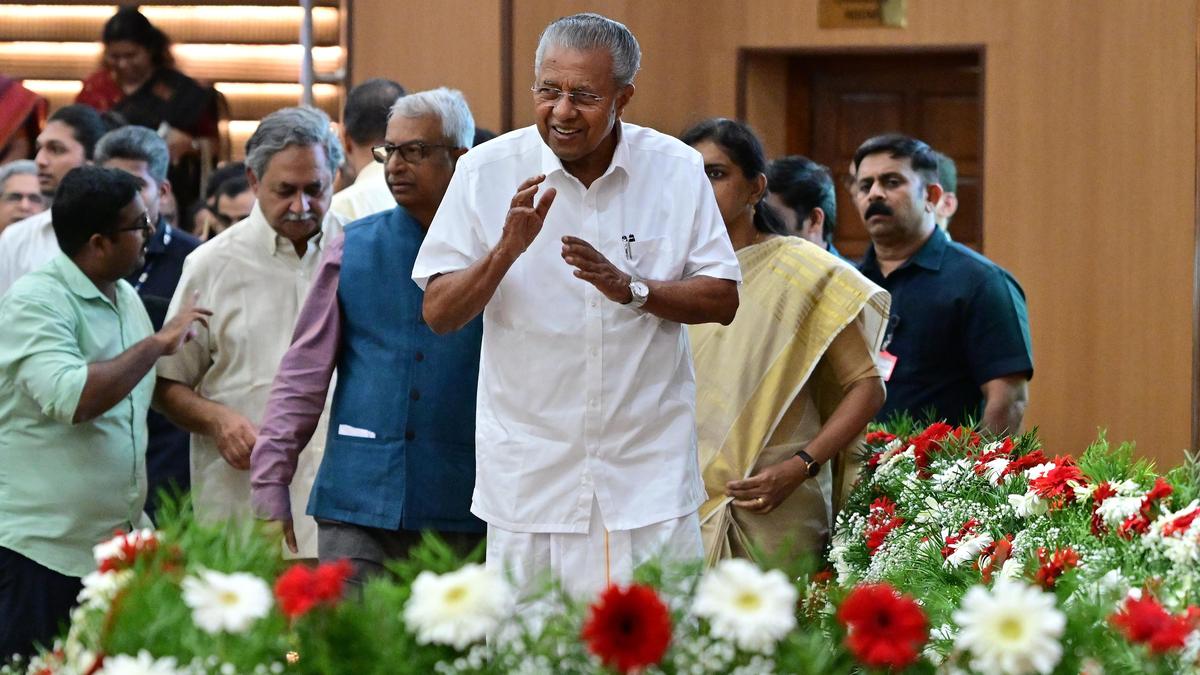
Kerala will not wait for anyone’s kindness, but it will move forward on its own strength by shaking off the mentality of a “small Kerala” and embracing the idea of a “Great Kerala,” Chief Minister Pinarayi Vijayan has said. He was speaking after inaugurating the fifth International Congress on Kerala Studies. The two-day congress, organised by the A.K.G. Study and Research Center, was held at A.K.G. Hall here on Saturday (February 21, 2026) and will serve as a guide for the developmental leap of future Kerala.
Stating that the study congress is a platform for constructive dialogue, he said the Communist movements, built on the social foundation laid by the renaissance movements, were the ones that steered Kerala forward with a progressive orientation. At every phase, the Communist movement guided Kerala by accepting what needed to be accepted, renewing what needed to be renewed, and leaving behind what needed to be left behind, he said.
The study congress is being organised at a time when the State is on the cusp of a new development trajectory. The experience of the last 10 years of continuous LDF (Left Democratic Front) governance, along with discussions on the way forward, is expected to forge a new direction. The last 10 years of rule are not merely an administrative phase in Kerala’s governance history, but a period that has laid a solid developmental foundation for the creation of Nava Kerala, he said.
“In 2016, when the Haritha Mission was formed, the general practice in household waste management was to dump waste indiscriminately, often by putting it in a bag and throwing it into someone else’s compound. By 2026, we have moved far beyond this practice and have set a new model for the country in waste management. However, much remains to be done in this sector. The ₹1.15 lakh crore allocation given to local self-government institutions played a pivotal role in eliminating this practice,” he said. “Prior to 2016, we had not anticipated that the State could be transformed into an investor-friendly destination. However, by amending around seven laws and ten rules, and by changing the public mindset, we achieved the feat of becoming the number one investment-friendly State in the country,” Mr. Vijayan said.
Many developed foreign countries do not follow the practice of providing bottled drinking water. Kerala, blessed with abundant natural water resources, can learn much from them. “The future of Kerala should not be limited to being merely a consumer State, but it should become a hub of human resources capable of creating world-class products and services and contributing to the global economy. To achieve this goal, we must have political will and social unity. Policies, programmes, and activities should be framed with this in mind, and the study congress is a major platform for this comprehensive process,” he said.
“Many flagship projects that brought transformative change to Kerala’s social sphere were not confined to the first five years of the LDF rule; rather, their continuation from 2021 onwards helped the State achieve significant progress. The secular fabric of Kerala, along with the decentralised development perspective envisioned by the State, played a major role in shaping Kerala. The State will not allow anyone to tamper with its secular credentials. Some may feel they were neglected, but the fact is that there is no part of the State where development did not reach in the last 10 years,” he added.


Udhayanidhi Stalin unveils fourth volume of Tamil-Indo-European etymological dictionary, highlighting Tamil's linguistic roots at Chennai seminar.

Kerala's CM Pinarayi Vijayan emphasizes the state's transformative journey towards becoming a "Great Kerala" through self-reliance and progressive development.

Navy Chief Admiral Tripathi emphasizes consensus-based joint maritime mechanisms in the Indian Ocean Region to enhance cooperation and capacity-building.

Rameswaram fishermen strike against Sri Lankan Navy arrests, demanding government action to address their livelihood and ongoing injustices.

20 years of Tamannaah: The actress speaks about her roles and new jewellery line

RTI activist Snehamayi Krishna arrested for circulating fake documents and audio clips to defame former MUDA commissioner G.B. Natesh.

Bengaluru police inspect 253 buses on Tumakuru Road to curb illegal narcotics transport, in a pre-dawn crackdown.

Mamata Banerjee emphasizes the equal respect for all languages on International Mother Language Day, pledging unity against linguistic attacks.

Two DMK functionaries were stabbed by a party worker in Dindigul; suspect apprehended, investigations ongoing.

T.N. CM Stalin inaugurates Pinnacle Infotech's engineering hub and housing project, enhancing Madurai's role in global engineering.

Home Minister Amit Shah asserts that Maoism will be eradicated from India by March 31, 2026, highlighting CRPF's pivotal role.

Telangana Prisons Department refutes claims of terror-linked meetings at Hyderabad's Central Jail

Kamal Haasan celebrates Tamil as his identity and essence on International Mother Language Day, emphasizing its deep cultural significance.