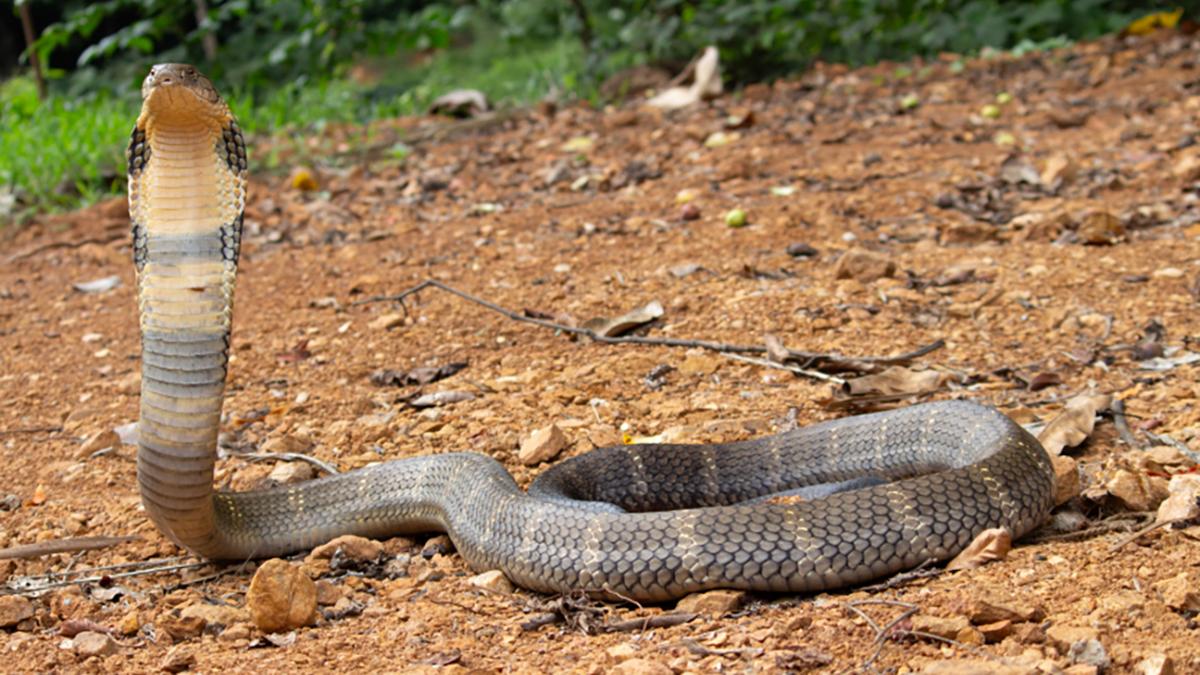
‘Kaalinga’ will be the scientific name for ‘Kalinga Sarpa’
The Hindu
Karnataka’s own king cobra found in the Western Ghats and known as ‘Kalinga Sarpa’ in the vernacular parlance will get its name ‘Kaalinga’ etched in the scientific world.
Karnataka’s own king cobra found in the Western Ghats and known as ‘Kalinga Sarpa’ in the vernacular parlance will get its name ‘Kaalinga’ etched in the scientific world.
A species that has inspired film and popular references in literature, the Western Ghat’s species will be officially named Ophiophagus Kaalinga.
Till recently, the king cobra whose habitat spreads across the South and South-east Asia was believed to belong to one species till a nearly decade-long research led by noted herpetologist, P. Gowri Shankar, brought to the fore four species of king cobra of which Kaalinga is one. It was in 1836 that a broad spectrum of king cobra species was named as Ophiophagus hannah by Danish naturalist, Theodore Edward Cantor.
After an extensive sampling across countries and DNA mapping among others, the king cobra species have been separated to be having four lineages — Western Ghats lineage, Indo-Chinese lineage, Indo-Malaysian lineage, and the lineage of Luzon Island in the Philippine Archipelago.
On November 22, the Western Ghats lineage ‘Kaalinga’ and Luzon Island lineage ‘Salvatana’ will be formally named in Bengaluru for these snakes that has often brought emotions ranging from reverence to fear.
“We found that the king cobra species in the Western Ghats was different from the others and hence the name. The rest of the king cobras found in India display characters of Ophiophagus hannah,” said Dr. Gowri Shankar, whose article naming king cobra as ‘Kaalinga’ appeared in the European Journal of Taxonomy in September this year.
“Since the time Cantor described king cobra, no one had taken up genetic work and for nearly 186 years it had remained as a single species. Genetic work on king cobra was taken up, more than 200 samples were used, and specimens from across the region were collected for the work,” Dr. Gowri Shankar said, speaking of his long research.


Congress leader K.C. Venugopal alleges corruption in Kerala's bar license renewals, accusing CPI(M) and BJP of unethical collusion ahead of 2026 polls.

Bengaluru police arrest three in a money-doubling fraud, recovering ₹40 lakh and uncovering additional victims.

AIADMK faces perception challenges and electoral setbacks in Tamil Nadu, struggling to maintain its traditional stronghold and voter base.

K. Ashok appointed Executive Director of BHEL Tiruchi, succeeding S. Prabhakar after 36 years of experience in the company.

Garbage collection resumes in Bengaluru amid contractor disputes over payment delays and new waste segregation rules by BSWML.

Delhi High Court rules universities cannot restrict peaceful expression of dissent, emphasizing the importance of independent thought and discourse.

Mettur Dam's water level is at 82.83 feet, with an inflow of 384 cusecs and discharge of 800 cusecs.

Lebanon expels Iran's ambassador, declaring him persona non grata, while maintaining a Charge d'Affaires at the embassy.

Sunny Joseph accuses Pinarayi Vijayan of targeting Rahul Gandhi as part of a political deal with the BJP.

AIADMK faces perception challenges and electoral setbacks in Tamil Nadu, struggling to maintain its traditional stronghold and voter base.

Sunny Joseph accuses Pinarayi Vijayan of targeting Rahul Gandhi as part of a political deal with the BJP.

Mahesh Dattani and Jonathan Taikina Taylor collaborate play, ‘The Monk & The Warrior’, to be staged at Mumbai’s Experimental Theatre from April 2 to 5

NHAI's rooftop solar plants on three toll plazas generate 521 daily units, saving 1.87 lakh conventional power units annually.