Jayalakshmi Vilas Mansion: Where the traditions of the Deccan come alive
The Hindu
Restoration of Jayalakshmi Vilas Mansion in Mysuru aims to transform it into a cultural landmark for diverse activities.
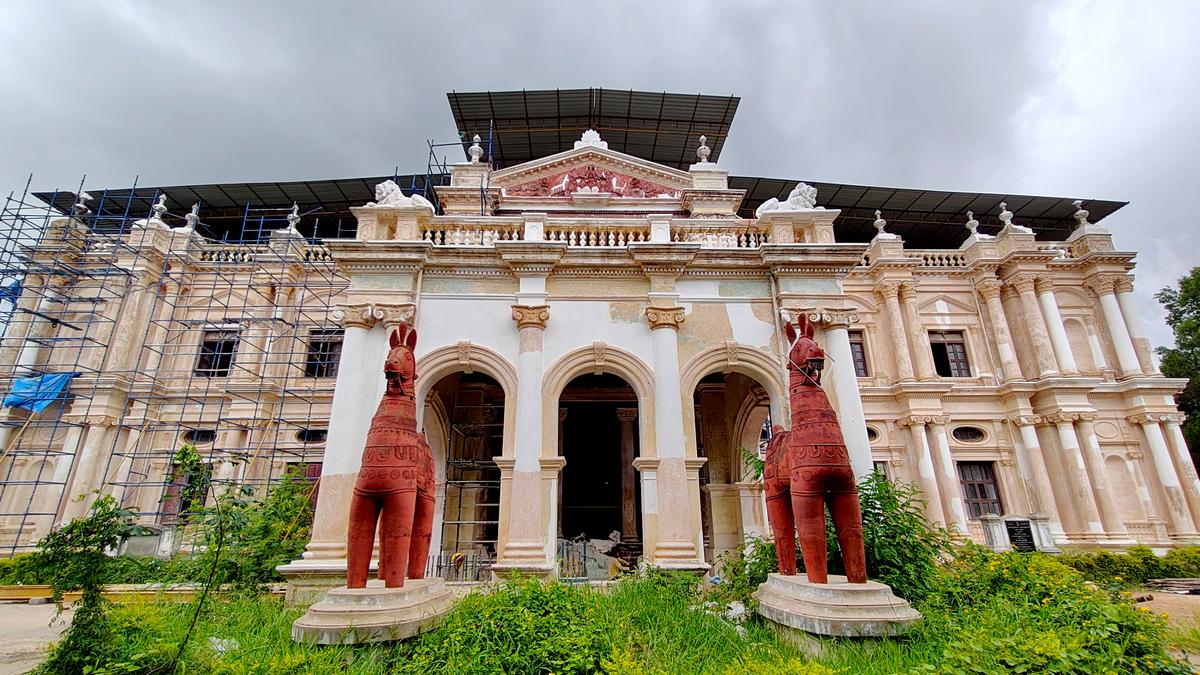
A tepid drizzle falls on the Jayalakshmi Vilas Mansion (JVM) in Mysuru, leaving behind silvery dribblets on piles of rubble, scaffolding and blue construction sheets covering vast sections of the lemon-hued edifice, currently under restoration. As soon as one enters the mansion, what strikes one almost immediately is the many years of neglect writ large across it. Yet vestiges of past glory still linger in this 120-year-old, former royal residence with its Roman columns, stained glass dome, ornate balconies, pressed-metal ceiling tiles, elaborately carved wooden pillars and Italian marble flooring, a testament to the eclectic architectural style so typical of Mysuru’s Wadiyar dynasty.
“Historically, Mysuru was one of the most prosperous regions in the Deccan, reflecting the rich, layered cultures of southern India — from early historic times to the modern era. The Jayalakshmi Vilas Mansion itself, with its four wings, is an architectural testament to transcultural and transhistorical influences,” says Dr. Helen Philon, co-founder of the Deccan Heritage Foundation India (DHFI), which is currently in the process of restoring this architecturally diverse building.
The restoration, which is being supported by the Harish and Bina Shah Foundation (HBSF) and the U.S. Ambassador’s Fund for Cultural Preservation (AFCP), doesn’t just stop at restoring the structural integrity and former glory of this building, which has served multiple purposes over its lifetime, including royal family residence, academic hub and finally a folklore museum housing thousands of anthropological and ethnographic artefacts sourced from across Karnataka. It also seeks to transform it into a cultural landmark of sorts that “will attract not only Mysoreans but also Bangaloreans, Deccanis, visitors from across India, and an international audience eager to attend its musical, dance, and other performance events, exhibitions, and culinary experiences celebrating the harmonious co-existence of its Deccani cultures,” says Dr. Philon.
In 1897, Maharajakumari Jayalakshammanni, the eldest daughter of Chamaraja Wadiyar X and Maharani Vani Vilasa Sannidhana, was married to her mother’s brother, Sir Kantharaj Urs. But during the wedding, the old wooden Mysore palace was destroyed in a fire, and so, her mother (who became the regent queen following the untimely death of her husband in 1894) commissioned British architect Henry Irwin to build a new palace that very same year, the oft-visited Amba Vilas Palace.
While the new Mysuru palace was being constructed, another palace, the JVM, was also built as a wedding gift to the princess. Pointing to one of the many wooden pillars inside the north wing of the mansion, Malavika Murthy, Project Coordinator, JVM Project, says, “Very interestingly, a lot of elements of construction you see here in JVM are patterns developed for the Mysore palace. The column design here is the same design you see on the cast iron columns in the marriage pavilion of the Mysore palace.”
Work on the JVM started around 1900, and the completed building was inaugurated a few years later. “Some records say 1905, some say 1907,” says Malavika. Archival research points to Sir Kantharaj and his family dividing their time between Mysuru and Bengaluru – he was appointed as the Dewan in 1918. “So what we understand is that the building was not used a lot during the initial years of its construction,” she explains. “It was mainly used by their daughter and her family afterwards.”
The family lived here until the death of Princess Leelavathi in 1954, after which, in 1959, the Mansion, along with 300 acres, was sold to the University of Mysore at a “nominal rate” when “Kuvempu (K.V. Puttappa) was its vice-chancellor.” Back then, the university was mainly functioning at the Maharaja’s College, so once they bought the land and the building, they suddenly had much more space to expand. “He started the Manasagangotri from this building,” she says. “This was the genesis of many master’s programmes in Mysore University.”


The government plans to amend the FCRA, introducing new regulations for NGO asset management and accountability for key functionaries.

The draft policy for “Responsible Digital Use Among Students”, released on Monday by the Department of Health and Family Welfare, has recommended that parents set structured routines with clear screen-time rules and prioritise privacy, safety, and open conversation with children on digital well-being.

Police Observer Sushant Kumar Saxena conducts surprise inspection at Shencottai police station, reviewing warrants and security arrangements ahead of elections.

Andhra Pradesh government to launch key projects in April, focusing on industrial growth and infrastructure development, says Nara Lokesh.

Lok Sabha refers the Corporate Laws (Amendment) Bill to a JPC amid opposition concerns over CSR provisions dilution.

SHG members in Kanniyakumari use snakes and ladders to raise election awareness and boost voter turnout.

Government accelerates consultations for early implementation of the Women’s Reservation Act to ensure women’s representation in 2029 elections.

CM A. Revanth Reddy distributes ₹1 crore insurance cheques to families of deceased Electricity department employees, enhancing financial security for workers.

The Bengaluru Traffic Police (BTP) registered 634 cases of drunk driving during a week-long special enforcement drive conducted across the city between March 16 and March 22.

GHMC intensifies action against property tax defaulters, seizing properties and offering a One Time Settlement scheme for payments.

CCB arrests three drug peddlers in Mangaluru, seizing ₹2.5 lakh worth of MDMA and other valuables.

TVK's 28 candidates in Puducherry include former BJP MLAs, a sitting Independent, and a retired police IG.

BRS submits notice on private member bill to Speaker