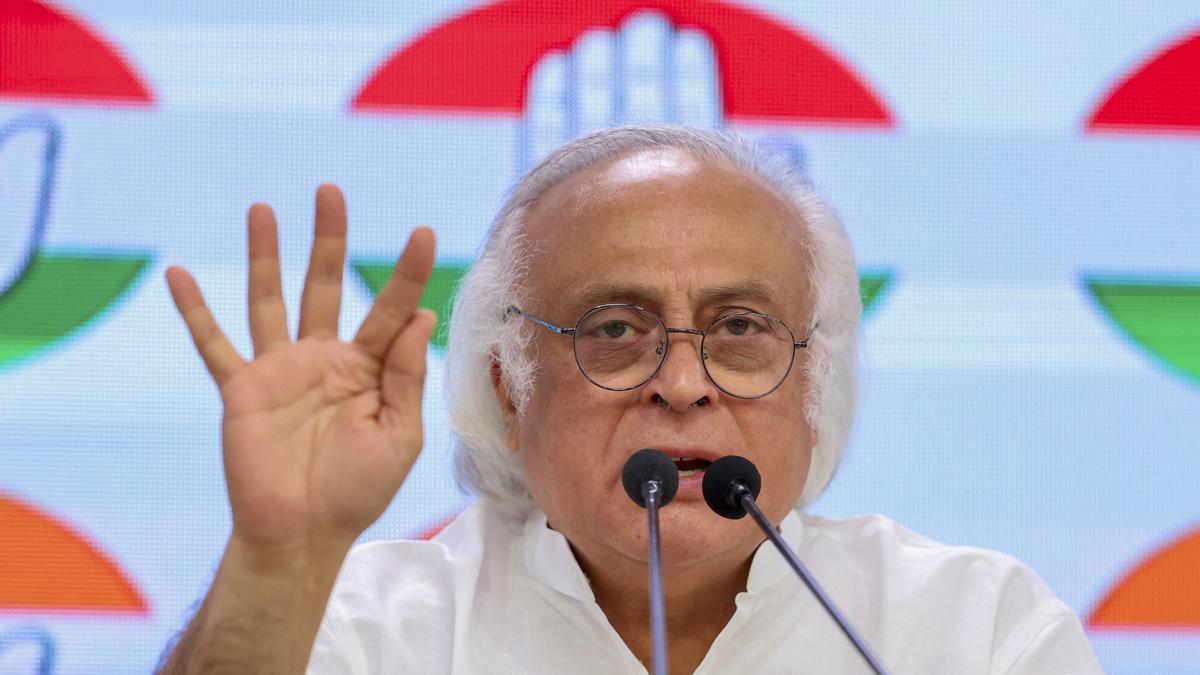
Jairam Ramesh says no reason to celebrate increased women participation in workforce, highights wage fall and job quality deterioration
The Hindu
Jairam Ramesh criticises Modi Government for misleading increase in women's LFPR, highlighting rural distress and declining wages.
Accusing the Narendra Modi Government of ignoring the fine print of the women’s Labour Force Participation Ratio (LFPR), which as per the government’s statement from last month, increased from 27% in 2017-18 to 41.7% in 2023-24, Congress general secretary (communications) Jairam Ramesh pointed out that 84% of this increase is actually in case of self-employed women many of who are engaged in unpaid family work.
The data, he said, reveals that the women entering the workforce as either salaried workers or self-employed are earning less today than they did six years ago.
What is the outlook on women’s employment? | Explained
The increase in women’s LFPR, he said, on a closer look reveals that it is primarily driven by rural women, whose entry into the labour force is driven by “economic distress”. He further pointed out that the proportion of rural women engaged in self-employment has jumped sharply from 57.7% (2017-18) to 73.5% (2023-24), and in case of urban women it has gone from 34.8% (2017-18) to 42.3% (2023-24). Unpaid family work by rural and urban women has risen from 31.7% (2017-18) to 36.7% (2023-24). 84% of the increase in the total women’s LFPR between 2017-18 and 2023-24 is accounted for by self-employment, which includes unpaid family work.
“Any modernising economy undergoes structural transformation as workers move from low-paying agricultural jobs to better prospects in manufacturing and service industries. This has tragically been reversed over the past decade,” Mr. Ramesh said.
The proportion of rural women working in agriculture has increased from 73.2% (2017-18) to 76.9% (2023-24), and remains above what it was even during the pandemic. Meanwhile the share of jobs in the modern services sector (health, education, IT etc.) for women has declined since 2021.
Underlining why the data is not promising, he also pointed out that there has been a significant dip in women’s income. “The final piece of this dismal picture is wages. After adjusting for inflation, the real average monthly wage of self-employed women plummeted by ₹3,073 between 2017-18 and 2023-24, a drop of 35%. The real wage of salaried female workers fell by ₹1,342, or a drop of 7%, over the same period,” he said.


Union Minister Ashwini Vaishnaw launches three initiatives to enhance India's creative economy through AI training, citizen platforms, and advanced tech access.

Two Indian-flagged LPG tankers approach the Strait of Hormuz, navigating safely amidst regional tensions to reach Indian ports.

Gold and silver prices plummet over 7% due to West Asia tensions, inflation fears, and a stronger dollar.

Asian shares fall as rising oil prices and escalating Iran conflict diminish hopes for U.S. interest rate cuts.

Japan's SoftBank Group said Saturday it plans to build a huge new gas-fired power plant in the US state of Ohio

Silver prices plunge 9% to ₹2.06 lakh per kg in futures trade amid weak global cues and rising macroeconomic pressures.

OpenAI plans to nearly double its workforce to 8,000 from 4,500 by the end of 2026, the Financial Times reported on Saturday, citing two people with knowledge

Global equity markets plummet as West Asia tensions rise and oil prices surge, triggering significant investor anxiety.

The rupee hits a record low of 93.94 against the dollar amid foreign fund outflows and a crashing equity market.

The Thane police have arrested two co-founders of cryptocurrency exchange platform CoinDCX in connection with an alleged fraud of Rs 71.6 lakh, officials said

Meta Chief Executive Mark Zuckerberg is building a CEO agent to help him do his job, the Wall Street Journal reported

Insurance penetration and density are often misunderstood and do not reveal how many families are insured or whether they would be financially secure if the main earning member were to die. The real issue is not reach but adequacy, as households may have life insurance but not enough cover to replace lost income, leaving them financially vulnerable.

Five top firms lose ₹1 lakh crore in market value, with HDFC Bank experiencing the largest decline of ₹56,124.48 crore.