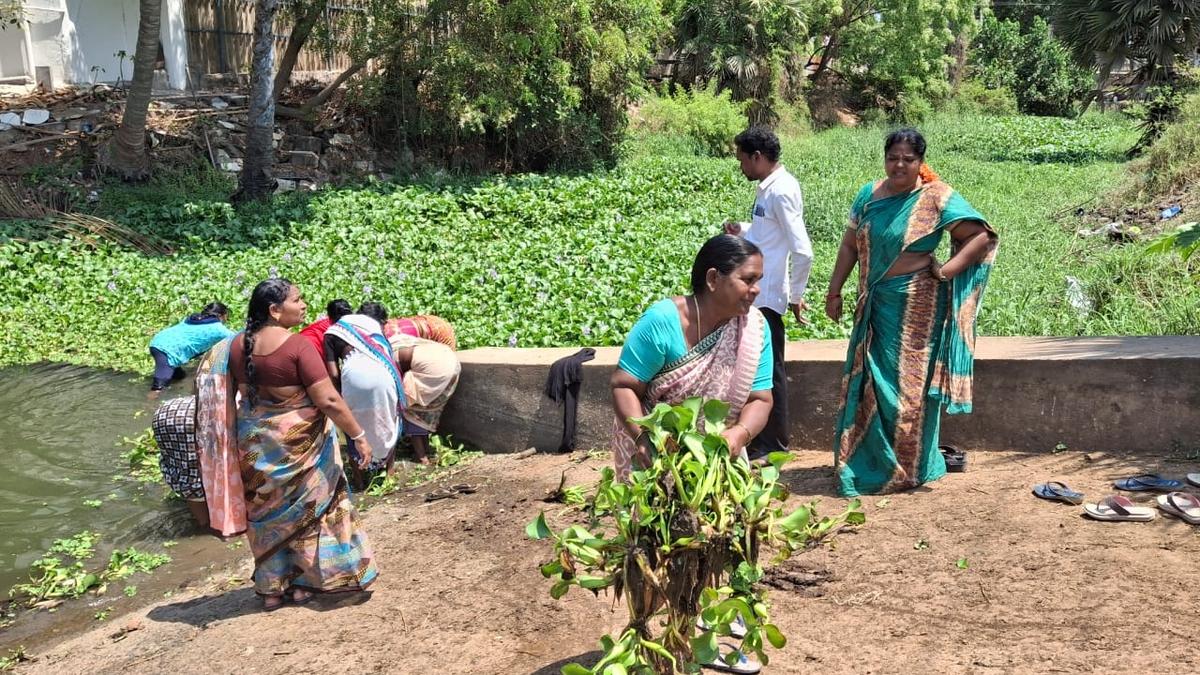
Invasive water hyacinth turned into organic manure in West Godavari
The Hindu
West Godavari district converts water hyacinth into organic manure, solving ecological issues and creating economic opportunities.
In a pioneering initiative, the West Godavari district administration is successfully converting the invasive water hyacinth (Eichhornia crassipes) into organic manure, thus turning a major ecological problem into an economic opportunity.
District Collector Chadalavada Naga Rani stated that the pilot project, launched in collaboration with women’s Self-Help Groups (SHGs), has shown promising results.
Speaking to The Hindu on Thursday, Ms. Naga Rani explained that the initiative was tested at three locations—Siddapuram village in Akiveedu mandal, Gollavanithippa in Bhimavaram mandal, and the Krishi Vigyan Kendra (KVK) in Undi. The pilot experiments used existing infrastructure, making the project cost-effective.
She noted that the composting process costs around ₹3,500 per batch but generates an income of ₹10,000, making it economically viable. “Each compost pit can produce manure five times a year, significantly enhancing agricultural productivity,” she said.
The compost pits, measuring 6-7 feet in length, 3 feet in width, and 2.5 feet in depth, were filled with chopped water hyacinth and cow dung in a 2:1 ratio, layered for decomposition. After 21 days, microbial culture was introduced to accelerate the process, and within 7-8 weeks, the compost matured, turning black with a fibrous texture and an earthy smell. The pilot project yielded one metric tonne of compost from three pits.
Water hyacinth has long been a menace in irrigation canals, obstructing water flow and damaging agriculture, aquaculture, and drinking water sources. The dense aquatic weed depletes oxygen levels, leading to fish mortality and mosquito breeding, which increases the risk of malaria and dengue.
By converting this weed into nutrient-rich compost, the district administration is not only addressing an environmental challenge but also providing a sustainable resource for aquaculture, agriculture, and horticulture. The compost is rich in macronutrients, organic carbon, and essential micronutrients like zinc, iron, and copper, making it highly beneficial for soil enrichment, she explained.


The actor, along with director Shashant Shah, speak about their upcoming series ‘Chiraiya’, Divya’s process of working on the dialect, Sushant’s approach to telling a story about women, and more

Sri Lanka's Minister Bimal Rathnayake announces support for Indian refugees, urging political sensitivity from Tamil Nadu and India.

51 couples take thebig plunge at Udaipur mass wedding event

India shows significant progress in reducing child mortality, despite global slowdowns, highlights a new UN report on child health.

Puducherry's upcoming elections test the NDA's governance model amid opposition rifts and promises of stability and welfare delivery.

A Russian oil tanker diverts to India, boosting local refineries despite sanctions and geopolitical tensions.

Supreme Court questions if temple activities like book publishing and prasadam manufacturing qualify as industrial activities under current laws.

Ten of Kozhikode's 13 incumbent MLAs are seeking re-election, with no women candidates from CPI(M) in the upcoming polls.

Height restrictions near airports are stifling Bengaluru's growth, prompting calls for a review to boost development potential.

Explore the Gandhi Bunakar Mela in Vijayawada, showcasing traditional textiles and supporting handloom weavers until March 31.

MDMK leader Vaiko announces a movement to remove Prosopis juliflora trees in Tamil Nadu following a landmark High Court directive.

Lok Sabha Speaker Om Birla emphasizes the importance of Question Hour over meetings and urges decorum during obituary references.

Karnataka approves 300-bed Puttur Government Medical College Hospital project, enhancing healthcare in the coastal region.