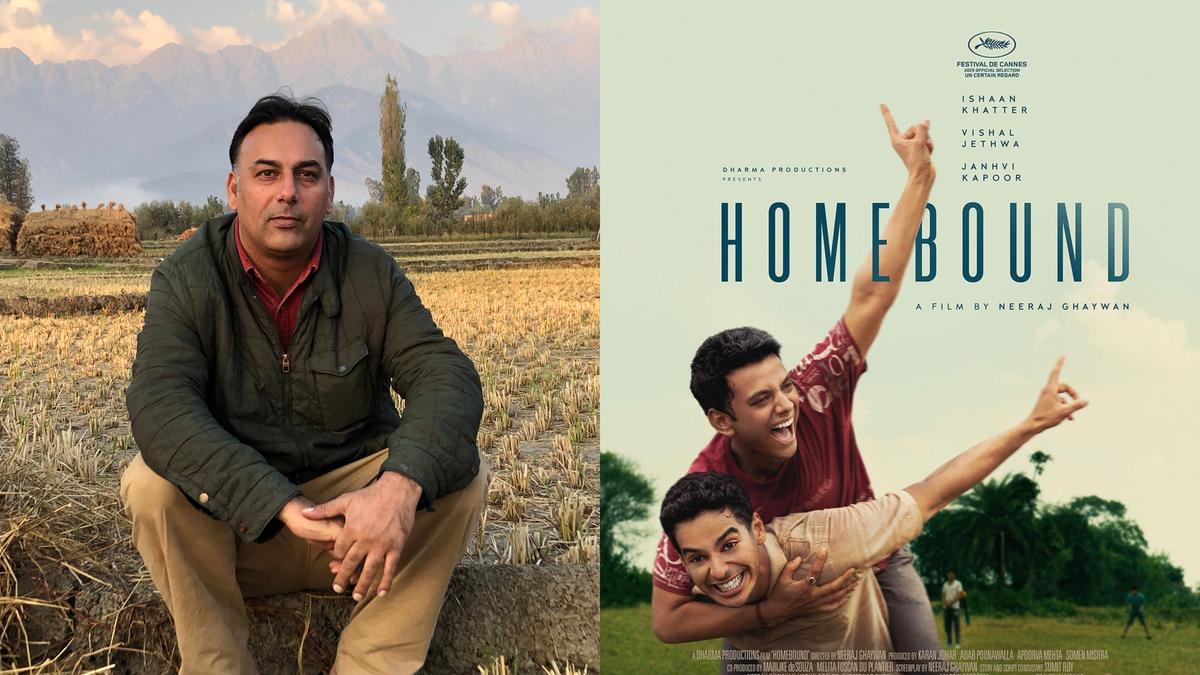
Interview | Basharat Peer on the story that became ‘Homebound’
The Hindu
As Neeraj Ghaywan’s ‘Homebound’ evokes global interest, writer Basharat Peer takes us to the origins of the moving tale of friendship and upholding human dignity in the face of tragedy
Basharat Peer was in Delhi on the evening of March 24, 2020, when Prime Minister Narendra Modi addressed the country on television and announced a countrywide, complete lockdown. “Four hours later, nobody would be allowed to step outside his or her home,” Peer writes in an e-mail conversation, reliving the urgency of the period. At the time, Peer was working as an International Opinion Editor for The New York Times. The COVID-19 pandemic was the most significant global story, and he was commissioning and editing essays about it from Asia, the Middle East, and Africa—the regions he was responsible for.
One day in mid-May, he came across a grainy photograph on Twitter (now X) of Mohammad Saiyub, a Muslim, and Amrit Kumar, a Hindu, sitting on a patch of burned earth by the side of a highway in the central Indian state of Madhya Pradesh. “In the punishing May heat, Saiyub cradled Amrit, his friend, who had collapsed from heatstroke. They were trying to reach their village in Basti district of Uttar Pradesh, which was around 1500 kilometres from Surat in Gujarat, where they worked in textile factories,” says Peer.
This was the time, he remembers, when the factories and businesses shuttered, millions of workers who had left their villages in “de-industrialised northern and central India for cities in the industrialised western, and increasingly, southern India” started running out of food and money. It was also a time when, he underlines, for several weeks, news channels and social media networks were “flooded with the hashtag, #CoronaJihad.” “The utter disregard for the lives of the poor increased the feeling of despondency,” notes Peer.
In this backdrop, when he followed the story behind the photograph, the bond between Saiyub and Amrit emerged as a symbol of hope amidst the socio-political fault lines that the deadly virus exposed. This past week, the poignant story found screen life as Neeraj Ghaywan’s Homebound was showcased at Cannes, tearing up a global audience.
Peer is not new to this cross-breeding of fact and fiction. A decade ago, his much-acclaimed memoir, Curfewed Night, which chronicles the alienation of the youth of Kashmir, took the shape of Haider under the direction of Vishal Bhardwaj.
More than a year after the story of Saiyub and Amrit was published in the newspaper, Peer was in Mumbai and met Somen Mishra, a journalist who veered towards films and now heads creative development at Dharma Productions. “I introduced him and his colleagues to The NYT people, and Dharma bought the rights. Somen told me he would bring Neeraj Ghaywan on board to direct the film. I met Neeraj, and we had a lengthy conversation. I was quite certain he had the right sensibility and would adapt it beautifully. And he did.”
Excerpts from an interview:


Vijay Deverakonda and Rashmika Mandanna star in the epic Telugu film 'Ranabaali,' releasing on September 11, 2026.

Ace director Lokesh Kanagaraj has spoken about the future of LCU, how ‘AA23’ happened, what criticisms on ‘Coolie’ taught him, exiting the much-awaited Rajinikanth-Kamal Haasan project and debuting as an actor in Arun Matheswaran’s ‘DC’

Filmmaker Lokesh Kanagaraj confirmed that he has a cameo in superstar Vijay’s much-awaited final film, Jana Nayagan.

Ravi Teja’s next film with director Shiva Nirvana has been titled Irumadi, the Telugu superstar made the announcement today (January 26, 2026) on his birthday

Written and directed by Sooriyaprathap S, ‘Root’ marks Aparshakti Khurana's Tamil debut

Mammootty and Mohanlal's Patriot finally has a release date. Directed by Mahesh Narayanan the film also stars Fahadh Faasil, Kunchacko Boban, Nayanthara and Darshana Rajendran

A double bill performance Your Symptoms, and Flight, will premiere in Bengaluru on January 25

A commemorative lec-dem by Madurai T.N. Seshagopalan in Chennai revisited the enduring musical legacy of Harikesanallur Muthiah Bhagavatar

The release date of Shah Rukh Khan's King, directed by Siddharth Anand and also starring Deepika Padukone, was unveiled on Saturday

Hamstrung by pacing and VFX issues, Anurag Singh’s standalone sequel to J.P. Dutta’s Border is affecting but predictable and generic in parts.

Yamaha launches India-focussed keyboards with riyaz mode and Carnatic music

Karsh kale will showcase a good chunk of "Dust' at his performance at Lollapalooza in Mumbai on January 24 and 25.

At the Red Lorry Film Festival 2026, over 120 titles will be screened including the India premiere of Bradley Cooper’s directorial ‘Is This Thing On?’