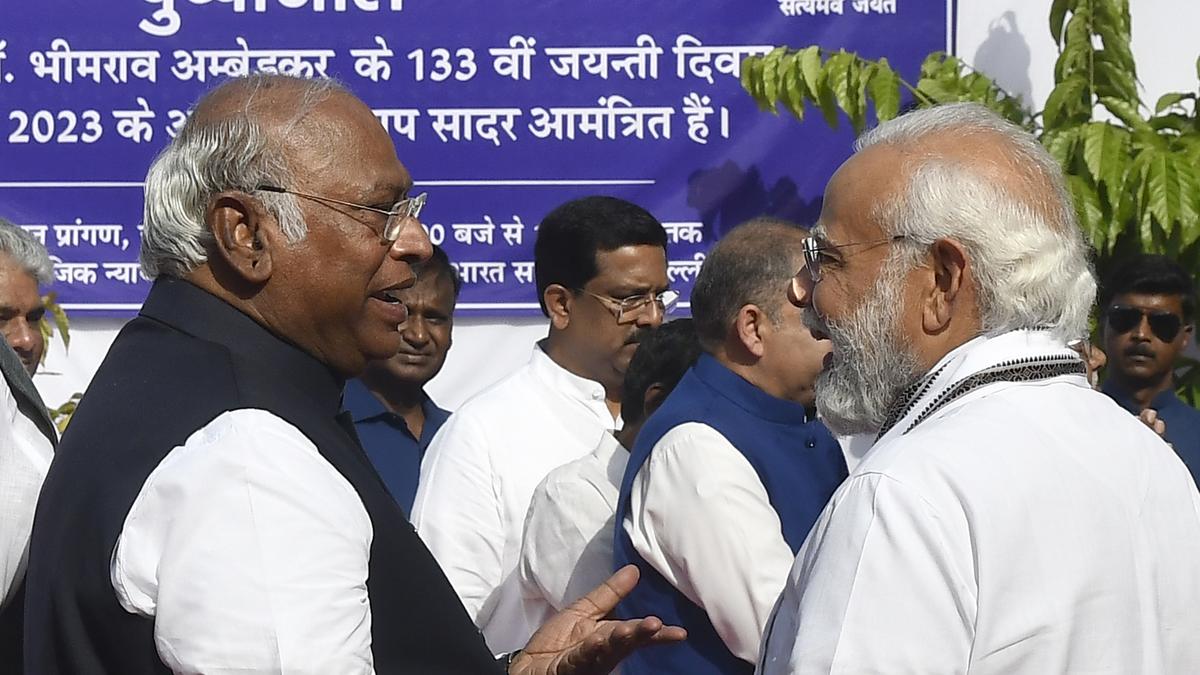
Initiate process of electing Lok Sabha deputy Speaker: Mallikarjun Kharge to PM Modi
The Hindu
Congress president urges PM Modi to elect deputy Speaker of Lok Sabha, citing violation of Constitution and democratic principles.
Congress president Mallikarjun Kharge on Tuesday (June 10, 2025) wrote to Prime Minister Narendra Modi, urging him to initiate the process of electing a deputy Speaker of the Lok Sabha.
Keeping the position vacant "does not augur well for India's democratic polity and is also in violation of well laid out provisions of the Constitution," the Congress chief said.
"Dear Prime Minister, I am writing to bring to your kind attention the highly concerning matter in regard to the prevailing vis-Ã -vis the vacancy of the deputy speaker in the Lok Sabha.
"Article 93 of the Constitution of India mandates the election of both the speaker and the deputy speaker of the House of the People. Constitutionally, the deputy speaker is the second-highest presiding officer of the House after the speaker," he said.
Mr. Kharge said traditionally, the deputy Speaker has been elected in the second or third session of a newly constituted Lok Sabha.
The procedure for this election mirrors that of the speaker, with the only distinction being that the date for the deputy speaker's election is fixed by the speaker, as per Rule 8(1) of the Rules of Procedure and Conduct of Business in Lok Sabha, he noted.
In his letter to the Prime Minister, Mr. Kharge noted that from the first to the sixteenth Lok Sabha, every House has had a deputy speaker.


Shorts News:‘Over 2.44 lakh Indians returned from Gulf so far’

Oppo on Tuesday launched the new K series smartphone in India for the mid segment buyers, the new Oppo K15 5G, featuring IP66, IP68 and IP69 ratings for dust, water immersion, and high-pressure hot water jets resistance

NCTP members oppose amendments to the Transgender Persons Act, citing lack of consultation and potential harm to transgender rights.

AIADMK MP C.Ve. Shanmugam faces backlash for derogatory comments about a female actor during an NDA protest in Villupuram.

Urea shortage disrupts farming in Tiruchi as demand spikes during critical sowing period, affecting supply at private outlets.

While granting bail to the tantri in February, the Vigilance Court had observed that the SIT failed to produce substantive evidence to support the allegations levelled against him

Gujarat's panel submits UCC report to CM Patel, paving the way for a draft bill in the ongoing Budget session.

Edappadi Palaniswami criticises the DMK government for failing to file an FIR on cash-for-jobs allegations, seeking High Court intervention.

Cookbook author Sabita Radhakrishna gives us tips on utilizing smart kitchen gadgets you probably already own to make easy meals without using LPG, from an induction stove to her trusty instant pot

Madras High Court postpones PMK intra-party dispute hearing until after Tamil Nadu and Puducherry elections conclude, on May 10.

TMC to contest 291 seats in Bengal polls, confident of winning over 226, announces Mamata Banerjee amid fierce competition.

Legendary screenwriter Salim Khan, the creative mind behind Bollywood classics like ‘Sholay’ and ‘Deewar’, is back home after a health scare that had fans worried

Election Commission deploys observers for Tamil Nadu Assembly poll to ensure free and fair elections in 234 constituencies.