In Iran, Trump faces the limits of American power | Analysis
The Hindu
Trump's Iran strategy reveals the limits of U.S. power, as Tehran emerges stronger amid failed military objectives and renewed diplomacy.
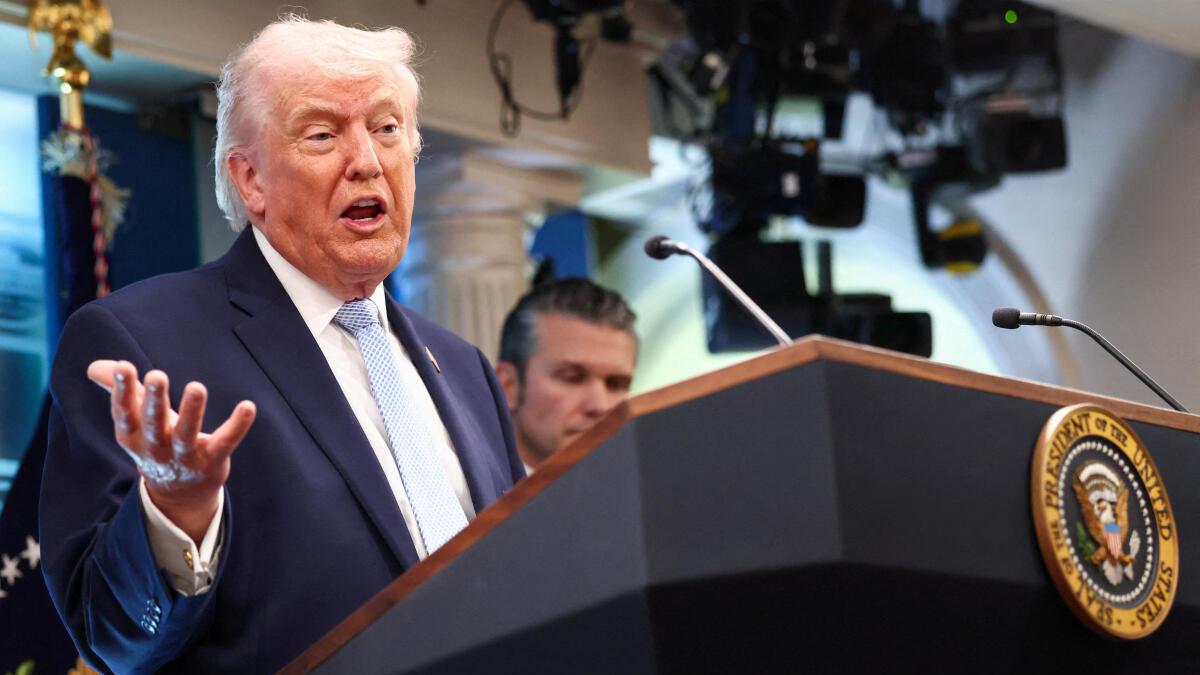
“There will be no deal with Iran except UNCONDITIONAL SURRENDER!,” U.S. President Donald Trump said on March 6, the seventh day of the war. “After that, and the selection of a GREAT & ACCEPTABLE Leader(s)..., we will work tirelessly to bring Iran back from the brink of destruction,” he said. On April 8, on the 40th day of the war, Mr. Trump announced a two-week ceasefire, hours after he threatened to erase the Iranian civilisation if Tehran did not accept his deal.
Mr. Trump announced not only a pause on his threatened strikes on Iran’s civilian infrastructure but a full ceasefire, and agreed to treat the Iranian proposal as “a workable basis” for future talks. Iran said it would honour the ceasefire and ensure “safe passage” of vessels through the Strait of Hormuz “in coordination with its forces”.
While it is too early to conclude whether the ceasefire would hold or it would lead to a lasting peace agreement, one thing is clear — the U.S.-Israeli war on Iran has not just failed to achieve its declared objectives but also reinforced Iran’s standing as a major regional power in West Asia, particularly in the Persian Gulf. When he launched the war on February 28, Mr. Trump outlined five broad objectives: to “raze” Iran’s missile industry “to the ground”; to “annihilate” Iran’s Navy; to ensure that Iran’s “proxies” could no longer “destabilise” the region; to prevent Iran from ever obtaining a nuclear weapon; and to bring about regime change. None of this has been met. Forty days later, however, his biggest demand was one that was not part of his original set of objectives — reopen the Strait of Hormuz.
Iran’s three moves
Iran got pounded over the past 40 days. It lost several top leaders, including Supreme Leader Ali Khamenei, Defence Council chief Ali Shamkhani and Security Council chief Ali Larijani. Its manufacturing facilities, petrochemical complexes, gas fields, oil depots, rail tracks, universities and even bridges were bombed. The damage is a major setback for an economy already in crisis.
But Iran made three moves that allowed it to play what Trita Parsi, of the Quincy Institute, calls the “longer game”. First, it ensured that decapitation would not affect the coherence of the state or its ability to fight back — a strategy likely put in place after the June 2025 war when Israel killed multiple Iranian military leaders. second, Iran immediately regionalised the conflict by attacking American bases in the Persian Gulf. The accuracy and lethality of these strikes suggest that Tehran had prepared for this moment. As Vali Nasr, of Johns Hopkins University, told The Hindu, Iran turned the entire Persian Gulf into a battlefield. Third, by taking control of the Strait of Hormuz, Iran dragged the global economy into the war launched by the U.S. and Israel.


Trump warns that failure to meet U.S. demands could lead to catastrophic consequences for Iran and its civilisation.

Explore Ukraine's strategic attacks on Russian refineries amid a global oil crisis to disrupt Moscow's war funding and economy.

Gunmen attacked the Israeli Consulate in Istanbul, resulting in a police clash; no diplomats were present amid security concerns.

Cameroon confirms 16 nationals died fighting for Russia in Ukraine, marking the country's first acknowledgment of such involvement.

Iran's President claims 14 million citizens, including himself, are ready to sacrifice their lives amid U.S. threats.

Doctors in England launch a six-day strike over rejected pay and workforce deal, citing long-standing issues and insufficient investment.

Trump extends Iran deal deadline to Tuesday, warning of severe consequences if negotiations fail, amid ongoing tensions and threats.

Trump praises Artemis astronauts for historic lunar mission, celebrating their courage and America's leadership in space exploration.

U.S.-Israel-Iran war Updates: Follow The Hindu for the latest updates on the Iran-Israel war amid the escalating conflict in West Asia on April 7, 2026.

Gujarat CM Bhupendra Patel emphasizes a ‘nation first’ ideology at BJP's Foundation Day, criticizing Congress leader Kharge's remarks on Gujaratis.

Kuwait reports six injuries from an Iranian attack on a residential area amid escalating regional tensions.

Air Chief Marshal Amar Preet Singh visits the U.S. to strengthen India-U.S. defence ties amid increasing strategic collaboration.

Israel’s Defence Minister says Iran’s Revolutionary Guards Corps intelligence chief Majid Khademi has been killed in a strike in Tehran. Iran calls it a “terrorist attack” and blames Israel and the United States. The killing marks the latest in a series of strikes targeting top Iranian leadership since late February.