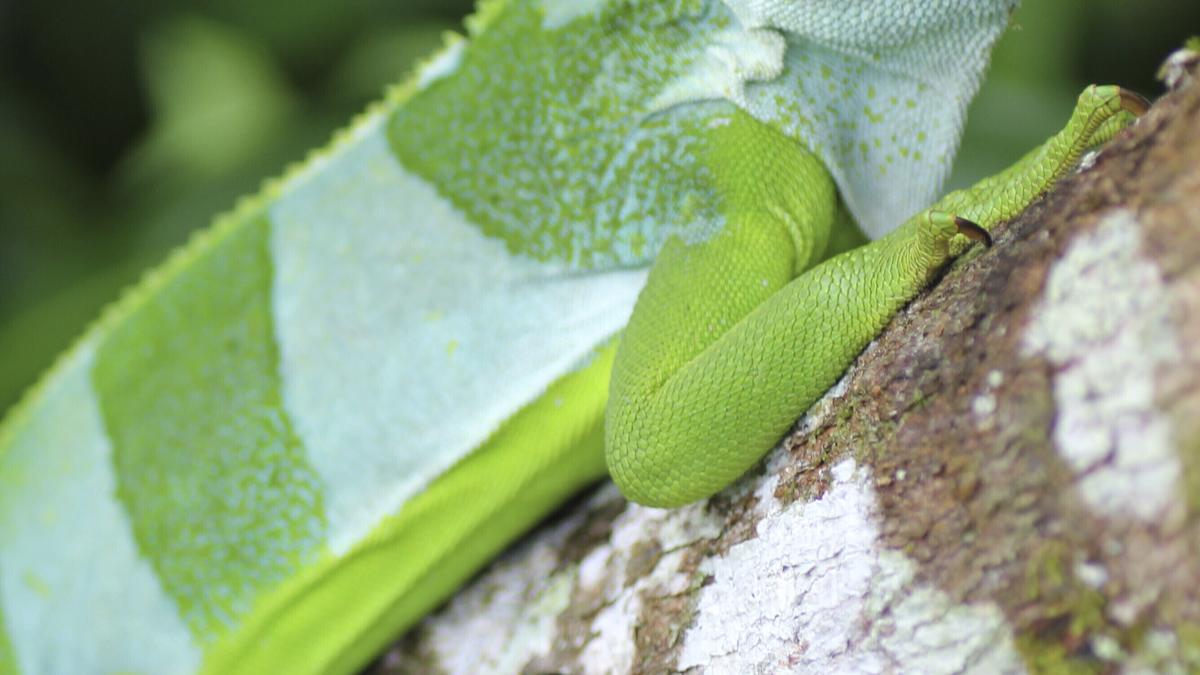
Iguanas likely crossed the Pacific millions of years ago on a record-setting rafting trip
The Hindu
Researchers have long wondered how iguanas got to Fiji, a collection of remote islands in the South Pacific.
Researchers have long wondered how iguanas got to Fiji, a collection of remote islands in the South Pacific. Most modern-day iguanas live in the Americas — thousands of miles and one giant ocean away.
They thought maybe they scurried there through Asia or Australia before volcanic activity pushed Fiji so far away.
But new research suggests that millions of years ago, iguanas pulled off the 5,000 mile (8,000 kilometer) odyssey on a raft of floating vegetation — masses of uprooted trees and small plants. That journey is thought to be a record — further than any other land-dwelling vertebrate has ever traveled on the ocean.
Scientists think that’s how iguanas got to the Galapagos Islands off of Ecuador and between islands in the Caribbean. Initially they thought Fiji might be a bit too far for such a trip, but in a new study, researchers inspected the genes of 14 iguana species spanning the Americas, the Caribbean and Fiji. They discovered that Fijian iguanas were most closely related to desert iguanas from North America, and that the two groups split off around 31 million years ago.
The researchers created a statistical model using that information and other tidbits about where iguanas live today and how they may spread. It suggested that the iguanas most likely floated to Fiji from North America.
“Given what we know now, their result is by far the most strongly supported,” said Kevin de Queiroz, an evolutionary biologist at the Smithsonian National Museum of Natural History, who was not involved with the new study.
The research was published Monday in the journal Proceedings of the National Academy of Sciences.


The actor, along with director Shashant Shah, speak about their upcoming series ‘Chiraiya’, Divya’s process of working on the dialect, Sushant’s approach to telling a story about women, and more

Sri Lanka's Minister Bimal Rathnayake announces support for Indian refugees, urging political sensitivity from Tamil Nadu and India.

51 couples take thebig plunge at Udaipur mass wedding event

India shows significant progress in reducing child mortality, despite global slowdowns, highlights a new UN report on child health.

Puducherry's upcoming elections test the NDA's governance model amid opposition rifts and promises of stability and welfare delivery.

A Russian oil tanker diverts to India, boosting local refineries despite sanctions and geopolitical tensions.

Supreme Court questions if temple activities like book publishing and prasadam manufacturing qualify as industrial activities under current laws.

Ten of Kozhikode's 13 incumbent MLAs are seeking re-election, with no women candidates from CPI(M) in the upcoming polls.

Height restrictions near airports are stifling Bengaluru's growth, prompting calls for a review to boost development potential.

Explore the Gandhi Bunakar Mela in Vijayawada, showcasing traditional textiles and supporting handloom weavers until March 31.

MDMK leader Vaiko announces a movement to remove Prosopis juliflora trees in Tamil Nadu following a landmark High Court directive.

Lok Sabha Speaker Om Birla emphasizes the importance of Question Hour over meetings and urges decorum during obituary references.

Karnataka approves 300-bed Puttur Government Medical College Hospital project, enhancing healthcare in the coastal region.