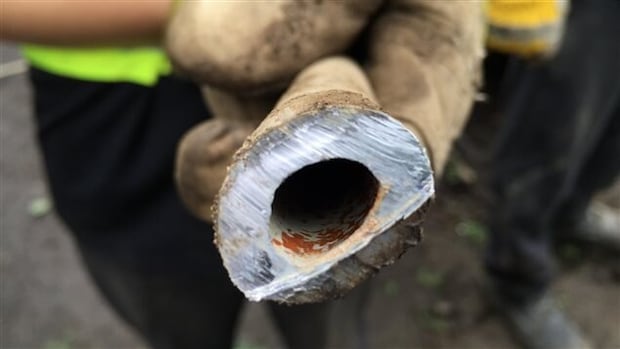
Hundreds of Thunder Bay homes have lead pipes. Would bylaws like ones in other cities reduce exposure?
CBC
Kevin Duke says replacing the lead pipes in his home doesn’t seem feasible.
The Thunder Bay, Ont., senior wasn’t aware of the lead pipes until the City of Thunder Bay began distributing NSF/ANSI-53-approved water filter pitcher kits in 2020. A couple of years ago, he said, the city replaced the main water line on his side of the street, but from there to his water meter, it’s all lead piping.
“I highly doubt that I would be able to afford to get all that replaced,” Duke said.
Before the mid-1950s, lead service pipes were commonly used to connect people’s homes to city watermains. But as research emerged about the dangers of the toxic metal to people’s health, the National Plumbing Code of Canada banned lead piping in 1975 and lead solder in 1986.
Still, many older homes across the country have lead pipes. Earlier this month, the Canadian Environmental Law Association (CELA) published a report calling for Ontario municipalities to stop only partially replacing lead service lines.
“There can be really high levels of lead in the months and years following the partial replacement because you've disrupted the lead line, and there can be big particles coming into your house,” said Julie Mutis, community outreach worker for CELA and lead author of the report.
The association is recommending that cities pass bylaws to make it mandatory for property owners to replace the lead pipes on their side of the property line, while also providing income-adjusted financial support to help cover the costs.
“When they find the lead pipe, they would not just be taking out the city side and then leaving the other lead [pipe] in place to continue harming people, but they would be removing everything at once,” Mutis said.
“This would mean that people who don't really know they have lead pipes are going to be supported in removing them.”
Hamilton is the only municipality in Ontario with a bylaw aimed at preventing partial lead service- line replacements. Mutis said several communities in Quebec and Saskatchewan already have similar bylaws in place; Saskatoon, for example, is on track to have all lead service lines replaced by 2029.
In Thunder Bay, the city offers an interest-free loan program as well as a $1,500 grant for eligible low-income earners and seniors. However, Duke questions whether that’s enough.
“I think they should go by the home income and how much it's going to cost to get it done at that home,” he said. “I realize that would probably be a little on the tricky side, but they should be able to do something.”
Corrosion control programs are one way to address lead, but they aren't always effective. In 2018, the City of Thunder Bay introduced a small amount of sodium hydroxide in the water supply to help reduce the amount of lead seeping in from old pipes.
After the chemical was added, people began to complain about pinhole leaks in their copper pipes and hundreds of homeowners began to experience flooding. The city removed the sodium hydroxide in early 2020, which is when it started to provide NSF/ANSI-53-approved water pitchers and filters to properties with known lead service lines.


The Northwest Territories government says it has found elevated levels of lead in drinking water at the Chief Jimmy Bruneau school in Behchokǫ̀.

Public Safety Minister Gary Anandasangaree faced pointed questions Tuesday about why the federal government has deported one Iranian official, despite longstanding concerns about how the regime operates in Canada and abroad.

An RCMP-led corruption investigation is underway and search warrants were executed on a number of properties including the homes of former mayor Jyoti Gondek, former councillor Sean Chu and sitting councillor Andre Chabot.

Toronto police say they are creating a counter-terrorism unit and a specialized task force that will see officers with semi-automatic rifles stationed at key locations in the city.

ATCO Ltd. says it's taking a 40 per cent ownership stake in the company building the Grays Bay Road and Port project.

Justice Minister Sean Fraser says he has no plans to change how judges are appointed in Canada despite four premiers writing to Prime Minister Mark Carney to ask for more of a say in the process.

An RCMP-led corruption investigation is underway and at least one current and one former Calgary city councillor, as well as a business were subject to search warrants executed last week, CBC News has learned.

Ontario’s education minister is telling school boards to ensure their upcoming graduation ceremonies don’t express any “political views” or “engage in divisive or contentious issues of any kind,” according to an internal memo obtained by CBC News.

A new daily non-stop flight between Charlottetown and Montreal is set to begin this summer.

The Crown has dropped mischief charges for a second time against a London, Ont., doctor accused of spraying ketchup on the office of a local MP during a 2024 protest.

An RCMP-led corruption investigation is underway into at least one current Calgary city councillor as well as a business, CBC News has learned.

Much of Newfoundland is digging out of a blustery and messy day as another storm slams into the island.

Timiskaming—Cochrane MPP John Vanthof recalls the meeting in Thunder Bay earlier this month. He was part of the nine-day road trip along Highways 11 and 17 with other NDP MPPs.