How to check if a material is a superconductor – in four steps Premium
The Hindu
Scientists in South Korea have claimed that a material called LK-99 is a room-temperature superconductor. To verify their claim, both they and independent scientists will look for the four characteristic features of the transition to superconductivity: the electronic effect, the magnetic effect, the thermodynamic effect and the spectroscopic effect.
In the last week of July, researchers in South Korea said they had discovered that a material called LK-99 is a room-temperature superconductor. Scientists have been looking for such materials for several decades now for their ability to transport heavy currents without any loss – a property that could revolutionise a variety of industrial and medical applications.
Independent researchers will have to check whether LK-99 is really a room-temperature superconductor before it is accepted as legitimate. When a material becomes a superconductor, the superconducting state will induce four changes in the material. Spot all four and you have yourself a superconductor.
1: Electronic effect – The material will transport an electric current with zero resistance. This is hard to check when the sample of the material is very small, and requires sophisticated equipment.
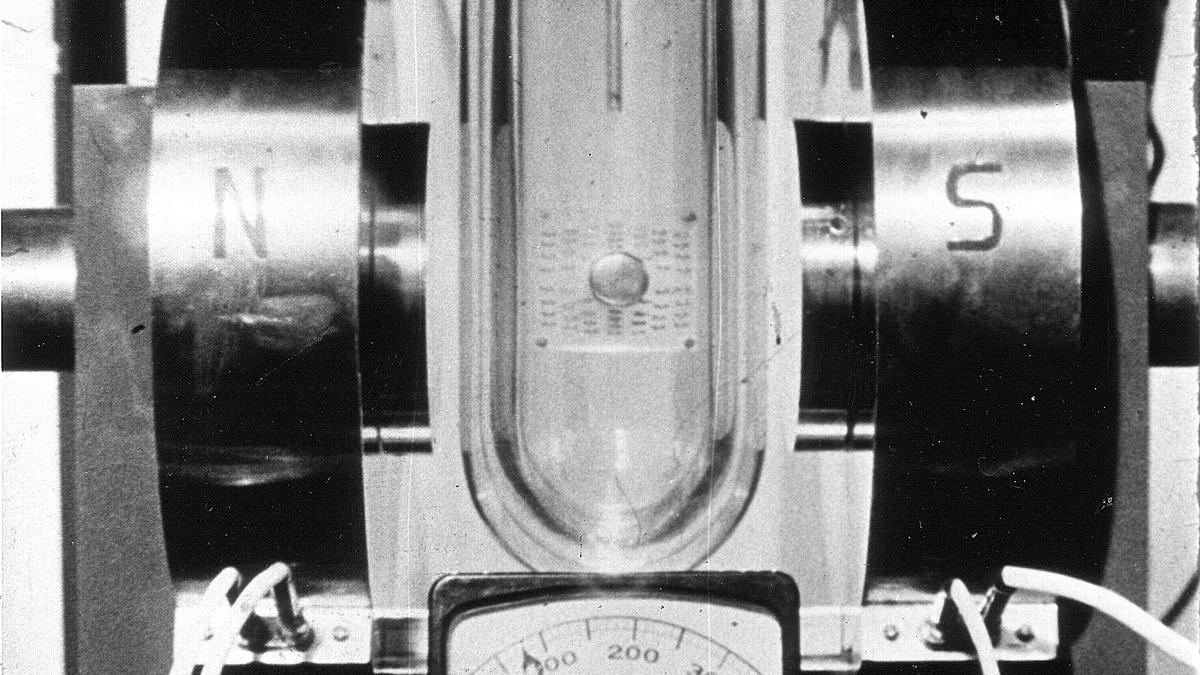
2: Magnetic effect – A type I superconductor (a material that, in the right conditions, becomes a superconductor throughout its bulk) will expel a magnetic field from its body as long as the field strength is below a critical value. This is the Meissner effect: a magnet placed near the material will be pushed away as the material transitions to a superconducting state. A type II superconductor – which transitions through a mix of superconducting and non-superconducting states en route to becoming fully superconducting – won’t expel magnetic fields but will prevent them from moving through its bulk. This phenomenon is called flux pinning. When a flux-pinned superconductor is taken away from a particular part of the magnetic field and put back in, it will snap back to its original relative position.
3: Thermodynamic effect – The electronic specific heat changes drastically at the superconducting transition temperature. The specific heat is the heat required to increase the temperature of the electrons in the material by 1 degree Celsius. As the material transitions to its superconducting state, the electronic specific heat drops. Upon warming the material back up to the critical temperature (below which the material is a superconductor), it jumps back to the value it was when the material was not superconducting.
4: Spectroscopic effect – The electrons in the material are forbidden from attaining certain energy levels, even if they could when the material wasn’t a superconductor. When scientists create a map of all possible energy levels in a superconductor, they should see this as a ‘gap’.
This article is about the two types of conventional superconductors – which are materials whose abilities can be explained using the Bardeen-Cooper-Schrieffer theory of superconductivity. Scientists also know of many unconventional superconductors, but the origin of superconductivity in these materials remains a mystery.


India approves 23 institutions for quantum labs under the National Quantum Mission, aiming to advance quantum technology and research.

The Gaza conflict exacerbates environmental damage, emitting millions of tonnes of CO2 and threatening climate stability in West Asia.

Chefs and cookery experts share smart kitchen hacks, hybrid cooking methods and appliance tips to help households reduce LPG use without compromising on food

Discover groundbreaking research on Titan's lakes, bat vaccinations, and the unique aroma of ripening bananas in just one minute.

IRSO's NavIC system faces challenges as the last atomic clock fails, reducing operational satellites for navigation services.

Discover efficient pressure cooking techniques to save up to 50% on fuel. OPOS B Ramakrishnan tells you how

Mercedes-Benz CLA 250+ with EQ Technology review: design, performance, range and features explained. Discover how the new electric CLA combines advanced AI, long range, fast charging and futuristic styling for the next generation of luxury EVs.

Pi Day is celebrated every year on March 14, honouring the significance of the mathematical constant π and its applications in mathematics.

Discover how sculptural interior design transforms modern spaces, blending creativity and functionality to evoke emotion and identity.

A study reveals that certain antibiotics can cause long-lasting changes in gut microbiome diversity for up to eight years.

Indian scientists and international experts are divided over a study questioning the viability of a nuclear reactor fuel called HALEU-thorium; while critics cite safety risks, proponents argue the technology is vital to achieve national energy goals.

ISRO and AIIMS partner to enhance space medicine research, focusing on human health during long-duration space missions.

A practical guide to induction setups for students, families, and home food businesses as India’s LPG supply faces its biggest disruption in years