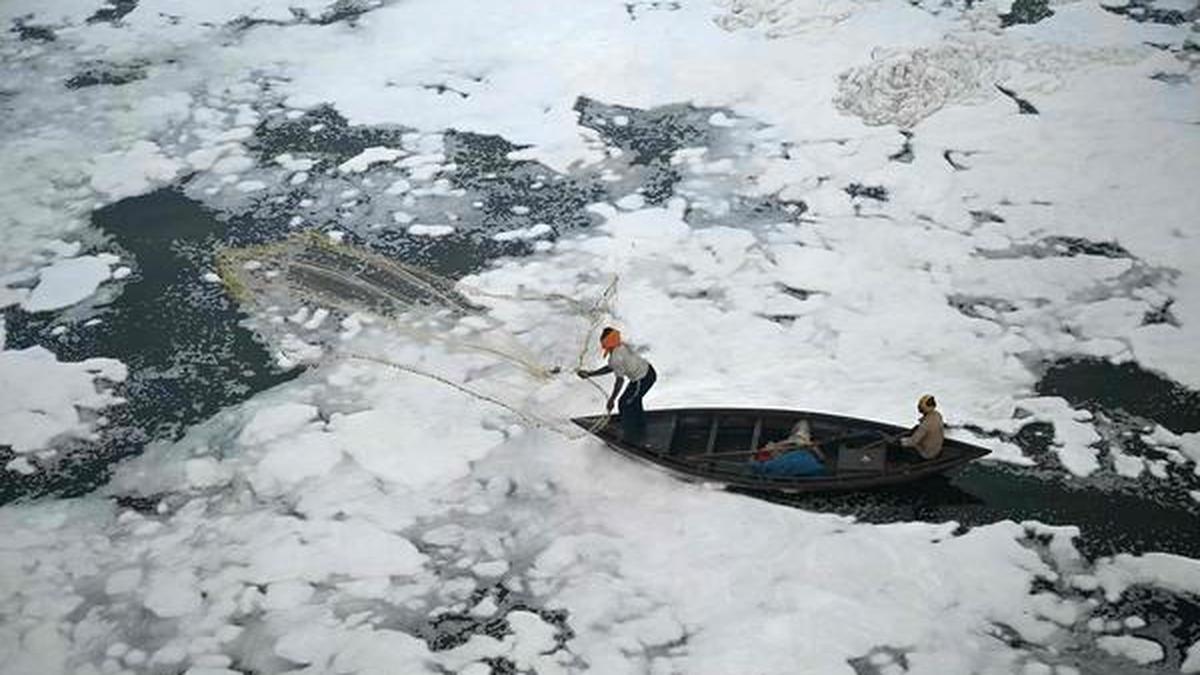
How the Yamuna appeared relatively ‘cleaner’ during Chhath Puja in Delhi last year
The Hindu
Last year, just before the start of Chhath Puja, excess water discharged into the holy river from Hathnikund Barrage in Haryana diluted the pollutants and made the water appear relatively ‘cleaner’ in Delhi.
Every year, during the preparations for and festivities of Chhath Puja in Delhi, there is a rise in discourse around the pollution that plagues the holy Yamuna river as it passes through Delhi. Visuals of people standing in the river while surrounded by toxic foam on river create a temporary uproar which also fuels political parties like the Bharatiya Janata Party (BJP) and Aam Aadmi Party (AAP) to point fingers at each other.
Yamuna’s passage across Delhi, especially the 22-kilometre stretch between Wazirabad and Okhla (which constitutes under 2% of the rivers total length of 1,400 kilometres) contributes to around 76% of the pollution load of the river, as per official data, majorly due to the several drains that merge into the river in this stretch. The discolouration of the river water, from being almost transparent at the northernmost sampling location (Palla) to severely discoloured along with foam at Okhla, is also evident as The Hindu reported earlier this month.
Just before the commencement of the Chhath Puja festivities on October 25, the Haryana government diverted nearly all the water from the Hathnikund Barrage towards Yamuna, thereby, diluting the holy river water’s pollutants, as reported by The Hindu in October 2025. This “unprecedented” step by the newly-formed BJP government, that came back to power in Delhi after 27 years, was met with backlash by AAP, did improve the water quality, as the data shows.
Every month, the water quality is sampled across eight locations by the Delhi Pollution Control Committee (DPCC) as shown in the map below. The water enters Delhi at Palla, where the quality of the water meets the standards set by the Central Pollution Pollution Control Board (CPCB) as the highly polluting Najafgarh drain flows into the Yamuna downstream of the Wazirabad bridge.
In the chart below, the readings taken during or the period immediately before and after Chhath festivities since 2019 are shown (readings of fecal coliform before November 2019 are not available). Readings taken on October 20, 2025 across different sampling stations are highlighted in red. Even in October, the levels of pollutants (fecal coliform) was still higher than bathing standards put forth by the CPCB.
The river has been the least polluted during Chhath Puja in 2025 when compared to similar periods in the past 7 years. In fact, from January to October last year, the data shows that, barring September, the river was least polluted in October (highlighted in red).


Amit Shah claims West Bengal's existence is threatened by infiltration, urging voters to embrace change and reject Mamata Banerjee.

PIL in Madras HC seeks to restrict SC-reserved constituency nominations to Hindus, Sikhs, and Buddhists amid concerns over Christian candidates.

Lok Sabha passes a bill declaring Amaravati as the permanent capital of Andhra Pradesh, ensuring future stability for the state.

Mamata Banerjee accuses BJP of attempting to impose President's rule in Bengal following Malda incident and urges non-violence.

Vivo on Thursday launched a new smartphone in its V70 series, the Vivo V70 FE (Fashion Edition), in India. The Chinese smartphone maker targets premium segment buyers with the new Vivo V70 FE

CM Reddy emphasizes transforming lives through actionable schemes, urging community involvement for Telangana's development and progress.

T.N. CM Stalin criticizes the FCRA amendment as an attack on minority institutions, urging the government to withdraw the bill.

Vir Das will be co-directing the film with Kavi Shastri, with whom he also collaborated on ‘Happy Patel: Khatarnak Jasoos’

Kerala Assembly elections: K.C. Venugopal alleges CPI(M) is printing fake IDs in Kannur to rig polls
K.C. Venugopal alleges CPI(M) is printing fake IDs in Kerala to rig elections, urging ECI to investigate the claims.

From indulgent Easter brunches and Kerala-inspired festive spreads to cooling summer menus and Nikkei dining experiences, here’s where to eat out in Bengaluru this April

Supreme Court deems gherao of judicial officers in Bengal a "calculated attempt" to disrupt elections amid severe political polarization.

Kerala Sports Minister claims Argentina football team deceived the state by not playing after receiving payment for a match.

Parliament Budget Session LIVE updates April 4 2026