How the forges of Venkatanayakanpatti keep bells tinkling
The Hindu
Home-based forges in Venkatanayakanpatti keep a tradition of brass bell manufacture through the lost wax casting process alive in Tamil Nadu
Shankar and his family members are seated on the floor outside their home, building up a mound of what looks like chocolate truffle balls when we meet at Venkatanayakanpatti village, on a hot day.
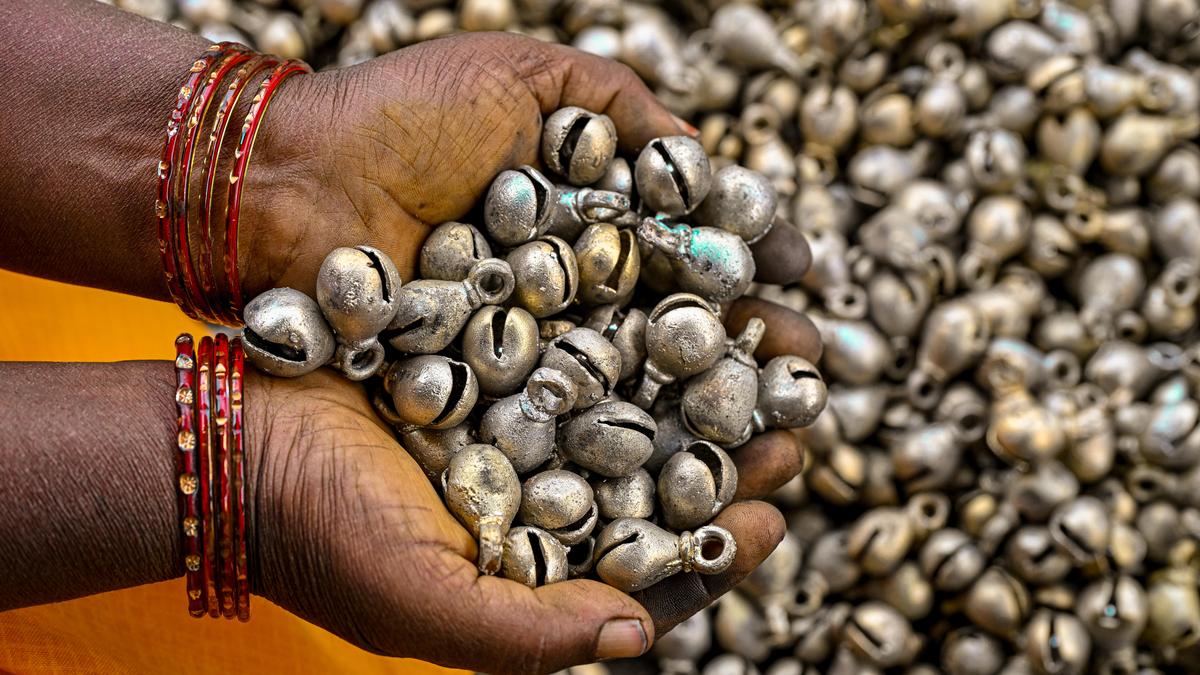
Weighing approximately 65 grams, each of these balls hold within, the mould that will eventually create the brass bells that provide the soundtrack to many different lives.
Whether stitched onto felt strips and worn by dancers as ‘salangai’ or ‘ghungroo’ to unite rhythm with beat, or as adornments on domesticated animals especially in rural sports such as ‘jallikattu’, these handmade bells, with their distinctive ‘jal-jal’ sound, have a humble start from home-based smithies such as those in Venkatanayakanpatti, situated 56 km from Tiruchi.
“There are at least 35 steps in manufacturing a ‘mani’ (bell), and this is just the first one,” says Shankar, as his fingers ceaselessly shape balls from a lump of clayey paste made with moist riverbed soil and a mixture of natural resins.
The small balls are dipped in melted beeswax and castor oil and then further coated in another clay paste. Hooks are shaped with the same moulding mixture and attached separately to each bell.
The completed bell casings are baked in batches of 24 or 36, set in handmade moulds that have an inlet for the molten metal and an outlet for the melted wax.


Kerala Speaker declares allegations against Minister K.B. Ganesh Kumar "a closed chapter," urging separation of family issues from politics.

Despite an LPG shortage, Hyderabad's iconic haleem remains unaffected as it's primarily cooked in traditional wood-fired ovens.

Hyderabad police seize over 5,000 litres of adulterated cooking oil and 5,000 kg of wheat flour in raids

Home-based forges in Venkatanayakanpatti keep a tradition of brass bell manufacture through the lost wax casting process alive in Tamil Nadu

Arundhati Roy criticizes the Indian government’s complicity in U.S.-Israel aggression and calls for a stand against imperialism.

KSRTC launches a double-decker bus service in Kozhikode, enhancing city tours despite challenges from low-hanging trees.

Shorts News:Summer-like heat grips parts of Rajasthan; yellow alert issued in Jaisalmer

NCERT issues an unconditional apology and withdraws textbook chapter referencing judiciary corruption after Supreme Court intervention.

V.S. Ugrappa criticizes BJP's dictatorial approach, contrasting it with Congress's democratic principles in internal decision-making.

Kerala Minister K.B. Ganesh Kumar's wife withdraws complaint after his apology regarding allegations of infidelity.

Kavitha and Visharadan Maharaj, on a hunger strike for Velugumatla displaced families, were shifted from Khammam to Hyderabad by police.

Two killed and one injured in a lorry crash on Hyderabad–Vijayawada highway; driver absconds after the incident.

CEC Gyanesh Kumar reviews West Bengal's poll preparedness and faces protests ahead of the upcoming Assembly elections on March 10.