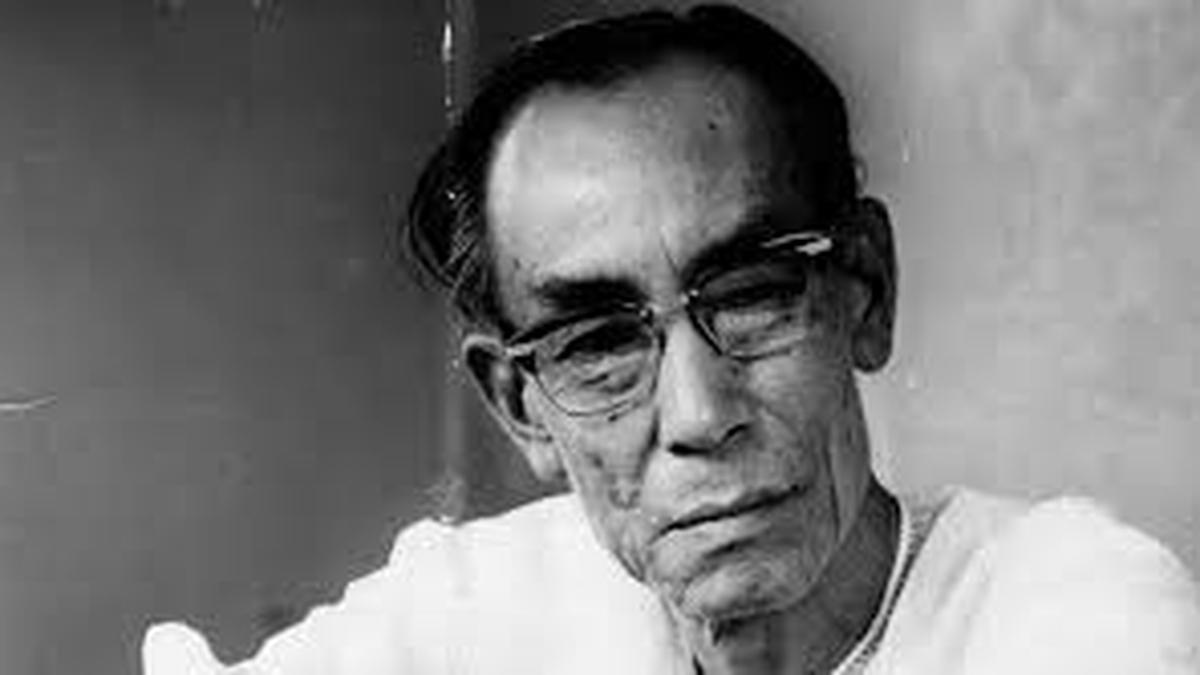
How S.D. Burman’s music was deeply influenced by folk and classical traditions
The Hindu
Discover anecdotes and insights into the life and music of S.D. Burman in the book The Monk And His Music.
Recalling an amusing incident on the sets of the 1960 film Kala Bazar, actor Waheeda Rahman describes how the entire team laughed when music director Sachin Dev Burman lifted his dhoti up to demonstrate what steps she should do in the song ‘Rimjhim ke taraane’. “We found it really sweet,” she says. In another instance, Gulzar talks about a debate between Burman and Bandini director Bimal Roy over how Nutan should be depicted in ‘Mora gora ang le le’, his debut song as a lyricist.
Though they represent different shades of S.D. Burman’s personality, they provide evidence of how closely the music director was involved in the way his songs were depicted on screen. This trait of his is mentioned often in the book The Monk And His Music (Qurate Books) by Moti Lalwani and Richa Lakhanpal. Other aspects such as his approach to studio recordings, the way he interacted with musicians and filmmakers, his sense of dressing, how he was a fan of the East Bengal football team and his love for paan are mentioned too.
This isn’t a quintessential musical biography. Thirteen books have already been written on the composer, including biographies in English by H.Q. Chowdhury, Khagesh Dev Burman, Anirudha Bhattacharjee-Balaji Vittal and Sathya Saran. We might see more in the years to come because Burman dada’s music is eternal. Though he belonged to an era gone by, admirers of his work across the globe are still eager to know how he managed to create songs that continue to tug at our heartstrings.
S.D. Burman’s music was a beautiful blend of folk and classical that he imbibed as a child growing up in Comilla (now part of Bangladesh). Quite a few of his songs drew a visual imagery of Bengal through their Baul and Bhatiali-inspired tunes. While Burman’s mother, Rajkumari Nirmala Devi, was the royal princess of Manipur, his father, Nabadwipchandra Dev Burman, was the son of the maharaja of Tripura. Moving away from the royal trappings, Burman found his calling in music.
In The Monk And His Music, Moti and Richa have interviewed several people associated with Burman either professionally or personally such as radio personality Ameen Sayani, music directors Anandji Shah, Ravindra Jain, Pyarelal Sharma and Khayyam, classical musicians Pt. Shivkumar Sharma and Pt. Hariprasad Chaurasia, and lyricists Yogesh Gaur and Gopaldas Neeraj. Thus the book has many anecdotes.
The interviews have been uploaded on YouTube, and then edited and compiled for the book. Filmmaker Brahmanand Singh, who has made documentaries on R.D. Burman and Jagjit Singh, has written the foreword. Says Moti, “The name S.D. Burman has such a magical effect that it opened all doors for us. Initially, we planned to make a biopic, but it proved to be an expensive proposition. So we ventured into writing this book.” .”
The book is divided into various sections featuring musicians, filmmakers, lyricists, composers, singers and other industry personalities. Some articles by musicologists give specific accounts of Burman’s life. The back cover carries a quote by son Rahul Dev Burman (Pancham) — “And now he is indeed gone forever, bequeathing his exalted legacy to me, a monumental legacy I will try my best to carry forward.” Pancham had said this to Ameen Sayani after dada passed away on October 31, 1975..


South African naturalist Steve Boyes speaks on ghost elephants, ancestral tracking, and Werner Herzog’s documentary exploring Angola’s elusive highland giants

Actor-director Amol Palekar will receive META's Lifetime Achievement award for 2026 on March 25 in New Delhi.

India's artists unite against rising censorship, advocating for creative freedom and support for marginalized voices in the arts.

Written and directed by Kunal, the film also stars Sparsh Shrivastava and Vanshika Dhir

This year, Bharatnatyam artistes will present the Tyagaraja Aradhane as a dance performance

This year, Bharatnatyam artistes will present the Tyagaraja Aradhane as a dance performance

The actor, along with director Sushant Shah, speak about their upcoming series ‘Chiraiya’, Divya’s process of working on the dialect, Sushant’s approach to telling a story about women, and more

An independent video, ‘Feel the Spark’ by Raleigh Rajan with vocals by Ciera Dumas that celebrates Tamil literary giants, garnered 1.4 million views in less than 36 hours.

In ‘Jack Ryan: Ghost War’, John Krasinski is back as the savvy CIA analyst, diving headfirst into a high-stakes mission that unravels a deadly conspiracy and pits him against a rogue black-ops unit

Shriram Bharatiya Kala Kendra’s Shankarlal festival showcased rare ragas, radiant artistry, and inclusive performances, from Pt Madhup Mudgal’s serene morning ragas to Ramana Balachandran’s Saraswati veena.

Explore "Threads that Bind: The Kantha Project," an exhibition in Delhi reimagining kantha as a medium of repair and renewal.

Sean Penn skips the Oscars to meet Ukraine's Zelenskyy, who praises him as a "true friend" amid the war.

The teaser of Tamil star Suriya’s much-awaited film with director Venky Atluri, titled Vishwanath and Sons, was unveiled by the makers on Monday