How politics turned fertile land barren
The Hindu
Suranahalli (Hassan) - A village caught in legal battles and political rivalry, impacting residents' livelihood and land ownership.
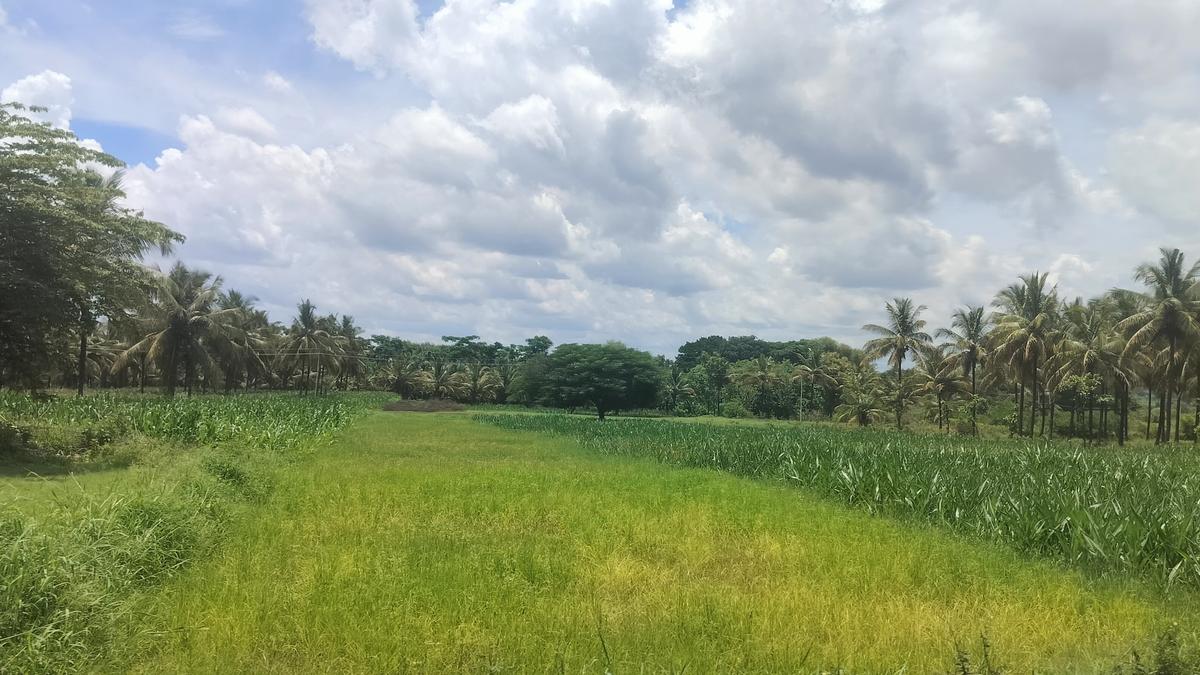
A kilometre to the east of Holenarasipur town, a politically significant place in Hassan district in south Karnataka, a verdant landscape dotted with coconut trees and neatly planted rows of maize greets travellers. It’s a picturesque sight that would make anyone pause for a moment and take a deep breath. A small board bears the name: Suranahalli.
The wetland on the banks of the Hemavathi River is suitable for paddy cultivation. People here earn a regular income from dairy farming, too, by selling milk to the Hassan Milk Union, one of the best-performing dairies in the State. However, over the last three decades, most of the village’s families have hardly seen any financial growth. Behind this is the tale of their land, caught in legal battles and political rivalry.
Two prominent political families belong to the area: former Prime Minister H.D. Deve Gowda represented the Holenarasipur Assembly constituency for nearly three decades, and Puttaswamy Gowda, who contested as an Independent candidate against him in 1985. The animosity between the two has grown over the years as the next generations entered politics. People of Suranahalli have, by and large, stood by Puttaswamy Gowda. They believe this is the reason former Minister H.D. Revanna, son of Deve Gowda, targeted them whenever he was in power.
Revanna is currently in the news as an accused in two criminal cases against him: for allegedly kidnapping a woman and sexually harassing a former domestic help. His son and MP Prajwal Revanna faces charges of sexually abusing many women and is facing a Special Investigation Team probe.
When Deve Gowda became the Prime Minister in 1996, giving up his Chief Minister’s post, J.H. Patel succeeded him. He inducted Holenarasipur MLA Revanna into his cabinet and offered him the Housing portfolio. “He proposed a housing project by acquiring wetlands in 1996,” said S.H. Mohan Kumar, a resident of the village and advocate.
A preliminary notification for the acquisition of 88 acres of land was issued on June 27, 1996. Though the land was fertile, the records were allegedly “created” to show it as barren land so that acquisition could be easy, according to Mohan Kumar. Within a year, a final notification was issued for acquisition. By 1998, the award for the land losers was fixed at ₹59,000 per acre. “By then, the market rate of the land was above ₹1 lakh per acre. We moved the court with a writ petition challenging the acquisition,” the advocate said.
Even as their petition was pending in the High Court, the Janata Dal government lost power in the 1999 Assembly elections. The party split into two, and both factions suffered defeat. Revanna, too, lost the battle for Holenarasipur. The Congress came to power under the leadership of S.M. Krishna.


Indian vessels can freely sail through the Strait of Hormuz without needing permission, confirms a senior government official.

The Hindu Morning Digest gives a select list of stories to start the day. Read the top news today on March 25, 2026

An IndiGo flight at Vijayawada airport was grounded due to a tyre burst, but all 79 occupants are safe.

Tamil Nadu Assembly election 2026: TMC(M) gets five seats in NDA, to contest on BJP's 'Lotus' symbol
TMC(M) secures five NDA seats, to contest Assembly elections using BJP's 'Lotus' symbol in Tamil Nadu.

The Karnataka government will discuss with officials the possibility of creating a portal for unemployed youth to share their details and access job opportunities in micro, small and medium enterprises (MSMEs), Minister for Small Industries and Public Enterprises Sharanabasappa Darshanapur said in the Legislative Council on Tuesday.

AIADMK's 2026 manifesto promises free rations, women's benefits, education reforms, and economic growth initiatives for Tamil Nadu.

U.S.-Israel war on Iran LIVE: Follow The Hindu for updates on the West Asia conflict on March 24, 2026

Join the 'Click & Commit' campaign on World TB Day, uniting Chennai's community to pledge against tuberculosis.

Brahmin candidates join Naam Tamilar Katchi, marking a significant shift in Tamil Nadu's political landscape and inclusivity.

Over 750 wheelchairs are prepared in Thoothukudi for accessible voting, ensuring convenience for differently abled and elderly voters.

Madras HC dismisses S.P. Velumani's petition challenging I-T assessment of ₹7 crore as unexplained election expenses from 2016.

The Lok Sabha passes a contentious Transgender Bill, sparking praise from the government and criticism from opposition parties.

Kamal Haasan announces support for DMK in 2026 elections, emphasizing the need for 'Dravidian Model 2.0' for Tamil Nadu's welfare.