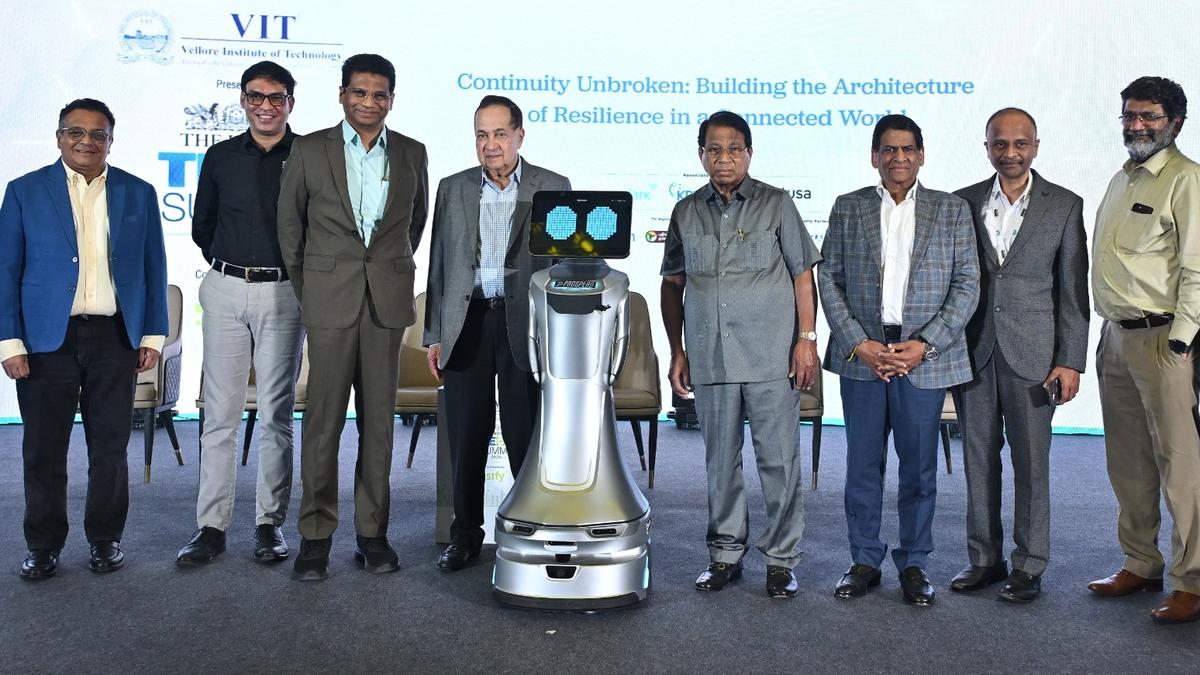
Higher education holds the key to reduce inequality and power economy forward: VIT Chancellor G. Viswanathan
The Hindu
Dr. G. Viswanathan emphasizes that higher education is essential for reducing inequality and boosting India's economy at The Hindu Tech Summit 2026.
Providing quality education and increasing enrolment in colleges and universities hold the key to improving the economy of the country and curtailing inequality, G. Viswanathan, Founder and Chancellor, Vellore Institute of Technology (VIT), said in Chennai on Thursday (February 12, 2026).
At the inaugural session of The Hindu Tech Summit 2026, jointly organised by The Hindu Group, Vellore Institute of Technology, and Sify Technologies, Dr. Viswanathan said that in the past 20 years or so, the economy has grown to place India as the fourth-largest economy in the world, overtaking Japan in 2025. Alongside, inequality has grown as well, with only about 70 lakh people in the country declaring themselves as belonging to the higher income group. “They say India is the most unequal country in the world, next only to Russia. Unless we provide education, this cannot be curtailed. It requires government policy,” Dr. Viswanathan iterated. For this, education should reach all children belonging to poor families and the middle class.
Quoting figures, he said Japan’s per capita income was 12 times that of India. While India’s per capita income stood at USD 2,900, Japan’s was USD 36,000. While some government officials exuded confidence that India could overtake Germany in a few years, it should be borne in mind that Germany’s per capita income was USD 58,000 – 20 times that of India. “In the year 2000, there were only nine billionaires in the country. Now, we have grown beyond 300,” he maintained.
The new education policy’s thrust to improve gross enrolment ratio from the present 28% to 50% in the next 15 years would mean that the number of students in colleges and universities needed to be doubled. This, Dr. Viswanath said, meant that someone had to pay for them. In the present scenario, the burden of higher education was mostly on the learner; the government spent barely 3% to 4% of the GDP, although the Kothari Commission in the sixties had recommended an expenditure of at least 6% of the GDP.
Due to lack of spending, only four crore children out of 14 crore eligible for higher education are in colleges and universities. Similarly, if India were to compete with developed countries, the spending on research and development should be increased manifold from the present 0.7%.
Tracing the history of VIT, Dr. Viswanathan said that what started in 1984 with 180 students has now grown to accommodate 1 lakh students from all Indian States and 75 other countries.


The Hindu Morning Digest gives a select list of stories to start the day. Read the top news today on March 20, 2026

CSK faces a major setback as Nathan Ellis's hamstring injury rules him out of IPL 2026, prompting replacement plans.

Tamil creators and activists demand the immediate withdrawal of the Jnanpith Award from Vairamuthu over serious allegations and literary concerns.

Air India's New York-Mumbai flight was safely diverted to Medina due to a false fire indication before resuming its journey.

Kerala's Malampuzha Assembly seat sees LDF-BJP rematch as UDF fields A. Suresh in a high-stakes 2026 election battle.

BJP's Ramchander Rao assures fuel security in India amid global turmoil, emphasizing stable LPG prices and strategic reserves.

Congress announces candidates for Kerala Assembly elections 2026, selecting Mohammad Shiyas for Kochi and denying Eldhose Kunnappilly a ticket.

What does it take to design gloves, masks and uniform that factor in the various challenges faced by workers on the waste beat? Indore, Bengaluru and Pune have an answer

Explore the behind-the-scenes of political strategy with "Inside the War Room," a must-read for aspiring politicians and managers.

Villivakkam faces civic challenges despite infrastructure improvements, with residents demanding better healthcare, transport, and green spaces ahead of elections.

District Collector launches e-dip lottery for Settipalle land plots, benefiting 2,111 beneficiaries with planned infrastructure development.

Chengalpattu's horticulture farm launches herbal tea, Idhazh, made from sun-dried hibiscus and organic herbs.

Hyderabad is set to become a global film hub, says CM Revanth Reddy at TGFA 2025, highlighting its cinematic potential.