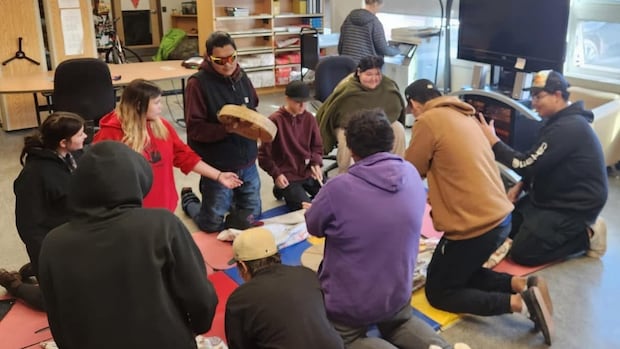
High school graduation now a point of pride for Indigenous community in northern Alberta
CBC
Angela Marcel was almost 40 years old when she graduated from high school.
"I remember always kicking myself that I didn't continue my education," said Marcel, a member of the Athabasca Chipewyan First Nation who lives in Fort Chipewyan, Alta., a tiny community about 740 kilometres northeast of Edmonton.
She got the chance to earn her diploma thanks to innovative programming at Therese Tuccaro Secondary School, an Indigenous-led school launched in 2020 to combat a worrying lack of students graduating from high school.
Between 2016 and 2019, only two students graduated from the high school serving the area. That prompted an education emergency to be declared in 2019 by the Mikisew Cree First Nation, Athabasca Chipewyan First Nation and Fort Chipewyan Métis.
In the five years since Therese Tuccaro opened as an independent nation, on-reserve school, 122 students have successfully earned their high school diplomas.
The school is unique in that it incorporates Indigenous traditions and cultural practices into its teaching, said Kerri Ceretzke, the school's principal and director of education for the Mikisew Cree First Nation.
"We also have a lot of land-based learning," said Ceretzke.
"There's moose hunting in the fall time. There is ice fishing. There's sweetgrass picking and braiding. The cultural component is not a one-off, it's woven into what we do," she said.
Therese Tuccaro, the school's namesake, was an advocate for Indigenous education and a member of education boards and councils. She died in 2023 but her descendants are among the school's graduates.
The school, which operates year-round, has 117 active students in the 2024-25 school year.
About half of the students are members of the Mikisew Cree First Nation, 25 per cent are from the Athabasca Chipewyan First Nation, and 10 per cent are Fort Chipewyan Métis. The remainder is made up of non-Indigenous students as well as those from other Métis or First Nations.
Almost a quarter of them are aged 22 and older.
Marcel said that for her, as well as younger students, the school's focus on cultural learning inspired her to go back every day.
"It's very inclusive," said Marcel, who graduated in March 2023.


The notion that home ownership guarantees financial security in old age is being challenged by a recent survey.

The family of Nash Prystie has identified him as the man who died in an Ontario Provincial Police (OPP) shooting earlier this month north of Kenora, and is calling for more and quicker help for people with mental health challenges.

Playoff action in the Ontario Hockey League gets underway Thursday night for Guelph and Friday in Kitchener.

UPEI wants its faculty to sign on to an updated version of its sexual assault and discrimination policy, but the union that represents the school's academic staff says it wants the policies to be part of its collective agreement.

In Texas this week for a global energy conference, the federal natural resources minister is proclaiming "Canada is back" and ready to bolster its energy sector and grow exports.

Members of Parliament last year went on the fewest sponsored international trips in the last 15 years, excluding the height of the COVID-19 pandemic.

Ontario is running out of time to beef up rules that would crack down on negligent and misbehaving municipal politicians ahead of the next civic election, some experts and opposition critics warn.

Six London teens are each facing multiple charges following a break-and-enter spree at homes in the city's southwest end early Sunday, police said.

The Department of Transportation and Infrastructure is putting the finishing touches on completing the Team Gushue Highway, but it means drivers might have to change their routes until later this summer.

Passage of the Nova Scotia government's budget bill stalled late Tuesday night when a group of singing protesters shut down the final vote to approve the budget.

Health Minister John Dornan said Woodstock-based eVisitNB will continue to provide virtual health-care services to New Brunswickers for another 90 days after March 31.

The head of Canada's largest airline has been summoned to Ottawa to explain why he spoke only in English when he offered his condolences to the families of those killed or hurt in the collision between a plane and a fire truck at a New York City airport on Sunday.

Manitoba is bucking a national trend by promising to slash its deficit, while boosting health care spending by nearly $1 billion and delivering modest affordability measures, including a PST cut that will save you money next time you buy a soda and bag of chips.