Hey London: How prepared are you for a major emergency?
CBC
City staff would like Londoners to take a good look around their home and ask themselves a direct and possibly difficult question: Could everyone in your family survive at home, without leaving and with no other help, for a full 72 hours?
And what if, as an added wrinkle, the power was also out or the water not running?
Developing the ability to be self-sufficient is a strong suggestion included in the emergency management section of the city's website. It's part of a push to get everyone thinking more about how they can be ready at home in case of emergency, a topic that's gaining traction at a time when wildfires, wild weather and a fast-changing political climate are making headlines.
"Since COVID, there's been a significant increase in demand for emergency management training," said Andre Beauregard with the city's emergency management department. "I believe with the current political situation and recent emergencies, that more people are paying attention to it."
The city has created a citizen's academy, a two-hour course in emergency preparedness that's free and open to anyone.
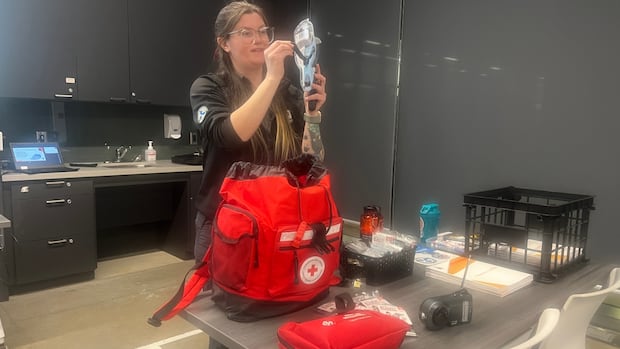
The course, which CBC News took part in this week, lays out how London is prepared to deal with a major emergency. It also has detailed information with practical advice for anyone keen to become better prepared for the worst.
Ontario municipalities are required to have an emergency management plan and London's spans 45 pages, spelling out in detail how various agencies are to work together should some type of emergency or disaster strike.
City staff have also built up detailed risk assessments for the London area along with disaster scenarios to deal with what might come, based on the city's location and climate. Tornadoes top London's list of potential emergency scenarios because they happen every year and have the potential to cause widespread damage.
A tornado that hit Goderich in 2011 left one person dead, injured more than 30 and caused extensive damage to buildings in the town's downtown.
Also near the top of the city's potential risks is a hazardous material spill, particularly resulting from a derailment on one of the two railway mainlines that traverse London's downtown core.
Other risks London is planning for include a major power outage, flooding or an explosion.
The city's website includes a detailed list of items people should assemble into an emergency preparedness kit. Some of the items, such as water, food, flashlights and batteries, are obvious. Other items that perhaps don't come immediately to mind include spare medication and prescriptions, candles and a battery-powered radio.
The idea is to assemble a kit than can help sustain everyone for at least three days.
The three-days target is based on the time it might take the province to send extra resources if a major emergency were to occur, said Taylor Simmons, who is with the city's emergency management team


The Agricultural Producers Association of Saskatchewan (APAS) found some reasons to celebrate the 2026-27 provincial budget, but it takes issue with the amount designated for the province's Water Security Agency (WSA).

The family of an Edmonton woman who died in Honolulu last year is pushing for Hawaiian authorities to re-open the case.

It was around this time in 2020 that everything changed.

With its emergency shelter beds frequently running at 50 per cent over capacity and demand so great that it's forced to refer some women escaping domestic violence elsewhere, Gillian's Place in St. Catharines will soon be able to offer a broader range of services to more victims of gender-based violence.

The ceiling of the CAW Student Centre at the University of Windsor is decorated by flags of numerous nations — among them, Iran.

Turmoil in Iran, a major disruption in world oil markets, and stratospheric gasoline prices in Canada and beyond. What's racking motorists and governments in 2026 also faced them in 1979, sparked by the Iranian Revolution.

Five decades later, and Thunder Bay's Music World Academy remains a family-run business.

Dalton Dubois of Guelph, Ont., made history at the recent Paris Fashion Week when she became the first transgender model to walk the runway for Chanel Exclusive.

Work is scheduled to begin over the summer at the site of the former Clinton Creek asbestos mine, about 65 kilometres northwest of Dawson City, Yukon.

They may be bitter rivals in the House of Commons, but outside the chamber, recent events may have led to Conservative Leader Pierre Poilievre and Prime Minister Mark Carney forging a bond.

Local fans and industry insiders say the province’s move to ban the reselling of event tickets for more than their original value is a step in the right direction, but some say there are still larger issues that need to be addressed.

This First Person column is the experience of Mehdi M. Kashani, who lives in Toronto. For more information about CBC's First Person stories, please see the FAQ.

A very quiet queue has formed in Europe where some of Canada's long-standing, closest allies are seeking shelter under France's small but robust nuclear umbrella.