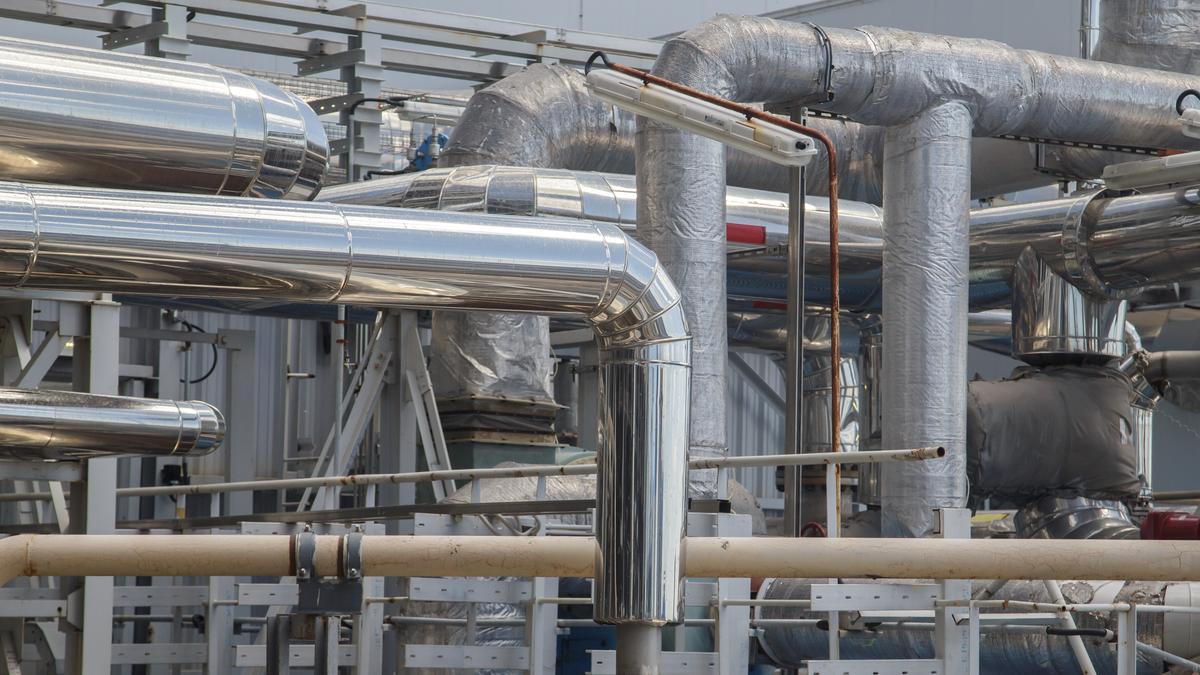
Government announces standards of green ammonia, green methanol
The Hindu
India sets green ammonia and methanol standards to boost green hydrogen trade and strengthen its position as a global producer.
The government on Saturday (March 7, 2026) announced standards of green ammonia and green methanol for India to accelerate trade of green hydrogen derivatives under the National Green Hydrogen Mission.
The mission was approved by the Union Cabinet on January 4, 2023, with an initial outlay of ₹19,744 crore to make India a global hub for production, utilisation and export of green hydrogen and its derivatives.
According to a statement of the Ministry of New & Renewable Energy, in a significant move for the advancement of the National Green Hydrogen Mission, the Government of India notified the Green Ammonia and Green Methanol Standards for India on February 27, 2026.
The standards issued by the Ministry of New and Renewable Energy (MNRE), outlines the emission thresholds and eligibility conditions that must be compiled in order for ammonia and methanol produced to be classified as 'green', i.e., produced using green hydrogen derived from renewable sources.
Green Ammonia Standard for India shall have a total non-biogenic greenhouse gas emission, arising from green hydrogen production, ammonia synthesis, purification, compression, and on-site storage, of not more than 0.38 kg CO₂ equivalent per kg of ammonia (kg CO₂ eq/kg NH₃), calculated as an average over the preceding 12-month period.
Green Methanol standard for India shall have a total non-biogenic greenhouse gas emission, arising from green hydrogen production, methanol synthesis, purification, and on-site storage, of not more than 0.44 kg CO₂ equivalent per kg of methanol (kg CO₂ eq/kg CH₃OH), calculated as an average over the preceding 12-month period.


Asian central banks face tough choices on interest rates amid rising oil prices and the escalating Iran conflict, impacting growth and inflation.

G7 Finance Ministers to discuss coordinated emergency oil reserve release amid surging prices and market instability.

Crude prices surge to $100 as investors sell off, causing Indian stock markets to drop 3% amid geopolitical tensions.

The U.S. urges India to purchase Russian oil at sea to alleviate supply fears amid ongoing West Asia conflict.

China’s commerce ministry on Saturday raised the possibility of another global semiconductor supply chain crisis due to “new conflicts” between Dutch chipmaker Nexperia and its Chinese subsidiary.

Sony will face a £2 billion ($2.7 billion) class action lawsuit starting Tuesday in London, accused of allegedly breaching competition law by overcharging millions of UK PlayStation users.

Oil prices eclipsed $114 per barrel for the first time since 2022 on March 9, 2026 as the Iran war intensified. Stock markets and forex markets

Asian equities drop sharply as oil prices surge 30% amid escalating West Asia conflict, raising inflation and economic concerns.

India’s renewable energy sector is in the midst of an extraordinary build-out. Capacity targets are being met, investments are flowing in, and the country has positioned itself as a global clean-energy leader. But beneath these headline achievements lies a troubling operational reality. Take the example of Rajasthan, where more than 4,000 MW of fully commissioned renewable capacity is unable to evacuate power during peak hours, due to grid congestion.

India seeks alternative crude oil supplies from the U.S., Russia, and West Africa amid ongoing West Asia conflict.

Sindhu Gangadharan emphasizes the need for women’s leadership in AI to ensure ethical, inclusive, and impactful technology development.

Room air conditioner prices will rise 5-15% ahead of summer due to increased raw material costs and new energy norms.

Explore the significance of the Strait of Hormuz and its impact on global oil trade, especially for India amidst rising tensions.