German military satellite plan fuels EU fragmentation fears
The Straits Times
March 24 - German plans for a 10 billion euro ($11.6 billion) military satellite network independent of a parallel European programme are raising red flags among some EU lawmakers over potential duplication, fragmentation of efforts and cost. Read more at straitstimes.com.
March 24 - German plans for a 10 billion euro ($11.6 billion) military satellite network independent of a parallel European programme are raising red flags among some EU lawmakers over potential duplication, fragmentation of efforts and cost.
Germany's proposed collaboration with Rheinmetall, OHB and Airbus is in addition to the bloc's 10.6 billion euro ($12.3 billion) IRIS² system, which is a central plank in its quest for strategic defence autonomy.
European Union lawmakers told Reuters that Germany's solo initiative risks undermining attempts to bolster collective defence capabilities as the bloc adapts to the relative decline of the U.S. defence umbrella under President Donald Trump.
"If Germany now builds a purely national architecture that is not integrated into IRIS², there is a risk of weakening European structures," said Marie-Agnes Strack-Zimmermann, chair of the European Parliament's security and defence committee.
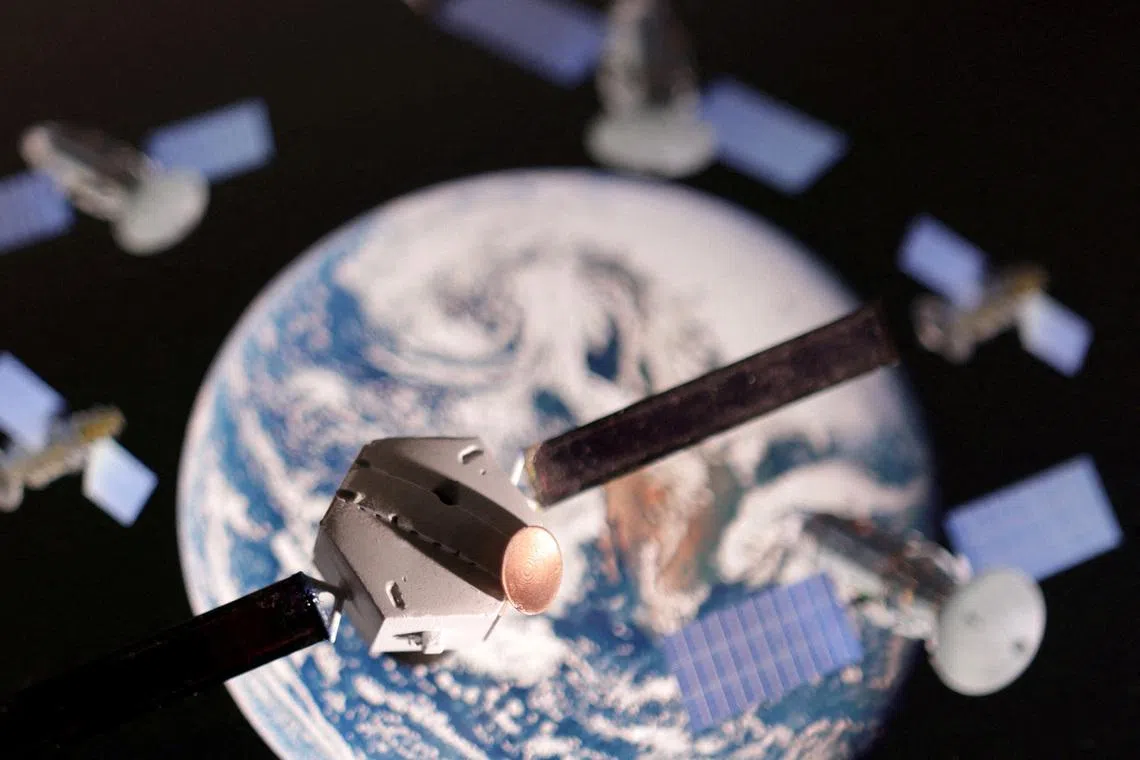
Germany envisages 100 low-Earth-orbit (LEO) satellites exclusively for military communications, while the EU project, which aims to deploy 290 satellites by 2029, is designed to establish a unified, space-based communication system.
Analysts say Germany's system will leverage technology similar to Elon Musk's SpaceX Starshield platform, which has been instrumental in Ukraine's battlefield communications.


The emissions open a new window into the conflict’s growing carbon footprint. Read more at straitstimes.com.

The WTO ministerial conference, its highest decision-making body, will take place in Cameroon. Read more at straitstimes.com.

The “temporary measure” could start as early as April 1. Read more at straitstimes.com.

The EU was Australia's third-largest two-way trading partner in 2024. Read more at straitstimes.com.

Around 70 per cent of Vietnam’s jet fuel is imported, primarily from China and Thailand. Read more at straitstimes.com.

He cited an urgent need to remain at home to manage the widening economic and livelihood impacts of the Iran war. Read more at straitstimes.com.

The move could dramatically shake up the market for routers, which are primarily made overseas. Read more at straitstimes.com.

The four-day Conservative Political Action Conference (CPAC) will open on March 23. Read more at straitstimes.com.

This comes as concerns over supply mount amid the ongoing US-Israel war with Iran. Read more at straitstimes.com.

Counter-terrorism police are now leading the inquiry, even though it was not yet determined to be a terror attack. Read more at straitstimes.com.

It has prompted columbarium operators to review their surveillance and access controls. Read more at straitstimes.com.

South Korea has agreed to deliver dozens of Cheongung missiles to the United Arab Emirates. Read more at straitstimes.com.

Now the effects are reaching industries that might have seemed insulated from the fallout. Read more at straitstimes.com.