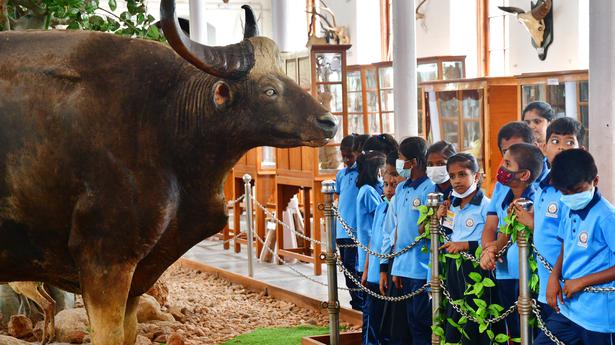
Gass Forest Museum in Coimbatore is now open for visitors
The Hindu
Iconic 120-year-old Gass Forest Museum is a record of the history of the land, lovingly curated for over a century. Now, explore its extensive collection from fungi to elephant remains
A giant stuffed Indian Gaur from the Biligiri Hills of Karnataka greets you even before you enter the towering two-tiered Gothic-style mansion that holds one of India’s largest and oldest natural history collections.
Nestled among greenery at the sprawling forest campus of Tamil Nadu Forest Academy, the iconic 120-year-old Gass Forest Museum named after Horace Archibald Gass (the Conservator of Forests in Coimbatore Southern Circle of the Madras Presidency in 1902) in recognition of his efforts and contributions, hosts as many as 4000 artefacts including wildlife, timber and non-timber forest produce, geological samples, tribal armaments, entomological specimens and forest engineering models. After remaining closed for two years due to the pandemic, the museum, which is maintained by the extension division of Institute of Forest Genetics and Tree Breeding (IFGTB) has now opened to visitors.
“In the ethnology section, there’s a collection of 16 ft long tiger spears used for hunting. It teaches you about the sociological and anthropological aspects of the tribes and also their physical strength. The throw of the spear should cover 360 degrees while hunting a tiger,” says P Chandrasekaran, assistant chief technical officer of IFGTB adding that every single exhibit has a story.
For example, the gaur displayed at the main exhibition room was presented in 1956 by Jayachamaraja Wodeyar, the last Maharaja of the princely state of Mysore while the 14-month and four-month elephant foetuses were gifted by renowned ‘elephant doctor’ V. Krishnamurthy, who performed the highest number of elephant post-mortems. The gaur is accompanied by various other stuffed animals including the great Indian hornbill, Nilgiri langur, slender lorris, and birds.
There is also a skeleton section with the skeleton of an elephant and a bull. “It’s a museum within a museum as the colonial building was built specifically for this purpose. The height of the ceiling was raised to accommodate a massive sandalwood trunk that weighs 1.75 tonnes and is 10.2 metres tall,” states Chandrasekaran.
Other notable exhibits include a cross-section of a 456-year-old teak wood, first man-made Conolly’s teak wood, and over 400 timber panels. This gives us a peek into history of the East India Company’s arrival and trading.
The entomology section has insects, beetles and butterflies on pins that have been in mahogany display cases for more than a century. “I noticed marbled map, a butterfly species that is distributed across South East Asia up to north east India till Andhra. Other rare species are autumn leaf and five band swordtail,” says A Pavendhan, founder of Tamil Nadu Butterfly Society. “Besides a comparative study of evolution of size, we can also understand how habitat destruction wiped off a few species. Adding common names along with scientific names and adding a display of new species can be helpful, especially for students.”


Set between the Siwalik hills and the plains, Butwal offers travellers a mix of regional cuisine, pilgrimage trails to Lumbini and the comfort of Hyatt’s new hospitality landmark

Explore 2026's wallpaper trends in India, highlighting botanicals and handmade designs that enhance modern homes with nature-inspired aesthetics.

Mercedes-Benz CLA 250+ with EQ Technology review: design, performance, range and features explained. Discover how the new electric CLA combines advanced AI, long range, fast charging and futuristic styling for the next generation of luxury EVs.

AI tool for sparrow conservation

BTS’s comeback with ‘Arirang’ marks a major global music event. When does the album release, and where can you watch their concert live stream? We have all the details

The 2026 U.S. cholesterol guidelines urge starting screening and treatment at 30 to prevent cardiovascular disease effectively.

Olam Festival 2026 in Thiruvananthapuram returns March 27-29 with 120+ vendors, music, art, and cultural zones.

A few storytellers in Thiruvananthapuram share their journeys, challenges, and evolving methods on World Storytelling Day, inspiring young minds.

76-year-old Kurian Jacob from Kerala triumphs with seven medals, including five golds, at the Open Masters Games in Abu Dhabi.

Explore the nature of the human mind as an emergent property of brain activity and complex neural interactions.

CERN's Large Hadron Collider discovers the Xi-cc-plus particle, enhancing understanding of quantum mechanics and baryon behavior.

Vibha Batra’s latest book, Spotless (Hachette India) is a novel in verse for young adults

In its first edition, the Madras Art Salon spotlights the works of journalist and artist Narayan Lakshman at The Botanical Club, a social space in the British Deputy High Commission, Chennai