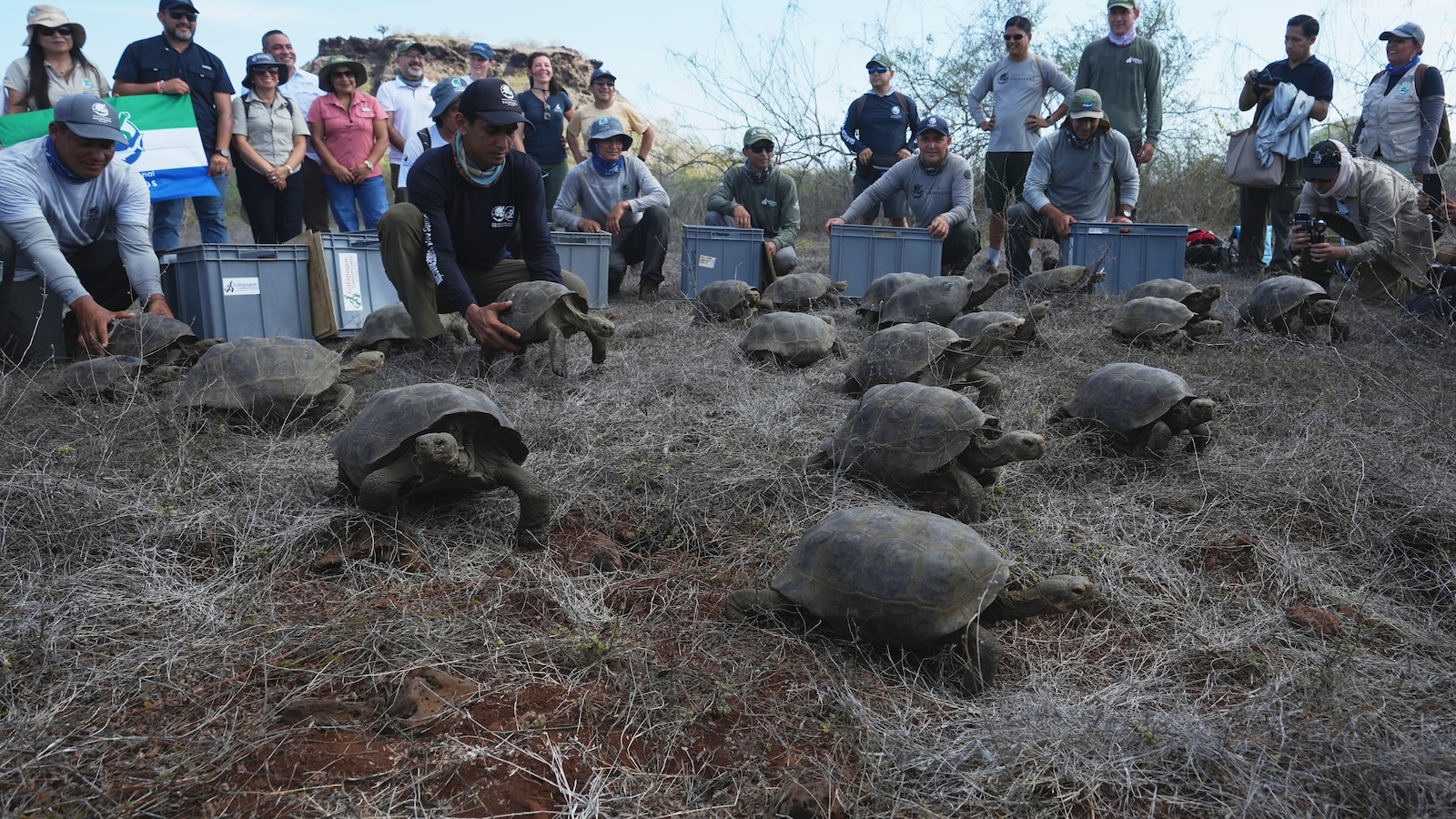
Galápagos park releases 158 juvenile hybrid tortoises on Floreana
ABC News
Giant tortoises have returned to Floreana Island in Ecuador's Galapagos archipelago as conservationists release 158 juvenile hybrids to restore the ecosystem
FLOREANA ISLAND, Ecuador -- Nearly 150 years after the last giant tortoises were removed from Floreana Island in Ecuador’s Galápagos archipelago, the species made a comeback Friday, when dozens of juvenile hybrids were released to begin restoring the island’s depleted ecosystem.
The 158 newcomers, aged 8 to 13, have begun exploring the habitat they are destined to reshape over the coming years. Their release was perfectly timed with the arrival of the season’s first winter rains.
“They are large enough to be released and can defend themselves against introduced animals such as rats and cats,” said Fredy Villalba, director of the Galápagos National Park breeding center on Santa Cruz Island, noting that the best specimens with the strongest lineage were selected specifically for Floreana.
These released juvenile specimens, out of a total of 700 planned for Floreana, will be introduced gradually. According to Christian Sevilla, director of ecosystems of the Galapagos National Park, they carry between 40% and 80% of the genetic makeup of the Chelonoidis niger —a species that has been extinct for 150 years.
The lineage of these hybrids traces back to Wolf Volcano on Isabela Island, a discovery that still puzzles scientists today. By selecting adults with the strongest genetic makeup, said Sevilla, the breeding program aims to gradually bring the extinct Floreana species back to its former purity.


A resistance leader in Myanmar has surrendered to the army after his group clashed with rival forces fighting against the military government

The Vatican has announced that Pope Leo XIV will travel up and down the Italian peninsula over the next few months

A South Korean court has sentenced former President Yoon Suk Yeol to life in prison for rebellion tied to his short-lived martial law order

A bus crash in South Africa’s Limpopo province has left at least four people dead and 31 injured, authorities say

Mine officials and a labor union say five miners are trapped deep underground at a South African diamond mine after a mudslide

Former South Korean President Yoon Suk Yeol arrived at a Seoul court to face a verdict on charges of rebellion for his short-lived attempt to impose martial law

The top U.S. military commander for Latin America has met with Venezuela’s acting president in Caracas as both sides discuss security and policy goals

Ghana and Kenya have launched investigations into the activities of a man believed to be a Russian national who is accused of secretly recording sexual encounters with several women and publishing them online without their consent

Pope Leo XIV has opened the church’s penitential Lenten season by presiding over Ash Wednesday

Another opposition Conservative lawmaker in Canada has defected to Prime Minister Mark Carney’s governing Liberals

British police forces are working together to assess potential crimes revealed in documents from the U.S. Justice Department’s investigation into the convicted sex offender Jeffrey Epstein

Gabon has suspended access to social media and digital platforms throughout the central African nation until further notice as critics accuse the country’s leader of crackdown on dissent

Greece is working with Germany, the Netherlands, Austria and Denmark to set up deportation hubs outside the European Union for migrants denied asylum