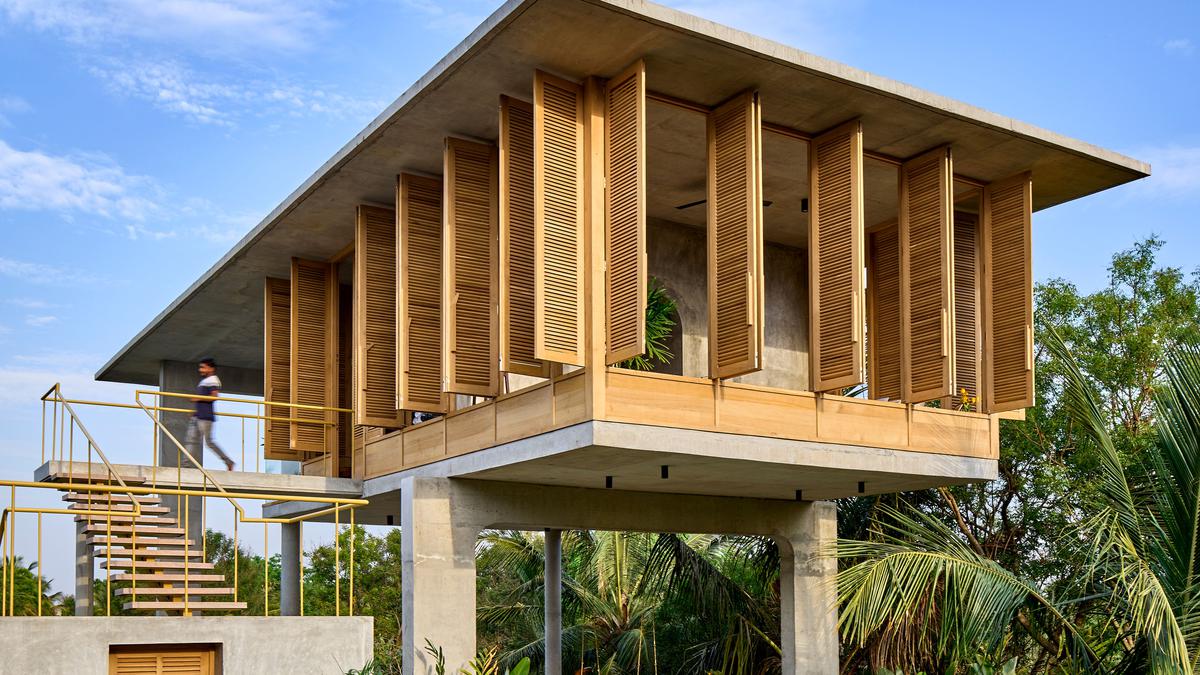
Functional living with Shibusa
The Hindu
A spectrum of materials that require minimum maintenance is used in this Japanese concept of understated elegance
Architects around the world are coming up with new concepts while designing a house for their clients. With people wanting to move out of city limits post-pandemic, and purchasing larger homes in the suburbs, the Japanese concept of Shibusa — intended to evoke appreciation of life — is beginning to trend.
When a client approached Veeram Shah, an architect and interior designer, based in Ahmedabad, for designing a house in Baner on the outskirts of Pune, the client asked for practical use of the 2,000 sq.ft. available space.
Viewing his client’s requirements, Shah was sure that Shibusa concept would make it possible. Shibusa refers to simple, subtle, and unobtrusive beauty in affinity with Japanese aesthetics and ideal human behaviour. Even as the architect focused on using natural materials such as wood, other simple materials and textures were also used to cater to a family’s efficient and functional lifestyle. “Since the concept resonated with a designer like me, we went ahead with it,” says Shah.
The designer tried to reinvent how age-old materials are perceived for a modern Indian home in a market with a plethora of new ones. Wood, brass, cane, lime plaster, concrete, stone, and fluted glass were used for the project based on their earthiness and imperfectly perfect attributes. The project, started in 2019, was completed in 2021.
Shah says the same can be replicated in smaller spaces too. “Most definitely, yes. The beauty of Shibusa, and the concept of this project as a whole, do not lie in the notion of larger square footage. In fact, the concept relies on encouraging users to interact with the surroundings based on their need and not the designated use of the room,” he says.
“In this home, we’ve allowed the kitchen to be a cooking and dining space, while the dining multi-functions as an eating and a working area. Lounging is not limited to the living room but also in the bedrooms for a more relaxed time,” says Shah.
Sustainability is very important for making a Shibusa house, as responsible sourcing forms an essential part of our design process. Shah says, “All the wood used in our projects is reclaimed. Our general inclination is towards using materials that are procured locally and ones that are closer to their natural state. We consciously steer away from merely visually appealing/ ‘synthetic’ spaces. Our focus instead lies in creating spaces that are ‘timeless’, ones that evolve with the user and the social context.”


IRSO's NavIC system faces challenges as the last atomic clock fails, reducing operational satellites for navigation services.

Discover efficient pressure cooking techniques to save up to 50% on fuel. OPOS B Ramakrishnan tells you how

Mercedes-Benz CLA 250+ with EQ Technology review: design, performance, range and features explained. Discover how the new electric CLA combines advanced AI, long range, fast charging and futuristic styling for the next generation of luxury EVs.

Pi Day is celebrated every year on March 14, honouring the significance of the mathematical constant π and its applications in mathematics.

Discover how sculptural interior design transforms modern spaces, blending creativity and functionality to evoke emotion and identity.

A study reveals that certain antibiotics can cause long-lasting changes in gut microbiome diversity for up to eight years.

Indian scientists and international experts are divided over a study questioning the viability of a nuclear reactor fuel called HALEU-thorium; while critics cite safety risks, proponents argue the technology is vital to achieve national energy goals.

ISRO and AIIMS partner to enhance space medicine research, focusing on human health during long-duration space missions.

A practical guide to induction setups for students, families, and home food businesses as India’s LPG supply faces its biggest disruption in years

Explore the electrifying Oscars 2026 race, featuring standout films, baffling nominations, and memorable performances amid a cinematic transition.

Zai and Rom Whitaker’s latest book for young readers, The Book of Indian Snakes, tackles common misconceptions surrounding snakes, highlighting their utility to humans

Discover PC Mahalanobis's pivotal role in India's statistical revolution and his lasting influence on modern statistics in this episode.

Explore why nothing can exceed light speed and the paradoxes that arise if it were possible.