Ferocious black holes reveal 'time dilation' in early universe
The Hindu
Scientists observed a ferocious class of black holes called quasars to demonstrate “time dilation” in the early universe
Time is a slippery thing, as profound thinkers like physicist Albert Einstein and, well, fictional time traveller Doctor Who plainly understood. The latter, in a 2007 episode of the British sci-fi series, accurately described time as "wibbly wobbly."
Scientists made that point anew on Monday in a study that used observations of a ferocious class of black holes called quasars to demonstrate "time dilation" in the early universe, showing how time then passed only about a fifth as quickly as it does today. The observations stretch back to about 12.3 billion years ago, when the universe was roughly a tenth its present age.
Also Read | Our galaxy’s black hole not as sleepy as thought: astronomers
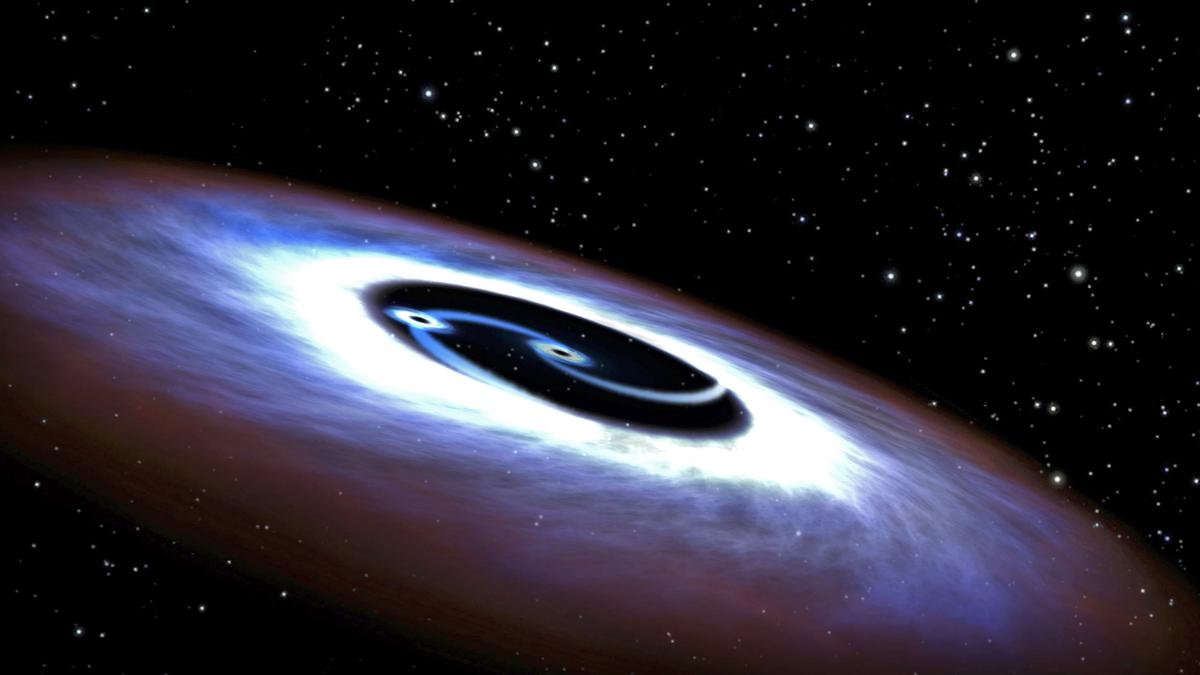
Quasars - among the brightest objects in the universe - were used as a "clock" in the study to measure time in the deep past. Quasars are tremendously active supermassive black holes millions to billions of times more massive than our sun, usually residing at centers of galaxies. They devour matter drawn to them by their immense gravitational pull and unleash torrents of radiation including jets of high-energy particles, while a glowing disk of matter spins around them.
The researchers used observations involving the brightness of 190 quasars across the universe dating to about 1.5 billion years after the Big Bang event that gave rise to the cosmos. They compared the brightness of these quasars at various wavelengths to that of quasars existing today, finding that certain fluctuations that occur in a particular amount of time today did so five times more slowly in the most ancient quasars.
Einstein, in his general theory of relativity, showed that time and space are intertwined and that the universe has been expanding outward in all directions since the Big Bang.
Astrophysicist Geraint Lewis of the University of Sydney in Australia, lead author of the study published in the journal Nature Astronomy, said this continual expansion explains how time flowed more slowly earlier in the universe's history relative to today.


The 2026 U.S. cholesterol guidelines urge starting screening and treatment at 30 to prevent cardiovascular disease effectively.

Olam Festival 2026 in Thiruvananthapuram returns March 27-29 with 120+ vendors, music, art, and cultural zones.

A few storytellers in Thiruvananthapuram share their journeys, challenges, and evolving methods on World Storytelling Day, inspiring young minds.

76-year-old Kurian Jacob from Kerala triumphs with seven medals, including five golds, at the Open Masters Games in Abu Dhabi.

Explore the nature of the human mind as an emergent property of brain activity and complex neural interactions.

CERN's Large Hadron Collider discovers the Xi-cc-plus particle, enhancing understanding of quantum mechanics and baryon behavior.

Vibha Batra’s latest book, Spotless (Hachette India) is a novel in verse for young adults

In its first edition, the Madras Art Salon spotlights the works of journalist and artist Narayan Lakshman at The Botanical Club, a social space in the British Deputy High Commission, Chennai

Cholesterol enhances melanoma cell invasion by making nuclei squishier, revealing a potential treatment target in cancer progression.

The designers reinterpret the Swedish artist’s symbolic forms and colour energy through contemporary resortwear silhouettes

Discover the inspiring legacy of Bibha Chowdhuri, a pioneering woman in physics and a trailblazer in STEM history.

Discover the inspiring legacy of Bibha Chowdhuri, a pioneering woman in physics and a trailblazer in STEM history.

Ashdeen’s Spring 2026 collection features saris inspired by the designer’s Parsi gara archive